Why AMD Is Reaching Beyond the Chip
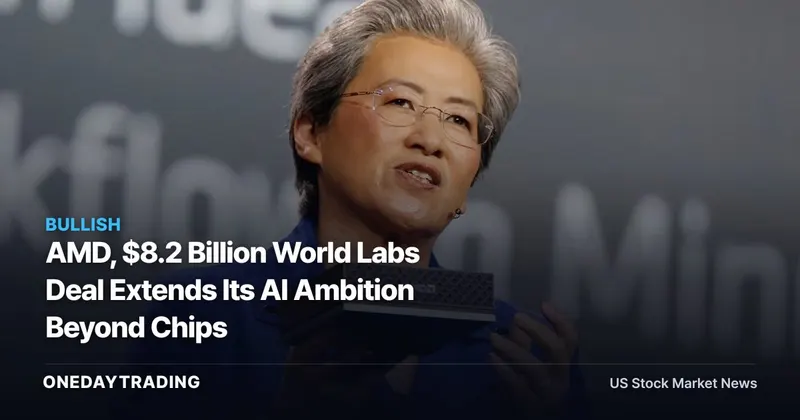
AMD’s $8.2 billion agreement for World Labs matters because it could connect frontier AI research with decisions about future computing hardware. Announced on 2026-09-28, the proposed all-stock acquisition adds a San Francisco-based AI lab that AMD had already backed and gives investors a new way to assess the company’s AI strategy beyond its existing chipmaking business.
A world model is an AI model designed to simulate a three-dimensional environment. World Labs’ Marble model can construct a three-dimensional scene from a few images, giving AMD direct exposure to research centered on simulated spaces rather than only the processors used to run AI workloads.
The strategic mechanism is straightforward, even if the financial payoff is not. Research into world models could help AMD study what future AI systems require from computing hardware. That information may influence how the company thinks about chip capabilities, while the separate operating structure preserves a boundary between exploratory model development and the chip business before closing.
This is not evidence that World Labs has already created demand for AMD products. The fact sheet provides no revenue, workforce, financial-performance or valuation-history data for the lab. Investors can therefore evaluate the strategic fit, but they cannot calculate the acquired operation’s contribution or compare the purchase price with its financial output.
The $8.2 Billion Price in AMD’s Deal History
CNBC described AMD’s World Labs agreement as an all-stock transaction worth about $8.2 billion. For context, AMD purchased Xilinx for roughly $50 billion in 2022, making World Labs a smaller commitment than that earlier acquisition while still representing a substantial expansion into AI research.
The stock consideration matters because the payment is tied to AMD equity rather than a stated cash outlay. The supplied facts do not disclose the number of shares involved or the detailed terms, so the potential effect on existing shareholders cannot be quantified. That missing information is central to judging whether the strategic access justifies the consideration.
The timing also leaves an execution interval. AMD plans to keep World Labs separate from its chipmaking business until the transaction closes later this year. No exact closing date is available, and the evidence does not say whether regulatory or shareholder approvals are required.
Fei-Fei Li and Marble Become the Strategic Assets
World Labs was founded by Fei-Fei Li, who is associated with Stanford and previously worked for Google. Under the agreement, she will take the roles of AMD chief scientist and executive vice president, placing the lab’s founder inside AMD’s senior scientific leadership while its operation remains separate through closing.
Marble provides the clearest concrete example of what World Labs has built. The model creates a three-dimensional scene from a few images. For investors, the relevant question is whether that research can eventually give AMD useful visibility into the computational needs of models that operate in simulated environments.
That possible research-to-silicon loop is the core upside case. AMD could gain earlier insight into the capabilities advanced models need, then use that knowledge when planning future AI chips. It is a conditional advantage, not a demonstrated commercial result: the facts establish Marble’s function and the acquisition agreement, not product integration, customer adoption or revenue.
Fei-Fei Li said, according to CNBC, “We're unwavering in our mission, and even more excited to continue building a world leading frontier research organization.” The statement clarifies the intended research continuity, though it does not provide financial targets or a timetable for translating that work into AMD products.
How the Deal Fits the Broader AI Transaction Pattern
AMD is not the only major technology company using transactions to add AI organizations and people. OpenAI purchased Jony Ive’s io for about $6.4 billion last year, linking the AI company with the designer through an acquisition of his AI-device startup.
Nvidia committed a combined $33 billion across Groq and Hugging Face in December and this month, buying assets from Groq and agreeing to acquire Hugging Face. Meta acquired a minority stake in Scale AI for $14 billion in 2025, a transaction associated with Scale AI founder Alexandr Wang joining a new AI division.
These transactions establish that AMD’s move sits alongside other large AI agreements, but they are not like-for-like valuation benchmarks. The relationships differ: asset purchases, an acquisition agreement and a minority investment do not transfer the same rights or produce the same financial exposure. Their defensible use here is to frame the scale of AI dealmaking, not to prove that AMD paid an attractive price.
Potential Winners and Pressure Points
- AMD: The company gains a proposed path to World Labs’ world-model research and adds Fei-Fei Li to its executive and scientific leadership. The benefit depends on whether research insight can inform future chip capabilities without the consideration outweighing that strategic value.
- World Labs: The lab would gain a place within AMD while remaining operationally separate until closing. Its mission and Marble model provide strategic relevance, although the available facts do not establish a financial contribution.
- AI semiconductor research: A closer connection between model research and hardware planning could improve the information available for future chip decisions. No disclosed shipment, order, yield or revenue metric shows that effect today.
- Existing AMD shareholders: The all-stock structure creates an important valuation question because detailed terms and the number of shares are unknown. Any assessment of the shareholder trade-off must wait for those disclosures.
- Nvidia and Meta: Their Groq, Hugging Face and Scale AI transactions provide evidence of separate AI deal activity. The facts do not establish a direct competitive outcome from AMD’s agreement.
What Could Break the Investment Thesis
- Price without operating evidence: World Labs’ revenue, valuation history, workforce size and financial performance are unknown, preventing a conventional assessment of the approximately $8.2 billion consideration.
- Unspecified stock terms: The transaction is all-stock, but its detailed terms are absent. Investors cannot measure the shareholder impact from the supplied information.
- Research may not become product value: Marble demonstrates a world-model capability, while no evidence shows that it has generated AMD chip orders or shaped a commercial product.
- Closing uncertainty: AMD expects to keep the lab separate until closing later this year, with no exact closing date or disclosed approval requirements.
The Next Tests for AMD’s World Labs Bet
The immediate checkpoint is the transaction documentation: investors need the detailed all-stock terms, the path to closing and any required approvals. After closing, the more important operating evidence will be whether AMD identifies specific chip capabilities informed by World Labs research and whether the separate lab becomes meaningfully connected to hardware planning.
The agreement is strategically bullish because AMD is adding a frontier AI laboratory, a working world model and Fei-Fei Li’s scientific leadership. The case remains bounded by a simple gap: AMD has disclosed the approximate $8.2 billion price and the research rationale, but not the financial profile needed to judge returns. Until those details arrive, the deal expands AMD’s AI ambition more clearly than it establishes economic value.
Market data check: Advanced Micro Devices, Inc.
Advanced Micro Devices, Inc. last traded near $607.87 (-3.61%). Our composite signal — blending price momentum and news flow — reads 🟡 neutral. Price momentum scores 21/100 (soft).
Data as of publication. Price via market feeds; for reference only, not investment advice.
📊 Analysis
Signal Bullish
Why The agreement could give AMD direct access to frontier world-model research, although the all-stock structure and missing financial details limit confidence in its value.
This article was independently written by OneDayTrading from public reporting. Read the original (CNBC)