At a Glance
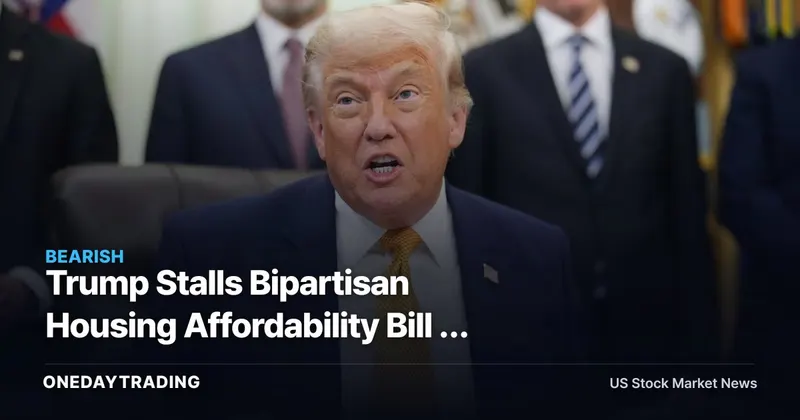
President Donald Trump abruptly canceled the signing of a bipartisan housing affordability bill roughly an hour before the scheduled Capitol ceremony, tying his approval to a new voter-ID provision. For investors, the immediate read-through is policy uncertainty for housing supply incentives — a headwind for sentiment around homebuilders, building-products suppliers and mortgage-linked names.
Why It Matters Now
The bill targeted housing affordability, the single biggest demand bottleneck in the U.S. residential market. Legislation aimed at boosting supply or easing the cost of construction typically benefits volume-driven builders directly: their earnings hinge on units delivered and on the pace at which entry-level buyers can clear affordability hurdles. A signed bill would have been a modest tailwind to forward order books; a stalled one removes that catalyst and reintroduces the risk that nothing passes before the political calendar tightens.
The mechanism matters more than the headline. By attaching an unrelated voter-ID condition, the President converted a rare bipartisan win into a contested negotiation. That raises the probability of delay, dilution, or outright failure — and markets dislike binary policy outcomes they cannot model. Builders with heavy exposure to first-time and lower-price-tier buyers are most sensitive, because affordability relief is precisely the lever that converts pent-up demand into closings.
The offsetting reality: this is a sentiment event, not a fundamentals event. No revenue line changes today. Mortgage rates, employment and existing-home inventory remain the dominant drivers of builder volumes, and a single delayed bill is marginal against those forces.
FAQ
- What actually happened? Trump pulled out of signing a bipartisan housing affordability bill about an hour before the ceremony, demanding a voter-ID provision be added.
- Why do homebuilders care? Affordability legislation can expand the addressable buyer pool and support construction volumes, which drive builder earnings.
- Is this a near-term earnings risk? Not directly — it is a policy and sentiment risk; near-term results still depend on rates and demand.
- Could the bill still pass? Possibly, but the added condition raises the odds of delay or renegotiation.
Related Stocks & Sectors
- D.R. Horton (DHI) — the largest U.S. builder by volume and heavily weighted to entry-level buyers most helped by affordability measures.
- Lennar (LEN), PulteGroup (PHM) — high-volume builders whose order pace is sensitive to first-time-buyer affordability.
- Home Depot (HD), Lowe's (LOW) — building-products and renovation demand tracks housing turnover and construction activity.
- Mortgage and title names — origination volumes rise or fall with affordability and buyer access.
What to Watch
- Whether the bill is renegotiated, re-scheduled for signing, or shelved in the coming weeks.
- Builder commentary on order trends and cancellation rates at the next earnings updates.
- The 30-year mortgage rate level, which remains the larger swing factor for affordability.
- Any guidance from management teams referencing federal housing policy.
Overall Outlook
The bull case is that affordability legislation, even if delayed, signals bipartisan intent to address supply — and that builders are already navigating demand with rate buydowns and incentives independent of Washington. The risk case is that a politicized stalemate removes a potential tailwind and adds noise to an already rate-sensitive group. The practical stance is to treat this as a policy-tracking item layered on top of the rate and demand fundamentals that still set the direction for the sector.
Market data check: DHI
DHI last traded near $167.55 (+7.35%). Our composite signal — blending price momentum and news flow — reads 🟡 neutral. Price momentum scores 95/100 (firm).
Data as of publication. Price via market feeds; for reference only, not investment advice.
📊 Analysis
Signal Bearish
Why A stalled bipartisan housing affordability bill removes a potential policy tailwind and adds uncertainty for builders and mortgage-linked names.
Tickers$DHI$LEN$PHM$HD$LOW
This article was independently written by OneDayTrading from public reporting. Read the original (CNBC)