Key Takeaways
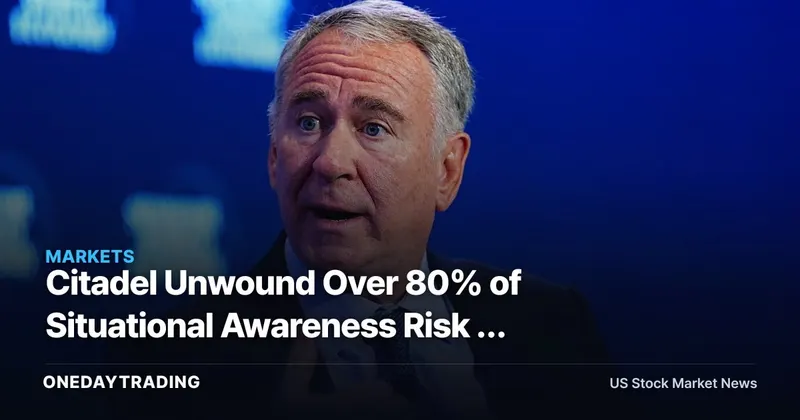
Citadel unwound more than 80% of the risk tied to its Situational Awareness portfolio, according to CNBC, which means Ken Griffin is signaling risk control rather than a lasting directional bet investors can map cleanly onto public stocks.
The investor read-through is financial-sector specific: private hedge-fund balance-sheet decisions can affect liquidity, positioning and confidence, but Citadel and Situational Awareness are not U.S.-listed equities.
What Happened
CNBC reported that Ken Griffin addressed Citadel's purchase of assets from Situational Awareness in a letter to clients, marking the first time Griffin publicly explained the transaction through that client communication.
The key figure is the risk reduction: Citadel unwound more than 80% of the risk connected to the Situational Awareness portfolio, per CNBC's reporting. For investors, the number matters more than the transaction label because risk retained is what determines exposure, volatility and capital at stake.
Situational Awareness portfolio risk, in this context, means market exposure attached to assets Citadel acquired from Situational Awareness; unwinding risk means Citadel reduced the economic sensitivity of that portfolio through sales, hedges or other position-management actions.
Background & Context
Citadel is a private investment firm, so public shareholders cannot trade Citadel stock or directly price Griffin's client letter into a listed equity. The market relevance sits in the hedge-fund channel: large managers can influence liquidity when they absorb assets, reduce exposure and reset risk budgets.
The more than 80% unwind also narrows the interpretation. The transaction looks less like Citadel taking a durable, high-conviction exposure from Situational Awareness and more like Citadel using scale and execution capacity to manage a portfolio after acquisition.
Market & Stock Impact
- Private hedge funds: Citadel's more than 80% unwind highlights risk discipline, but private funds do not give retail investors a listed earnings line or daily disclosure to model.
- Brokerage and prime-brokerage activity: Asset transfers and portfolio unwinds can support trading volume and financing demand, but CNBC's report did not name banks or counterparties.
- Market structure: A large risk reduction lowers the chance that the acquired portfolio remains a concentrated market overhang, but the source did not disclose asset classes, position sizes or sectors.
- Public financial stocks: The read-through is limited because Citadel and Situational Awareness are private, and CNBC's report did not connect the event to any listed bank, broker or exchange operator.
Investor Checkpoints
- Retained exposure: Track whether future reporting identifies the remaining less than 20% of Situational Awareness portfolio risk and the asset classes involved.
- Client-letter details: Watch for any additional disclosures from Griffin or Citadel on why the assets were purchased and how the unwind was executed.
- Counterparty names: Public-market impact becomes more concrete only if banks, brokers or listed exchanges are tied to the transaction.
- Market volatility: If later reporting links the portfolio to a crowded trade, the more than 80% unwind becomes relevant to sector positioning rather than only hedge-fund process.
Outlook
The bull case for market stability is straightforward: Citadel removed more than 80% of the risk tied to the Situational Awareness portfolio, which reduces the odds that the acquired assets remain a concentrated exposure. The risk is informational: CNBC's report does not disclose the portfolio composition, the price paid, the hedging method or the remaining risk, so investors should not turn a private-fund risk update into a public-stock thesis without new facts.
FAQ
Why did Citadel unwind Situational Awareness portfolio risk?
Citadel unwound more than 80% of the risk tied to the Situational Awareness portfolio, according to CNBC, but CNBC's description did not state the specific reason. The practical interpretation is that Citadel reduced market exposure after buying the assets rather than leaving the full acquired risk on the book.
Is Citadel stock publicly traded?
Citadel is not a U.S.-listed public company, so retail investors cannot buy Citadel stock directly on a public exchange. That is why the Situational Awareness portfolio update has indirect market relevance rather than a direct ticker impact.
What does more than 80% risk unwound mean for investors?
Citadel reducing more than 80% of Situational Awareness portfolio risk means most of the acquired exposure was neutralized or removed, per CNBC's reporting. The investor takeaway is risk containment, but the absence of portfolio-level details limits conclusions about affected sectors or stocks.
📊 Analysis
Signal Neutral
Why Citadel's risk reduction is meaningful for hedge-fund positioning, but the companies are private and CNBC's report does not identify listed stocks or asset classes directly affected.
This article was independently written by OneDayTrading from public reporting. Read the original (CNBC)