At a Glance
Fed interest-rate policy is the market issue behind Trump’s latest criticism, because lower U.S. borrowing costs would support equity multiples, housing demand and bank loan growth only if inflation data allow the Federal Reserve to cut without damaging credibility.
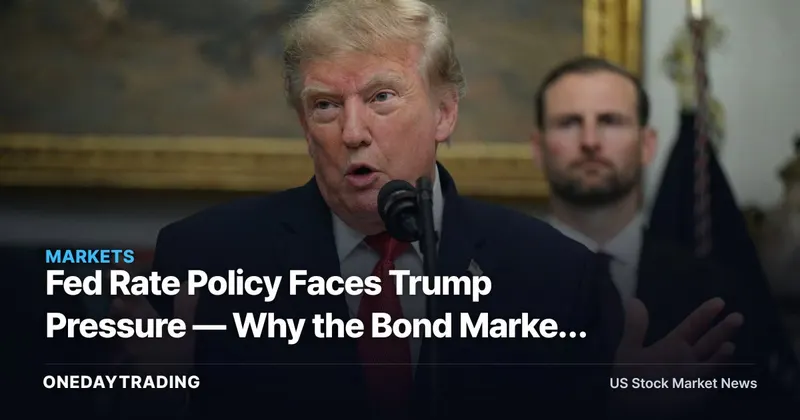
CNBC Markets reported that Trump said the U.S. should be paying much less in interest and again accused Federal Reserve officials of political motives. The investable point is not the complaint; the investable point is whether the bond market treats the complaint as policy noise or a signal of future pressure on the central bank.
Why It Matters Now
The federal funds rate is the Fed’s benchmark short-term interest-rate target, and that target flows through Treasury yields, mortgage rates, credit-card APRs, bank funding costs and the discount rates used to value equities.
Trump’s statement matters for investors because rate expectations sit inside nearly every U.S. equity valuation. If traders price a higher probability of easier Fed policy, long-duration growth stocks and real estate-linked shares benefit first; if traders instead price institutional risk, the dollar, Treasurys and bank shares can absorb the stress.
CNBC’s source item did not cite a new CPI print, jobs number, Fed meeting decision or Treasury interest-cost figure. That absence matters: the tape can react to political pressure for a session, but sustained repricing usually needs inflation, labor-market or Fed-communication evidence.
Key Debates
- Fed independence: Trump’s accusation of political motives puts the Federal Reserve’s credibility back into the equity-risk discussion, especially for investors watching the dollar and Treasury yields.
- Rate-cut channel: Lower expected rates can lift stock multiples, but the benefit is strongest when falling yields reflect cooling inflation rather than pressure on policymakers.
- Bank math: JPMorgan Chase and Bank of America can gain from stronger loan demand when rates fall, but net interest margin can compress if asset yields reset faster than deposit costs.
- Housing sensitivity: Homebuilders such as D.R. Horton and Lennar are exposed because mortgage affordability improves when Treasury yields and mortgage rates fall.
Related Stocks & Sectors
- JPMorgan Chase (JPM): Large banks are direct read-throughs because Fed policy changes affect loan demand, deposit costs and securities portfolios.
- Bank of America (BAC): Bank of America is highly rate-sensitive because shifts in yield curves can change net interest income expectations.
- D.R. Horton (DHI): Homebuilders benefit when lower rate expectations reduce mortgage-payment pressure on buyers.
- Lennar (LEN): Lennar is tied to the same affordability channel, with demand depending on mortgage rates more than political headlines.
- Real estate and financials: REITs and banks sit on opposite sides of the rate debate because cheaper financing helps property values while bank margins can narrow.
What to Watch
- Next Fed communication: Investors should compare Trump’s comments with the next Federal Reserve statement, minutes or speaker remarks for any change in policy language.
- Inflation data: CPI and PCE inflation determine whether rate-cut pricing rests on data or politics.
- Treasury yields: The U.S. 10-year Treasury yield is the market’s cleanest test of whether investors believe lower policy rates are becoming more likely.
- Bank earnings guidance: JPMorgan Chase and Bank of America commentary on net interest income will show how rate expectations are hitting income statements.
Overall Outlook
The near-term equity read is modestly bullish for rate-sensitive groups if Trump’s comments pull expectations toward easier Fed policy. The risk is that political pressure without supporting inflation data raises the premium investors demand for U.S. duration assets, which would cap the multiple expansion that lower-rate narratives usually create.
FAQ
Why is Trump criticizing Fed interest-rate policy?
CNBC Markets reported that Trump said the U.S. should be paying much less in interest. CNBC Markets also reported that Trump accused Federal Reserve officials of political motives, consistent with criticism he has made before.
How do lower Fed rates affect bank stocks?
Lower Fed rates can support JPMorgan Chase (JPM) and Bank of America (BAC) by improving loan demand and credit conditions. Lower Fed rates can also pressure bank net interest margin when asset yields decline faster than funding costs.
What stocks are most sensitive to Fed rate-cut expectations?
Rate-cut expectations usually matter most for banks, homebuilders, REITs and long-duration growth stocks. D.R. Horton (DHI) and Lennar (LEN) are exposed because mortgage affordability changes directly with interest-rate expectations.
📊 Analysis
Signal Neutral
Why Trump’s pressure for lower rates is supportive for rate-sensitive equities, but the source provides no new inflation, jobs or Fed-decision data to confirm a durable market repricing.
This article was independently written by OneDayTrading from public reporting. Read the original (CNBC Markets)