What Changes in Election Prediction Markets
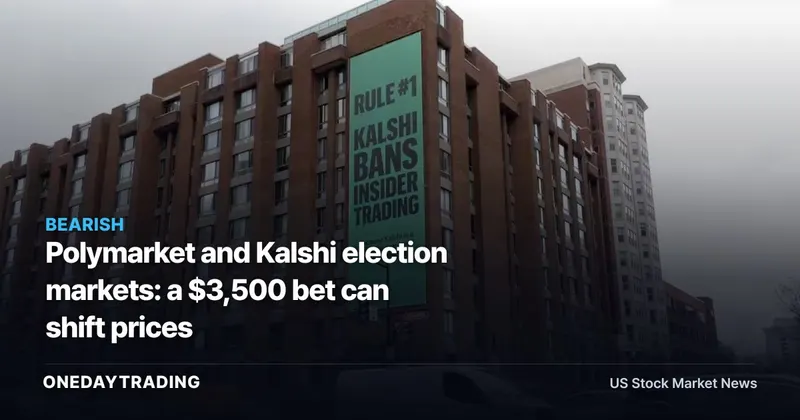
For investors assessing prediction markets as information signals, the central issue is price resilience rather than the popularity of the contracts. CNBC reports that ACDC found most campaign-related markets can be shifted with sums below the $3,500 maximum personal campaign contribution allowed under federal law. A five-cent move may look small in isolation, but ACDC said a manipulated price can ripple through the information ecosystem as if it represented genuine momentum.
Kalshi and Polymarket offer yes-or-no contracts that users trade on whether an event will happen. That structure differs from a poll: a poll asks sampled people about views or intended choices, while a prediction market records traded prices. CNBC’s reporting on the ACDC research implies that a thin order book or limited liquidity can allow a relatively small order to alter the displayed probability. That is an analytical implication of the reported price moves, not proof that any trader sought to manipulate an election.
The distinction matters because election prices are routinely visible to the public and news organizations. ACDC’s report said conditions for manipulation exist in most markets and may already have been used, while also acknowledging that wallets could have been making risky bets they believed would be profitable. The identities of the wallets, their intent and any real-world electoral effect are unknown.
By the Numbers: Small Bets, Large Price Effects
ACDC examined 1,094 markets and found that 806 markets priced at five cents or less could be moved by five cents with less than $100. CNBC reports that 94% of the examined markets would move 10 cents under a $1,000 bet, and that most markets would move 25 cents after bets of $25,000. The reported pattern indicates that underdog contracts were cheaper to move than higher-priced markets.
Polymarket supplied a second lens. During the election cycle, ACDC identified 353 instances where one or two wallets moved a market by five cents or more. After the initial move, 211 instances stayed at the new price, 62 continued moving and 80 returned to the original price. Those outcomes show that a price shock did not have a uniform persistence pattern; they do not reveal whether the original trade was manipulative.
Texas Senate Markets Illustrate the Transmission Risk
In December, CNBC reports that one Polymarket wallet placed $1,760, moving Ken Paxton’s contract from 55 cents to 50 cents. Fourteen hours later, another wallet bet $1,240, lifting the price from 52 cents to 63 cents. The price then remained in the sixties for six weeks, according to ACDC, before a later wallet push took it below 55 cents. Newsweek published a story showing Paxton in the lead four days after the upward move.
On Feb. 7, three Polymarket wallets shifted two markets covering Paxton and Wesley Hunt. Two wallets spent $23,953 and pushed Hunt’s contract up 10 cents. Over the next two hours, another wallet spent $38,830, pushing Paxton’s contract down eight cents. The Hunt price later slipped and was pushed back up by several wallets on Polymarket and Kalshi two days later. The next day, 17 Polymarket wallets, including automated ones, pushed Paxton’s price down; ACDC said prices later reverted after public polling continued to show Paxton leading.
Winners & Losers
- Potential beneficiaries: traders able to enter early. CNBC’s account indicates that a small order can change a displayed contract price, creating an opportunity for participants who correctly anticipate a rebound. That is a conditional trading dynamic, not a reported gain.
- Potential losers: readers treating prices as confirmed momentum. ACDC warned that manipulated prices can spread through the information ecosystem as though they reflected real support. News organizations and investors relying on a single contract may therefore face a distorted signal.
- Kalshi and Polymarket’s credibility exposure. Both platforms are named in the research, and the reported low cost of moving contracts may increase scrutiny of liquidity, surveillance and market design. CNBC and Kalshi also disclose a commercial relationship involving customer acquisition and a minority investment.
Risk Check
- Intent is unproven. ACDC and CNBC do not identify the wallets or establish that the trades were deliberate manipulation; some could have been unsuccessful directional bets.
- Persistence varies. Of 353 Polymarket cases, 80 returned to the original price, while 211 stayed and 62 continued moving. A price move therefore does not guarantee a lasting change in market expectations.
- Methodology is incomplete. The full data and methodology underlying the ACDC report are not supplied here, limiting independent assessment of the sample and thresholds.
- Political outcomes are unknown. The eventual results of the referenced elections and any connection between market prices and voter behavior are not established.
Bottom Line
ACDC’s research, as reported by CNBC, presents a market-structure vulnerability: a $3,500 bet can move 97% of midterm-related prediction markets by at least five cents, and many low-priced contracts can be shifted for less than $100. That may weaken the reliability of election prices as standalone signals and could increase scrutiny of Kalshi and Polymarket. The counterpoint is equally important: the report does not prove intent, identify traders or show that any move changed an election. Investors should treat sharp contract moves as observations requiring context, then compare their persistence with subsequent trading and public polling as the November midterms approach.
FAQ
How much does it cost to move a midterm prediction market?
CNBC reports that ACDC found a $3,500 bet could move 97% of midterm-related markets by five cents or more. In the examined sample, 806 of 1,094 markets priced at five cents or less could be moved by five cents for under $100.
What did ACDC find on Polymarket?
ACDC identified 353 instances during this election cycle where one or two wallets moved a Polymarket market by at least five cents. Of those, 211 stayed at the new price, 62 continued moving and 80 reverted, according to CNBC’s account of the report.
Does the research prove election-market manipulation?
No. The supplied facts do not establish whether the wallet activity was intentional, who controlled the wallets or whether any market movement affected an election. ACDC said risky bettors could explain some trades, while also warning that routine media quoting of prices creates an opening for perception buying.
📊 Analysis
Signal Bearish
Why The reported low cost of moving election contracts may undermine confidence in prediction-market prices and the information built around them.
This article was independently written by OneDayTrading from public reporting. Read the original (CNBC)