Summary
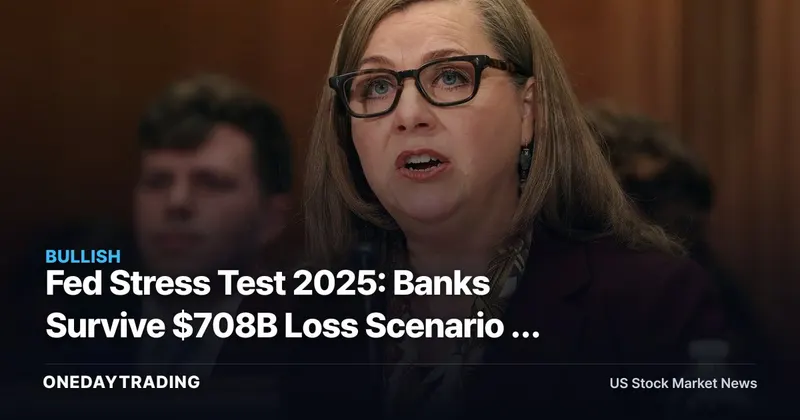
The Federal Reserve's annual stress test shows large U.S. banks could withstand roughly $708 billion in hypothetical losses while staying above minimum capital levels. The pivotal change this year: unlike prior cycles, the results will not directly set the banks' capital requirements. For investors, that decoupling matters more than the headline loss number, because it loosens the regulatory leash on capital return.
The Full Story
Every year the Fed runs the largest banks through a severe hypothetical downturn — spiking unemployment, falling home and commercial real estate prices, and market shocks — to gauge whether they can keep lending. The 2025 exercise concluded the system absorbs about $708 billion in losses and remains solvent above regulatory minimums.
What is genuinely new is governance, not arithmetic. In past years the test fed straight into each bank's stress capital buffer, the cushion they must hold on top of baseline requirements. This time the outcome is being detached from that mechanism as the Fed reworks how capital rules are calibrated. The practical read: the test becomes more of a health check than a binding constraint on how much capital each firm must trap on its balance sheet.
That is why the market reaction centers on capital return. When the buffer is the binding limit, excess earnings are frozen as retained capital. When the test no longer dictates that buffer, banks gain clearer line of sight to raise dividends and accelerate share repurchases — the most direct lever on per-share value for a sector that trades heavily on book-value and payout dynamics.
Structural Background
Post-2008 rules pushed systemically important banks to hold thick equity cushions, which suppressed return on equity even in good years. The current overhaul reflects a broader regulatory shift toward easing the most punitive elements of capital calibration. For money-center banks with the largest trading and lending books, even a modest reduction in required buffers frees billions that can flow to buybacks rather than sitting idle.
Stock & Sector Ripple
- JPMorgan (JPM) — the largest U.S. bank by assets has the deepest excess-capital position; a softer buffer regime most directly expands its repurchase capacity and supports payout growth.
- Bank of America (BAC) — rate-sensitive net interest income plus a large deposit base means freed capital can amplify both buybacks and lending leverage.
- Goldman Sachs (GS) and Morgan Stanley (MS) — trading- and markets-heavy firms have historically faced higher stress losses; loosening the link to requirements eases a structural drag on their capital plans.
- Citigroup (C) and Wells Fargo (WFC) — turnaround and efficiency stories where extra capital flexibility strengthens the buyback-driven re-rating thesis.
Bull vs Bear Scenarios
Bull case: detaching the test from capital rules removes an overhang, lifts return on equity, and lets banks return more cash — a re-rating catalyst for a sector often valued near or below tangible book. Bear case: easier capital standards raise tail risk if a real downturn hits, and the $708 billion figure underscores that loss capacity is finite. A genuine credit cycle — rising unemployment, commercial real estate stress, or a market shock — could quickly turn looser buffers into a vulnerability, and the final calibration of the new rules is still uncertain.
Investor Action Points
- Watch each bank's capital-return announcements in the weeks after results — dividend hikes and new buyback authorizations are the clearest signal of how much room the new regime creates.
- Track the common equity tier 1 ratio versus the firm's stated target; the gap shows the capital available to deploy.
- Monitor the Fed's final rule on capital calibration — the binding number for 2026 depends on that text, not on this test.
- Cross-check loan-loss provisions and net interest income trends in the next quarterly results to confirm earnings can fund the higher payouts.
Market data check: JPM
JPM last traded near $335.5 (+0.41%). Our composite signal — blending price momentum and news flow — reads 🟡 neutral. Price momentum scores 53/100.
Data as of publication. Price via market feeds; for reference only, not investment advice.
📊 Analysis
Signal Bullish
Why Decoupling stress-test results from capital requirements eases buffers and expands buyback and dividend capacity for large U.S. banks.
Tickers$JPM$BAC$GS$MS$C$WFC
This article was independently written by OneDayTrading from public reporting. Read the original (CNBC)