Summary
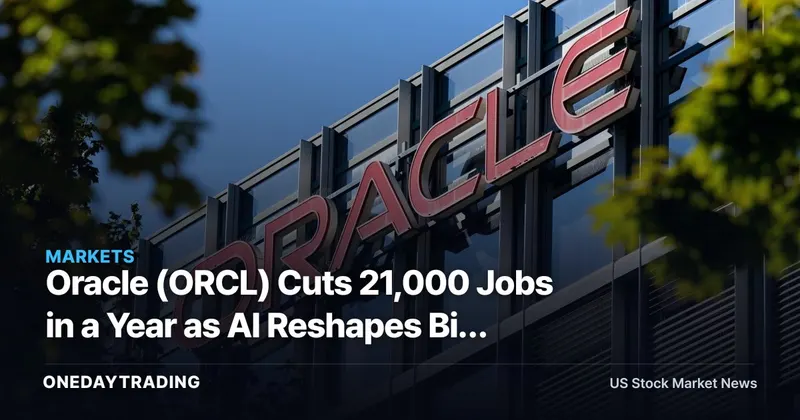
Oracle disclosed it has reduced its workforce by 21,000 roles over the past year, explicitly tying the cuts to the adoption and deployment of AI across its operations. The move places Oracle alongside other tech giants reshaping cost structures as AI shifts both what they build and how many people it takes to run them. For investors, the question is whether these reductions translate into durable margin expansion or signal softer demand beneath the AI capex narrative.
The Full Story
Oracle framed the 21,000 headcount reduction as a direct consequence of integrating AI technologies into its own workflows, and warned the trend may continue. That language matters: it positions the layoffs as a structural efficiency play rather than a one-off restructuring tied to a weak quarter.
The timing aligns with a broader wave of AI-linked layoffs across the sector. Companies that spent the prior cycle hiring aggressively are now using automation in coding, support, sales operations, and back-office functions to lower fixed labor costs. For Oracle specifically, the cuts arrive as the company pours capital into cloud infrastructure and data-center capacity to serve AI training and inference workloads.
The tension is visible in the model itself: Oracle is spending heavily on GPUs and facilities to capture AI demand while simultaneously stripping out human cost elsewhere. If both move as planned, operating leverage improves. If cloud revenue disappoints, the capex burden lands on a leaner but still capital-intensive base.
Structural Background
Oracle has repositioned from a legacy database and on-premise software vendor into a contender in AI cloud infrastructure, competing for large compute contracts against the dominant hyperscalers. That pivot requires enormous upfront capital, which pressures free cash flow even as it builds future revenue. Trimming labor is one of the few near-term levers management controls directly to protect margins while the infrastructure bet plays out.
Stock & Sector Ripple
- Oracle (ORCL): Lower headcount supports operating margins, but the market will weigh whether the cuts reflect efficiency or thinner end-demand for traditional software lines.
- Nvidia (NVDA): Oracle's continued cloud and AI buildout underpins GPU demand; capex commitments from cloud players are a key revenue channel for Nvidia.
- Microsoft (MSFT) and Amazon (AMZN): As rival cloud providers, they face the same labor-versus-capex calculus, and Oracle's framing reinforces an industry-wide efficiency push.
- Salesforce (CRM): Enterprise software peers are also automating internal functions, making Oracle's disclosure a read-across for sector-wide margin trajectories.
- IT staffing and services: Sustained AI-driven headcount reductions across tech giants pressure demand for contract labor and outsourced roles.
Bull vs Bear Scenarios
Bull case: the 21,000 reduction is a genuine productivity dividend from AI, expanding margins while cloud bookings convert into recurring revenue, validating Oracle's infrastructure spend. Bear case: the cuts mask softening demand in legacy segments, and heavy data-center capex compresses free cash flow before AI cloud revenue scales, leaving valuation exposed if growth slows or contract ramps slip.
Investor Action Points
- Watch Oracle's next earnings for cloud infrastructure revenue growth and remaining performance obligations to confirm whether demand justifies the capex.
- Track operating margin and free cash flow to see if the headcount cuts actually flow through to profitability rather than being offset by spending.
- Monitor capital expenditure guidance for signs the AI buildout is accelerating or being scaled back.
- Compare layoff and automation commentary from MSFT, AMZN, and CRM to gauge whether this is Oracle-specific or a sector-wide structural shift.
Market data check: ORCL
ORCL last traded near $170.29 (-2.73%). Our composite signal — blending price momentum and news flow — reads 🟡 neutral. Price momentum scores 28/100 (soft).
Data as of publication. Price via market feeds; for reference only, not investment advice.
📊 Analysis
Signal Neutral
Why Headcount cuts can lift margins but the AI-driven reductions cut both ways — efficiency gain versus possible demand softness — leaving net direction unclear.
Tickers$ORCL$NVDA$MSFT$AMZN$CRM
This article was independently written by OneDayTrading from public reporting. Read the original (CNBC)