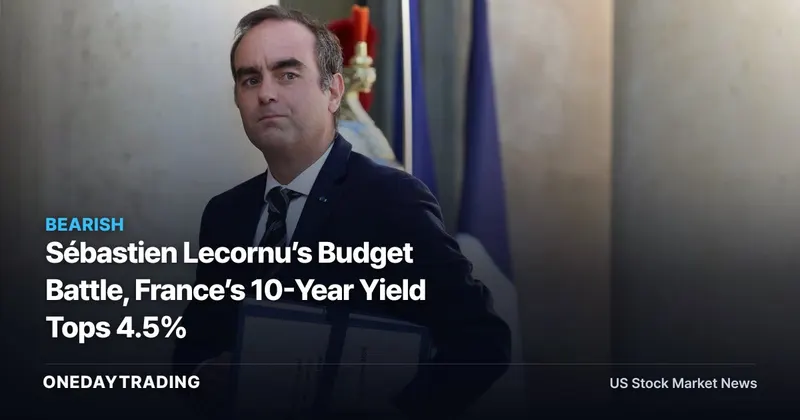
Sébastien Lecornu’s Budget Meets a Bond Market Already Demanding More
Sébastien Lecornu is taking France’s draft 2027 budget to parliament in early October after the country’s 10-year government bond yield rose above 4.5% on Friday. For investors, the sharpest signal is not simply that financing has become more expensive; it is that the bond market has repriced France before lawmakers have determined whether the minority government’s fiscal program can survive.
CNBC Markets reported that France’s 10-year yield crossed 4.5% for the first time since 2008 and was last reported at 4.6696% on Thursday. That move directly raises the market’s required return for holding French sovereign debt. Its wider effect on banks and other rate-sensitive assets will depend on whether the budget process stabilizes expectations or adds another layer of political uncertainty.
OATs are French government bonds, while the OAT-Bund spread measures the difference between French and German government borrowing costs. France’s 10-year yield now stands more than one percentage point above Germany’s 10-year yield for the first time since 2012. The spread therefore functions as the cleanest market gauge of how much extra compensation investors demand to lend to France rather than Germany.
The 54 Billion-Euro Test for France’s 2027 Package
Lecornu’s minority government plans to submit the draft package in early October, with a parliamentary vote scheduled for Nov. 17 and a budget deadline in mid-December. CNBC Markets said Sébastien Lecornu is targeting 54 billion euros, equivalent to 61.8 billion dollars, in spending cuts for the 2027 package. The target is a proposal, not an achieved reduction, and the final measures remain unknown.
The scale of the fiscal challenge is visible in the finance ministry’s debt path. National debt is expected to reach 119.3% of gross domestic product in 2026 and 121.7% in 2027. France is also seeking to move toward 5% from 5.4% this year, placing the budget debate at the intersection of fiscal restraint and parliamentary arithmetic.
Investors should distinguish the part already visible in prices from the part the market cannot settle in advance. The higher yield and wider relative borrowing cost show that investors already require a larger risk premium. Parliament’s approval of the package, the government’s survival, any renewed use of special constitutional powers and possible intervention in French bond markets all remain unknown.
Why Sébastien Lecornu Faces More Than a Fiscal Negotiation
The political backdrop makes the budget a test of governing capacity. France’s July 2024 snap election preceded a period in which administrations were ousted through no-confidence votes in December 2024 and September 2025. Lecornu then used a constitutional clause in February this year to pass the 2026 budget.
That sequence matters because the 2027 package must pass through a divided parliament while the government seeks large spending cuts. Mujtaba Rahman, managing director for Europe at Eurasia Group, is among the named analysts following the political process. The available facts do not establish whether compromise, another constitutional route or rejection will define the final outcome.
Emmanuel Macron’s nine years provide the broader political timeframe, while the immediate market calendar is much shorter. Early October begins the formal submission stage, Nov. 17 supplies the parliamentary decision point, and mid-December marks the budget deadline. Each checkpoint can change the probability investors assign to approval and government survival without guaranteeing either result.
ING and HSBC Focus on the Risk Premium
ING rates strategists Benjamin Schroeder and Michiel Tukker wrote that “time is not in favour of French bond spreads.” Their framing shifts attention beyond a single parliamentary vote: a budget agreement could remove one immediate uncertainty without automatically reversing the premium already embedded in France’s borrowing costs.
ING expects the OAT-Bund spread to sit between 100 and 125 basis points in the coming months. That is a forecast rather than a confirmed outcome. The useful investor test is whether the spread stays within that range, moves beyond it, or narrows as lawmakers approach the scheduled vote and deadline.
Chris Attfield, European rates strategist at HSBC, highlights another pressure point through the ownership base. CNBC Markets reported that non-domestic ownership of OATs now exceeds 50%. If those holdings prove less stable, replacement demand would need to emerge at a price acceptable to buyers; the fact sheet does not establish whether such a shift will occur.
French Bonds, Banks and the Limits of the Read-Through
- French government bonds: They carry the most direct exposure because the market has already pushed France’s 10-year yield above 4.5%, with the last reported level at 4.6696% on Thursday. Budget progress could reduce uncertainty, while failed approval or renewed political disruption could keep the risk premium elevated.
- French financials: Higher sovereign yields can affect the valuation and funding environment surrounding domestic financial institutions. The supplied evidence does not quantify earnings, balance-sheet or capital effects, so a company-level profit conclusion would go beyond the record.
- BNP Paribas: Lars Machenil, chief financial officer at BNP Paribas, told Karen Tso that lawmakers “should take the time to have a budget that makes sense.” His comment supports the importance of a workable fiscal package, though it provides no BNP Paribas earnings forecast or measurable stock impact.
- Rate-sensitive assets: A persistent sovereign premium can influence discount rates and valuation conditions. The direction and size of any equity effect cannot be calculated from the available facts, making the OAT yield and OAT-Bund spread more reliable checkpoints than unsupported stock calls.
What the Bear and Bull Cases Actually Require
The bearish case starts with persistence. France enters the debate with a 10-year yield above 4.5%, projected national debt of 119.3% of gross domestic product in 2026 and 121.7% in 2027, plus a minority government operating after two administrations were removed in no-confidence votes. If the budget process deepens uncertainty, investors may continue demanding greater compensation for French sovereign risk.
The constructive case requires credible movement through the stated calendar. A draft in early October, progress toward the Nov. 17 vote and completion by the mid-December deadline could reduce one source of uncertainty. The 54 billion-euro spending-cut target gives markets a concrete figure to assess, though approval, implementation and the composition of the final package are not established.
Neither scenario supports certainty about intervention. Whether the European Central Bank will enter French bond markets is explicitly unknown. That leaves fiscal execution and parliamentary durability as the observable variables, while the yield and spread reveal how investors are pricing those variables in real time.
Investor Checkpoints Through the Mid-December Deadline
- Early October: Compare the submitted draft with Lecornu’s stated target of 54 billion euros in spending cuts, without treating proposed measures as enacted policy.
- Before Nov. 17: Track whether parliamentary negotiations improve the probability of approval or expose the minority government to another confidence crisis.
- At the Nov. 17 vote: Separate passage of the proposal from the government’s survival, since both outcomes remain uncertain.
- Into mid-December: Monitor France’s 10-year yield and the OAT-Bund spread against ING’s forecast range of 100 to 125 basis points in the coming months.
The decisive signal will not be another fiscal promise in isolation. It will be whether the package clears its political checkpoints while France’s borrowing premium stabilizes. Until those two tracks converge, the bond market is likely to remain the clearest verdict on Lecornu’s budget strategy.
📊 Analysis
Signal Bearish
Why Higher sovereign borrowing costs, political division and an unresolved budget process create a negative backdrop for French rates and exposed financials.
This article was independently written by OneDayTrading from public reporting. Read the original (CNBC Markets)