Key Takeaways
Canada-U.S. tension is a macro risk only if Mark Carney's rebuke to Trump Cabinet insults turns into policy, not because of the tone itself. For investors, the first read-through is the Canadian dollar, Canada-heavy equities, and any cross-border business tied to trade, spending, or procurement.
CNBC reported Carney's comment as a response to attacks on Canada's military, and that matters less as a headline than as a signal of possible friction. The market usually prices rhetoric quickly, then waits to see whether the rhetoric changes cash flows.
What Happened
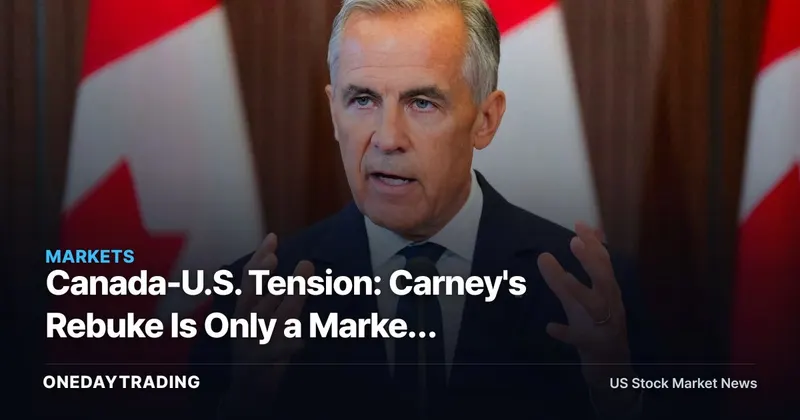
Carney said the remarks were beneath the office when asked about Trump Cabinet secretaries insulting Canada's military, according to CNBC. That is a political response, but for markets it is only the first layer of the story.
The real question is whether the dispute stays verbal or leaks into policy. If it stays verbal, the tape can ignore it. If it feeds tariffs, procurement shifts, or border friction, the Canadian dollar, Canada-linked funds, and banks with domestic exposure would feel it first.
Background & Context
Canada and the U.S. sit inside one of the deepest trade relationships in the world, so diplomatic noise matters only when it changes the rules of the relationship. A one-off insult does not change earnings estimates by itself.
A diplomatic spat is a political risk premium, not an earnings event. It matters when it moves prices through three channels: currency translation, trade flow assumptions, and the discount investors assign to cross-border growth.
Market & Stock Impact
- FXC: the Canadian dollar proxy is the cleanest market barometer if this story turns from rhetoric into policy risk.
- EWC: broad Canada exposure makes the fund sensitive to any shift in growth sentiment, with financials and energy carrying much of the weight.
- TD, BNS, RY: Canadian banks would feel a broader policy fight through growth expectations and currency translation before any direct earnings hit shows up.
- SU: energy exposure matters more if political tension spills into cross-border infrastructure, export rules, or regulatory treatment.
Investor Checkpoints
- Watch whether either side adds policy detail, because that is the point where the story stops being noise.
- Watch FXC and the Canadian dollar for the first confirmation that traders are assigning a real risk premium.
- Watch EWC, TD, BNS, and RY for any gap between headline volatility and actual earnings guidance.
- Watch the next official U.S.-Canada response for signs that tone is turning into trade or spending decisions.
Outlook
The bull case is simple: this stays a rhetorical clash and markets treat it as background noise. In that version, the impact fades fast because there is no cash-flow change to price.
The bear case is more relevant for positioning: if the language becomes a prelude to tariffs, procurement changes, or broader bilateral strain, the first repricing should hit FXC and Canada-sensitive financials, then ripple into broader North American cyclicals. The next catalyst is not the insult itself but the next policy move.
FAQ
Why does Canada-U.S. tension matter to markets?
Canada-U.S. tension matters when it changes expected policy, not when it stays as commentary. Carney's response matters for investors only if it feeds trade rules, defense spending, or currency volatility.
Which stocks or funds move first if the dispute escalates?
FXC and EWC are the clearest market proxies because they reflect the currency and broad Canada equity mix. TD, BNS, RY, and SU would be the next names to watch because they are sensitive to domestic growth and cross-border sentiment.
Is this a reason to trade Canadian assets now?
Not on the comment alone. The market signal changes only if the rhetoric becomes a measurable policy step, and the first confirmation would likely appear in FXC and Canada-exposed banks before it reaches broader U.S. equities.
Market data check: FXC
FXC last traded near $70.33 (-0.40%). Our composite signal — blending price momentum and news flow — reads 🟡 neutral. Price momentum scores 55/100.
Data as of publication. Price via market feeds; for reference only, not investment advice.
📊 Analysis
Signal Neutral
Why The story is a diplomatic headline without a direct policy or earnings catalyst, so the market impact is contingent on escalation rather than immediate.
Tickers$FXC$EWC$TD$BNS$SU
This article was independently written by OneDayTrading from public reporting. Read the original (CNBC)