Summary
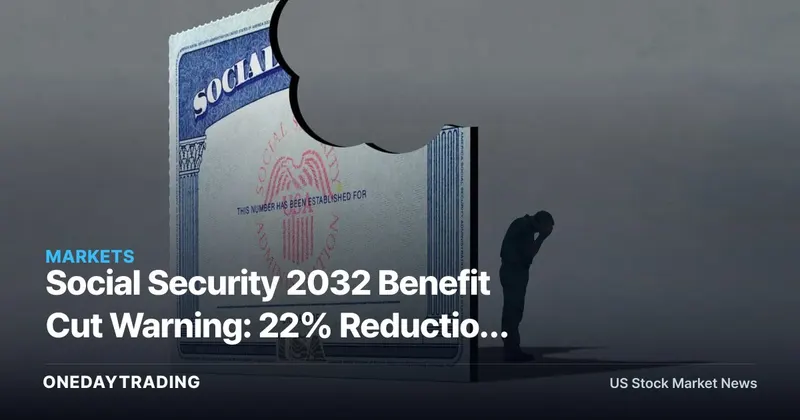
The most recent Social Security Trustees report projects that benefits could be cut by roughly 22% in 2032 if the program's trust fund reserves are not shored up. For retail investors near or in retirement, that is not an abstract policy debate — it is a measurable hole in future monthly income that needs to be modeled today. The practical response is to calculate the personal dollar impact and lean harder on private retirement savings vehicles.
The Full Story
The Trustees report functions as the official actuarial scorecard for Social Security, and its latest projection flags 2032 as the year combined trust fund reserves could be depleted under current law. At that point, incoming payroll taxes would only cover an estimated 78% of scheduled benefits, implying an across-the-board reduction of about 22% unless Congress acts.
For an individual, the math is straightforward but sobering. A retiree expecting 3,000 dollars a month would, under the projected shortfall, see roughly 660 dollars vanish monthly — about 7,920 dollars a year. Multiplied across a multi-decade retirement, the cumulative gap runs into six figures. The key analytical step is to take your own estimated benefit, apply the 22% haircut, and stress-test whether your portfolio and other income sources can absorb it.
Importantly, a 22% cut is a projection under unchanged law, not a certainty. Historically, lawmakers have intervened before prior depletion deadlines through tax adjustments, eligibility-age changes, or benefit-formula tweaks. Still, prudent planning assumes the gap is real and treats any legislative fix as upside.
Structural Background
Social Security is funded primarily through payroll taxes, but an aging population and a shrinking ratio of workers to beneficiaries have steadily eroded the program's long-term balance. As baby boomers retire and longevity rises, outflows outpace inflows, drawing down the reserve that has historically bridged the difference. This demographic pressure is the structural driver behind every Trustees warning and is unlikely to reverse on its own.
Stock & Sector Ripple
- Annuity and life insurers (MET, PRU) — A perceived Social Security shortfall pushes households toward guaranteed-income products, a structural tailwind for annuity providers.
- Asset managers (BLK, BX) — Greater reliance on private retirement savings channels more flows into IRAs, 401(k)s, and target-date funds these firms manage.
- Brokerages and advisory platforms (SCHW) — Rising demand for retirement planning, calculators, and advice benefits self-directed and advised wealth platforms.
- Dividend and income-equity strategies — Investors seeking to replace lost guaranteed income may favor stable dividend payers and income-focused ETFs.
Bull vs Bear Scenarios
Bull case: Congress reforms the program before 2032, as it has historically, softening or eliminating the cut. Meanwhile, the heightened awareness drives durable inflows into private retirement products, lifting insurers and asset managers regardless of the legislative outcome.
(Bear case: Political gridlock delays action, retirees face real income loss, and discretionary consumer spending among older Americans contracts — a modest headwind for retail and consumer-facing sectors. Markets may also price in higher payroll taxes or means-testing that pressures household budgets.)
Investor Action Points
- Pull your personal benefit estimate and apply a 22% reduction to size the exact annual and lifetime gap.
- Prioritize maxing tax-advantaged accounts (401k, IRA) to build a private buffer against the projected shortfall.
- Evaluate guaranteed-income tools like annuities and dividend strategies to replace a portion of at-risk benefits.
- Treat any future Social Security reform as upside, not as your base-case plan.
📊 Analysis
Signal Neutral
Why A projected Social Security shortfall is a long-dated policy risk that mildly favors retirement-product providers but carries no clear near-term directional catalyst for broad equities.
Tickers$MET$PRU$BLK$SCHW$BX
This article was independently written by OneDayTrading from public reporting. Read the original (MarketWatch)