What Changes
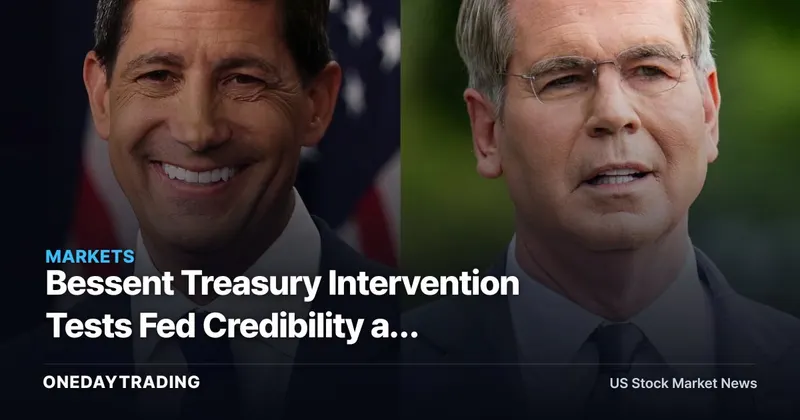
Bessent's Treasury move does not simply lower the cost of government debt; per MarketWatch's reporting, Bessent's Treasury Department is becoming newly activist in a market that anchors the discount rate for U.S. equities.
Daniel Park's read is that the tape can price cheaper government funding quickly, but the tape prices damaged central-bank credibility more slowly. If Federal Reserve Chairman Kevin Warsh is seen as constrained by Treasury intervention, the equity multiple benefit from lower yields comes with a larger policy-risk premium.
The mechanism is direct. Lower Treasury yields reduce the rate used to value long-duration cash flows, which helps technology, software, utilities and REITs; weaker faith in independent rate-setting can lift volatility, steepen risk premiums and pressure banks if investors question the policy reaction function.
By the Numbers
The source provides no yield level, basis-point move or dollar amount for the intervention, so investors should avoid treating the MarketWatch report as a quantified easing signal. The concrete facts are the actors and channel: Treasury Secretary Scott Bessent, the Treasury market, lower government debt costs and Federal Reserve Chairman Kevin Warsh's policy credibility.
That absence of numbers is itself a checkpoint. The market impact becomes measurable only when Treasury yields, equity multiples and sector leadership show whether investors are pricing cheaper funding, institutional risk or both.
Winners & Losers
- Rate-sensitive growth stocks: Lower Treasury yields can raise present values for companies with cash flows expected further out, but the benefit weakens if policy credibility risk lifts equity volatility.
- Utilities and REITs: Dividend-like sectors benefit when government yields fall because relative income becomes more competitive, yet those sectors suffer if inflation expectations rise on concern about politicized rates.
- Banks: A forced lower-rate backdrop can pressure net interest margin, while a credibility shock can support trading volatility; the stock effect depends on the curve, not just the headline.
- Small-cap equities: Smaller companies often benefit from lower borrowing costs, but credit spreads can offset the help if investors demand more compensation for macro uncertainty.
Risk Check
- Fed independence risk: MarketWatch reports that experts said Bessent's move undercuts Warsh's credibility to set interest-rate policy.
- Valuation risk: Equity multiples can expand on lower yields before earnings estimates justify the move.
- Curve risk: A lower front-end signal paired with higher long-end inflation concern would not help all equities equally.
- Data risk: Without a reported basis-point move or dollar amount, the market must confirm the scale through Treasury yields.
Bottom Line
Bessent's Treasury intervention is modestly supportive for rate-sensitive equities if lower government debt costs flow through to yields, but the larger investment issue is whether Warsh's Federal Reserve credibility becomes a new risk premium. The next trigger is not a speech; it is the Treasury curve and whether equity leadership follows lower rates or fades on institutional doubt.
FAQ
Why does Bessent's Treasury intervention matter for stocks?
Bessent's Treasury intervention matters for stocks because Treasury yields set the discount-rate baseline for U.S. equity valuations. MarketWatch reported that Treasury Secretary Scott Bessent moved to lower the cost of government debt, which can help rate-sensitive sectors if yields actually fall.
How can Treasury market intervention undercut the Fed?
Treasury market intervention can undercut the Fed when investors believe fiscal authorities are pressuring the rate environment while the Federal Reserve is supposed to set interest-rate policy independently. MarketWatch reported that experts said Bessent's move undercuts Federal Reserve Chairman Kevin Warsh's credibility.
What sectors benefit if Treasury yields fall?
Rate-sensitive sectors such as technology, software, utilities, REITs and small caps usually benefit when Treasury yields fall because borrowing costs and discount rates decline. If the yield decline comes with doubts about Fed credibility, banks and high-valuation growth stocks face a less clean setup.
📊 Analysis
Signal Neutral
Why Lower government borrowing costs can support rate-sensitive equities, but the reported hit to Fed credibility adds a material policy-risk offset.
This article was independently written by OneDayTrading from public reporting. Read the original (MarketWatch)