At a Glance
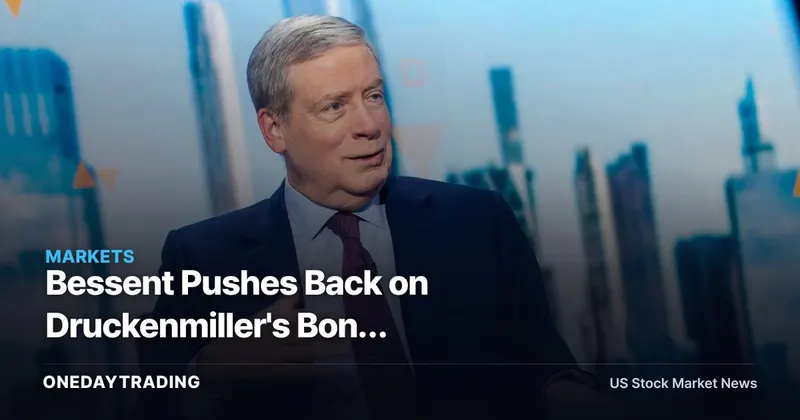
Scott Bessent's pushback on Stanley Druckenmiller's bond-intervention critique matters because it sets the tone for Treasury-market policy without changing the policy itself. At a G20 finance meeting, Bessent told CNBC he spoke with Druckenmiller after the critical op-ed and that the conversation went fine. For investors, that is a messaging signal, not a new backstop.
Bond intervention means any attempt to influence Treasury yields or market functioning, whether through communication, liquidity tools or direct support. The market does not need a formal announcement to reprice rates-sensitive stocks; it only needs to decide whether officials will tolerate more or less bond-market stress than before.
Why is Scott Bessent pushing back on Stanley Druckenmiller's bond intervention critique?
Bessent is trying to narrow the gap between public criticism and policy credibility. If investors read his response as a de-escalation, Treasury volatility can cool at the margin. If they read it as sensitivity to dissent, the term premium stays sticky and long-duration equity multiples stay under pressure.
That is the real read-through for U.S. equity investors. Higher long-end yields usually compress valuation for sectors that trade on cash flows far in the future, while banks only benefit when the curve steepens enough to support net interest income. A flat or inverted curve helps neither the rates debate nor the earnings math.
What does this mean for Treasury yields and rate-sensitive stocks?
- The Treasury market is the first transmission channel. If Bessent's tone reduces fears of near-term intervention, the move is less about fundamentals and more about the risk premium embedded in yields.
- Financials care differently from bond proxies. JPMorgan Chase and Bank of America can benefit from a steeper curve, but they lose the positive signal if the market interprets policy noise as a weaker growth backdrop.
- REITs and utilities remain the cleanest duration trades. XLRE and XLU tend to react to higher discount rates because their cash flows are priced like long bonds.
- Small caps are also exposed. IWM usually feels pressure when funding costs rise and investors demand a larger equity risk premium.
Key Debates
- Whether Bessent's response is meant to reassure markets or simply cool a public dispute.
- Whether Treasury volatility is being driven more by policy expectations than by macro data.
- Whether the market is pricing a real policy floor under bonds or just reacting to headlines.
- Whether a calmer tone helps banks more than it hurts bond proxies.
Related Stocks & Sectors
- JPMorgan Chase and Bank of America: sensitive to the shape of the yield curve and the pace of deposit repricing.
- XLF financials: the cleanest broad read on whether rates and policy talk are helping or hurting bank multiples.
- XLRE real estate: financing costs and cap rates move directly with Treasury yields.
- XLU utilities: long-duration dividend streams usually trade like bond substitutes.
- IWM small caps: higher funding sensitivity and lower balance-sheet flexibility make them vulnerable to rate swings.
What to Watch
- The next CPI print, because inflation is still the cleanest test of whether yields should rise or fall.
- The next FOMC meeting, because the Fed still sets the broad rate backdrop even when Treasury policy dominates headlines.
- The 10-year Treasury yield, because that is where the intervention debate turns into equity multiple pressure.
- Any follow-up Bessent remarks, because a shift from tone management to explicit policy language would matter more than the op-ed itself.
Overall Outlook
The bullish reading is that Bessent is trying to keep the bond market orderly without committing to a standing rescue, and that can lower headline risk for rate-sensitive assets. The bearish reading is that the market may keep pricing a policy floor under bonds, which leaves real yields and valuation pressure intact. Until CPI and the Fed test that view, this is a message trade, not a regime change.
FAQ
What did Scott Bessent say about Stanley Druckenmiller?
At a G20 finance meeting, Scott Bessent told CNBC that he spoke with Stanley Druckenmiller after Druckenmiller's critical op-ed and that the conversation went fine. The market reads that as a sign of de-escalation, not as a policy reversal. The key question is whether the tone change affects Treasury pricing.
What is bond intervention in Treasury markets?
Bond intervention is any policy effort aimed at influencing Treasury yields or market functioning directly. That can include communication, liquidity support or other market tools. Investors care because even the hint of intervention can change the risk premium embedded in rates.
Which stocks react most to Treasury yield moves?
Rate-sensitive groups usually move first, especially banks, REITs, utilities and small caps. JPMorgan Chase, Bank of America, XLF, XLRE, XLU and IWM are the cleanest market read-throughs here. The main variable is whether yields move because growth is firming or because policy uncertainty is rising.
📊 Analysis
Signal Neutral
Why Bessent's comments are a policy signal, but the story does not announce a concrete market action or new intervention, so the direct equity impact is mainly on rate-sensitive sectors rather than decisively bullish or bearish.
Tickers$XLF$JPM$BAC$XLRE$XLU$IWM
This article was independently written by OneDayTrading from public reporting. Read the original (CNBC)