What Changes
Apple’s foldable iPhone rumor matters less as a design story than as a potential replacement-cycle catalyst for Apple shares. A foldable smartphone uses a flexible display to offer a larger screen in a device that still closes into a phone-sized form. If Apple enters the category, it can address customers who want that format but have resisted leaving the iPhone ecosystem.
That mechanism could make the product incremental to Apple’s current upgrade cycle, but it is not automatically incremental to total iPhone demand. Some buyers may choose a foldable instead of another iPhone model, changing product mix without adding a new customer or accelerating a replacement. Price, availability and the quality of the finished hardware will determine whether the format expands demand or merely redistributes it.
The event itself remains unconfirmed in one crucial respect. CNBC reported on Sept. 8 that Apple was rumored to unveil its first foldable iPhone on Wednesday as a major product initiative under new CEO John Ternus. Investors therefore face two separate questions: whether the device appears, and whether its commercial details support the demand assumptions already forming around it.
By the Numbers
Counterpoint Research estimates that Apple could ship 6 million foldable iPhones this year and capture 25% of global foldable-smartphone volume. The research firm said that share could rise to 40% in 2027. Those projections describe a rapid market-share entry, but they are forecasts rather than reported orders or sales.
Counterpoint partner Neil Shah identified deferred ecosystem demand as the channel behind that forecast. He told CNBC on Tuesday that many Apple customers interested in foldables had declined to switch to Samsung, while some who did switch could return if Apple delivers a sufficiently compelling device. That distinction is important: Apple would not need to create all of the interest from scratch, but it would still need to convert stated appetite into paid shipments.
Huawei’s position makes China a more demanding test than the global figures imply. The company accounts for more than two-thirds of China’s foldable market, while Xiaomi is the world’s third-largest smartphone vendor. Shah said Chinese consumers interested in Apple’s newest hardware could generate upgrades from the existing iPhone base, but the source provides no estimate for Apple’s prospective foldable volume in China.
The Launch Calendar Becomes a Competitive Weapon
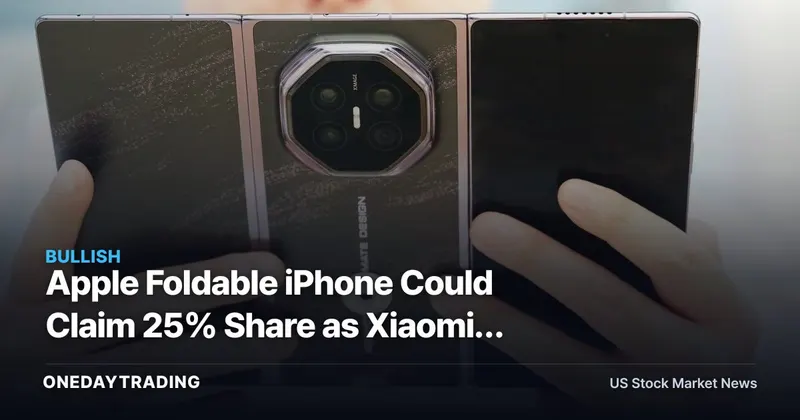
Xiaomi launched the passport-sized Xiaomi 18 Fold on Monday. The device resembles Samsung’s Galaxy Z Fold8, which was released earlier this year. Huawei unveiled the Mate XT2 the same day, extending the trifold format it pioneered into a third generation.
The timing gives both Chinese vendors a straightforward tactical advantage: their products exist before Apple defines its foldable proposition. IDC mobile-device Vice President Francisco Jeronimo told CNBC that the launches were deliberate, allowing consumers to compare the Chinese devices with Apple’s product if and when it reaches stores. The benefit is not proven demand; it is the ability to present an available alternative during Apple’s highest-attention period.
Samsung occupies a different position. It introduced its first foldable in 2019 and remains Apple’s main global rival in the category. Apple’s arrival could validate the format and increase consumer awareness, but it could also challenge Samsung for users who considered a foldable yet stayed with conventional iPhones to avoid switching platforms.
Custom Silicon Moves Into the Foldable Pitch
Xiaomi and Huawei are competing below the display as well as above it. Xiaomi said the Xiaomi 18 Fold uses the XRing O3, its latest self-designed smartphone processor, manufactured on an advanced process. Huawei said the Mate XT2 is the first device to feature LogicFolding, a new semiconductor technique designed to move electrical signals on a chip.
Custom silicon can help a manufacturer coordinate processor behavior with the device’s displays, software and power requirements. In a foldable, that integration matters because the hardware must support different screen configurations without compromising the overall experience. The source, however, supplies no process-node measurement, performance benchmark, power-consumption result, manufacturing yield or shipment figure for either chip technology.
The announcements therefore confirm that Xiaomi and Huawei are treating processors as part of their product differentiation, not that either has established a measurable technical lead. The next useful evidence is independent testing of performance and battery behavior, followed by commercial shipment data. Branding alone cannot answer whether the new silicon improves the economics or appeal of the phones.
Winners & Losers
- Apple could unlock deferred upgrades. Counterpoint’s 6 million-unit forecast rests partly on iPhone users who wanted a foldable without changing ecosystems. The opportunity strengthens if Apple converts that waiting group rather than shifting buyers among its own models.
- Huawei enters the contest from an established position in China. Its share above two-thirds shows that it already commands most of the country’s foldable sales. The Mate XT2 also gives Huawei a third generation of its trifold format before Apple’s possible first entry.
- Xiaomi gains timing and product differentiation. The Xiaomi 18 Fold arrives before Apple’s event, while the XRing O3 provides a self-designed processor for its hardware pitch. The source does not disclose pricing, sales or performance data needed to quantify the benefit.
- Samsung faces a two-sided outcome. Apple could expand attention around a category Samsung entered in 2019, but an iPhone foldable may retain Apple users who otherwise would have considered the Galaxy Z Fold8.
- Premium foldables gain more supply, not guaranteed mass adoption. Consumers will have several current devices to compare, yet foldables remain among the most expensive smartphones. A broader lineup does not remove the affordability constraint.
Risk Check
- The product is still a rumor in the supplied reporting. Expectations for shipments and market share depend first on Apple actually unveiling a foldable iPhone.
- Price could block conversion. Neither Apple’s prospective price nor the prices of the newly introduced Chinese devices are provided. Interest among existing users does not establish willingness to pay.
- Market share may overstate incremental growth. Apple could capture foldable volume while cannibalizing conventional iPhone purchases, limiting the effect on total unit demand.
- China may follow a different adoption path. Huawei already holds more than two-thirds of the local foldable market, so a strong global launch would not ensure comparable penetration there.
Bottom Line
The bullish case for Apple is specific: a foldable could release demand from customers who wanted the format but refused to abandon the iPhone ecosystem, with Counterpoint projecting 6 million shipments and 25% global share this year. The restraint is equally specific. Huawei leads China’s category, Xiaomi and Samsung already have current devices, and premium pricing could turn enthusiasm into substitution rather than growth. Wednesday’s highest-value evidence is confirmation of the product and its commercial terms; after launch, reported shipments will determine whether the forecast represents a genuine upgrade cycle or only a new shape for existing iPhone demand.
FAQ
Is Apple launching a foldable iPhone?
CNBC reported on Sept. 8 that Apple was rumored to unveil its first foldable iPhone at a Wednesday event. The supplied reporting does not contain confirmation from Apple, so the expected launch should not be treated as an announced product.
How many foldable iPhones could Apple sell?
Counterpoint Research estimates that Apple could ship 6 million foldable iPhones this year, representing 25% of global foldable volume. It projects that Apple’s share could reach 40% in 2027, but these figures remain forecasts rather than reported sales.
Why are Xiaomi and Huawei launching foldables before Apple?
IDC’s Francisco Jeronimo said the vendors wanted their products available so consumers could compare them with Apple’s prospective device. Xiaomi launched the Xiaomi 18 Fold, while Huawei introduced the Mate XT2, its third-generation trifold smartphone.
📊 Analysis
Signal Bullish
Why Counterpoint’s shipment forecast and reported pent-up demand point to an Apple upgrade catalyst, although premium pricing and established rivals limit the upside case.
This article was independently written by OneDayTrading from public reporting. Read the original (CNBC)