Anthropic’s White House meeting collides with a binding defense restriction
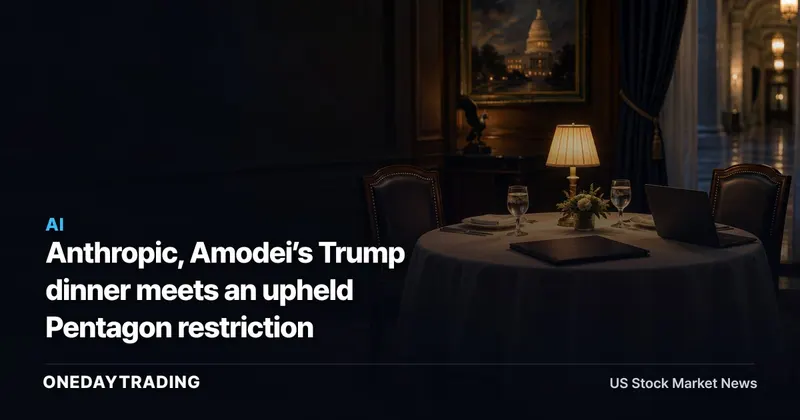
Anthropic enters Dario Amodei’s 2026-09-27 private dinner with Donald Trump carrying a policy opportunity, not a resolved investment catalyst. CNBC confirmed that the Anthropic CEO will meet the president at the White House on Sunday in their first one-on-one meeting. The immediate relevance for the AI sector is the gap between improved access to the administration and a defense restriction that remains legally intact.
The event matters because government relationships can affect where an AI model may be used. Here, the operative fact is unusually concrete: the Department of Defense’s supply-chain-risk designation prevents the U.S. military from using Anthropic models and stops defense contractors from using those models in agency work. A dinner can create room for dialogue; it does not itself alter that prohibition.
What Dario Amodei and Donald Trump bring to the dinner
Amodei did not attend Trump’s Thursday state dinner for Xi Jinping because of a scheduling conflict, according to a source familiar with the details. The private invitation therefore replaces a missed engagement with direct access. Its format is significant because this will be the first one-on-one meeting between Amodei and Trump, although the exact time and agenda have not been disclosed.
Policy differences form the backdrop. CNBC reported that Dario Amodei published a 3-step proposal earlier this month. The proposal is the only quantified policy initiative in the available record, making it a clearer reference point than speculation about what either participant may seek from the dinner.
Political history also complicates the setting: Amodei supported Kamala Harris in the 2024 presidential election. That fact establishes distance between the Anthropic chief and Trump, though it does not establish the dinner’s likely outcome. Investors should treat the meeting as evidence of communication, not evidence that either side has changed its position.
Anthropic’s federal relationship is split across government channels
Anthropic’s position with the U.S. government is not a single relationship. The company shares models with the government under Trump’s voluntary AI executive order, while the Department of Defense bars military use of those same models. For investors assessing AI policy exposure, that split is more informative than a broad label such as government support or government opposition.
CNBC reported that temporary export controls applied to 2 advanced Anthropic models in June. Howard Lutnick later said, “We trust Anthropic,” while Michael Kratsios described the administration’s relationship with the company as “in a good cadence.” Those statements indicate that some federal engagement continues, but neither quotation overrides the separate defense designation.
Tom Brown, an Anthropic co-founder and chief compute officer, is another relevant participant in the company’s government-facing structure. His role shows that Anthropic’s engagement is not confined to its CEO. The dinner nonetheless places Amodei directly into the political channel at a moment when the company’s legal and defense-policy channels remain unsettled.
The Pentagon designation is the hard constraint
Negotiations between Anthropic and the Pentagon collapsed in February. The Department of Defense subsequently designated the company a supply chain risk, creating a practical barrier: neither the military nor defense contractors working with the agency may use Anthropic’s models. That restriction defines the current downside more precisely than the tone of public comments defines any upside.
Anthropic sued the Trump administration to reverse the designation. On Friday, a federal appeals court panel upheld the Pentagon’s action. The company could petition for a rehearing or ask the Supreme Court to take the case, but the available facts do not say whether it will pursue either route.
Hegseth reinforced the government’s position with the statement, “Confirmed: @AnthropicAI = Supply Chain Risk,” according to CNBC. The record also identifies Emil Michael in connection with the Department of Defense, though it supplies no separate decision by him that changes the restriction. The decisive investor fact remains the upheld designation, not the volume of political commentary around it.
Read-through for Anthropic and the listed AI sector
- Anthropic: The company gains direct access to Donald Trump, which could improve the clarity of communication around AI policy. The bearish constraint is immediate and verifiable: the military-use ban remains effective after the appeals-court decision.
- AI software: The case demonstrates how access rules can divide government model sharing from defense deployment. The facts do not establish revenue effects, market-share shifts or benefits for another provider, so no listed-company earnings conclusion is justified.
- Defense technology: Contractors working with the Department of Defense cannot use Anthropic models in agency work under the designation. No supplied evidence identifies a contractor, contract value or substitute model, preventing a defensible ticker-level read-through.
- Other technology leaders: Sam Altman leads OpenAI, Elon Musk leads SpaceX, Jensen Huang leads Nvidia and Mark Zuckerberg leads Meta. The record establishes those relationships, but it does not show that the Anthropic dinner changes the outlook for any of those companies.
The conditional bull and bear cases after the dinner
Bull case: The first private meeting gives Amodei and Trump a direct forum while other parts of the administration continue to engage with Anthropic. Model sharing under the voluntary AI executive order, Lutnick’s expression of trust and Kratsios’s description of the relationship support the possibility that the broader federal channel stays open. A credible positive signal would require a subsequent policy or legal development, not merely cordial language.
Bear case: The appeals panel has upheld a designation that excludes Anthropic from military and defense-contractor use. If that status persists, dialogue elsewhere in the administration does not remove the operational boundary imposed by the Department of Defense. The company also faces uncertainty over whether another court will review the dispute.
The central tension is therefore measurable in permissions rather than rhetoric. Anthropic can share models with the government under one framework while remaining barred from a defined defense channel under another. Until one of those conditions changes, the dinner is best viewed as a political opening layered over an adverse legal status.
Investor checkpoints after the Amodei-Trump meeting
- Look for an official account of the dinner: The exact agenda is unknown, so only a disclosed policy commitment or decision would support a stronger conclusion about the relationship.
- Track the Pentagon designation: The key test is whether the supply-chain-risk label or its restrictions change. General statements about cooperation should not be treated as substitutes.
- Watch Anthropic’s legal choice: A petition for rehearing or a request for Supreme Court review would identify the next formal venue. The company has not disclosed which path, if any, it will take.
- Separate IPO speculation from confirmed facts: The timing, valuation and outcome of any Anthropic IPO are unknown. Without those terms, the White House meeting cannot support a public-market valuation conclusion.
📊 Analysis
Signal Bearish
Why The White House meeting opens a channel for dialogue, but the upheld supply-chain-risk designation still blocks Anthropic’s models from military use.
This article was independently written by OneDayTrading from public reporting. Read the original (CNBC)