What Changes
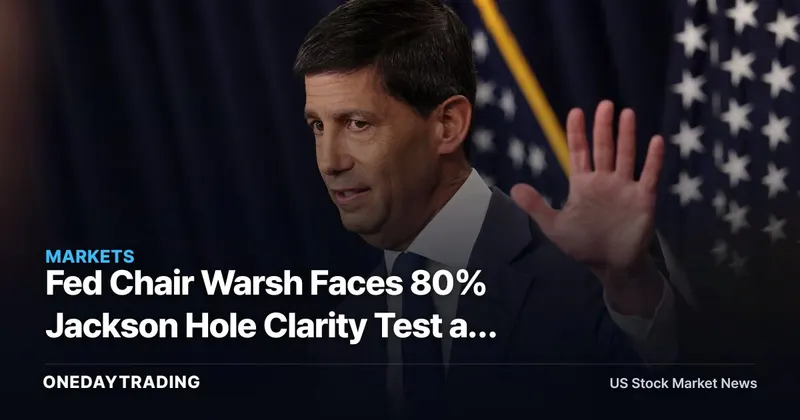
Fed Chair Warsh at Jackson Hole is not just a speech risk; Fed Chair Warsh at Jackson Hole is a test of how much policy uncertainty investors must price into U.S. equities, bonds and the dollar. The CNBC Fed Survey figure matters because 80% of respondents asked for more economic detail, which says the market wants the Fed chair’s reaction function before the next rate-sensitive repricing.
Jackson Hole is the Federal Reserve’s annual central-bank forum where investors parse how policymakers connect inflation, employment and financial conditions to the path of interest rates. If Fed Chair Warsh defines the economy clearly, equity investors can separate growth risk from inflation risk; if Fed Chair Warsh stays broad, long-duration technology shares and rate-sensitive financials carry a wider discount-rate band.
By the Numbers
CNBC reported that 80% of CNBC Fed Survey respondents said Federal Reserve Chairman Warsh should provide more insight into his economic views. That number is the article’s core signal: the issue is not whether investors know the Fed exists, but whether investors know which data Fed Chair Warsh will privilege when growth and inflation point in different directions.
The tape can price a hawkish Fed chair, and the tape can price a dovish Fed chair. The harder trade is an under-specified Fed chair, because valuation models for the S&P 500, Nasdaq and rate-sensitive sectors depend on the expected path of real yields.
Winners & Losers
- Large-cap growth and Nasdaq exposure: Higher ambiguity around Fed Chair Warsh’s economic view can pressure long-duration earnings because discount rates drive a larger share of valuation.
- Banks and financials: JPMorgan Chase and Bank of America can benefit from higher rate expectations through net interest income, but a less clear Fed path can also raise credit-cycle uncertainty.
- Homebuilders and real estate: Lennar and other rate-sensitive housing names face the cleanest transmission channel because mortgage affordability moves quickly when Treasury yields reprice.
- Defensive sectors: Utilities and staples can attract capital if Fed Chair Warsh leaves investors uncertain about growth, though high yields can still compete with dividend equities.
Risk Check
- CNBC’s survey reports investor preference for more clarity, not a policy decision by Fed Chair Warsh.
- A detailed Jackson Hole framework from Fed Chair Warsh would reduce uncertainty without guaranteeing lower interest rates.
- A vague Jackson Hole message from Fed Chair Warsh would matter most if bond yields move, because equities respond to rates through multiples before earnings estimates change.
- The counter-scenario is simple: if markets already expect limited detail from Fed Chair Warsh, a general speech may not force a major repricing.
Bottom Line
Fed Chair Warsh’s Jackson Hole task is to narrow the policy distribution that investors now have to model. If Federal Reserve Chairman Warsh connects economic data to rate decisions with enough precision, equity multiples get a cleaner discount-rate input; if Federal Reserve Chairman Warsh leaves the framework loose, the next inflation or jobs print becomes the trigger that does the communicating for him.
FAQ
Why do investors want Fed Chair Warsh to explain his economic view?
Investors want Fed Chair Warsh to explain his economic view because 80% of CNBC Fed Survey respondents said the Federal Reserve chairman should provide more insight, per CNBC. Clearer views help markets price interest rates, equity multiples and sector rotation with less guesswork.
What does Jackson Hole mean for the stock market?
Jackson Hole matters for the stock market because Federal Reserve communication can shift expectations for Treasury yields and the discount rate applied to corporate earnings. Fed Chair Warsh’s message can affect growth stocks, banks, housing and defensive sectors through that rates channel.
Which sectors are most sensitive to Fed Chair Warsh at Jackson Hole?
Fed Chair Warsh at Jackson Hole is most relevant for rate-sensitive sectors such as large-cap technology, banks, housing and utilities. The key variable is whether Federal Reserve Chairman Warsh gives investors a clearer framework for reading the economy and future interest-rate decisions.
📊 Analysis
Signal Neutral
Why The CNBC survey highlights a market-relevant demand for Fed clarity, but the source reports no policy action, rate move or asset-price reaction.
Tickers$SPY$QQQ$JPM$BAC$LEN
This article was independently written by OneDayTrading from public reporting. Read the original (CNBC)