What Changes
The most valuable variable embedded in JPMorgan shares is not next quarter's net interest income — it is the durability of the Dimon-era operating discipline. By naming two co-presidents, the board is signaling a structured, internal-handoff path rather than an outside search, which historically reduces the strategy-discontinuity risk investors price into a leadership transition.
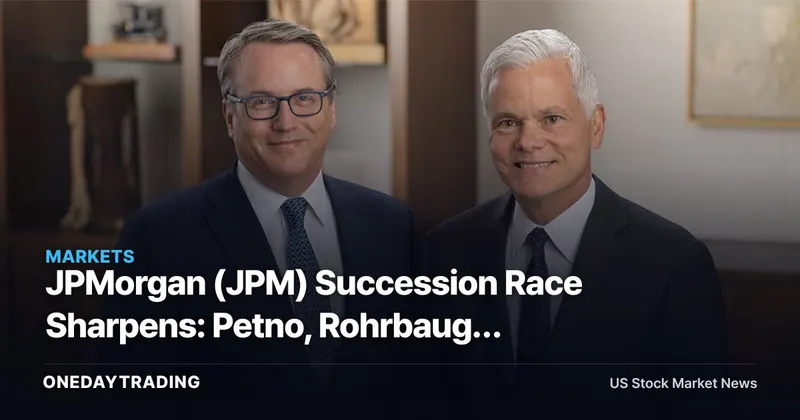
Petno and Rohrbaugh now sit closest to the top, spanning the commercial and markets-facing engines of the franchise. The dual-president structure lets the board test both leaders under live conditions before committing, but it also reintroduces a question every bank investor dislikes: a contested succession can trigger senior-talent departures, and Lake's exit is the first concrete cost of that dynamic.
By the Numbers
This is a personnel decision, so the relevant figures are organizational, not financial: two named co-presidents, one departing senior executive previously seen as a frontrunner, and an unchanged CEO in Jamie Dimon. There are no guidance or results figures attached to the announcement, which means the near-term move in JPM should be driven by sentiment and key-person perception rather than fundamentals.
Winners & Losers
- JPM — Subject of the story. A clarified internal succession ladder modestly de-risks the long-term Dimon-departure question, the single largest qualitative discount on the shares.
- Money-center peers (BAC, C, WFC, GS, MS) — Potential beneficiaries of any JPMorgan senior-talent dislocation; banks that lose succession races often see executives recruited by rivals.
- Investors in JPM management quality — A smoother handoff narrative supports the premium valuation JPMorgan carries versus peers; a messy one would compress it.
Risk Check
- Co-president structures can become rivalries; if one leader exits, the perceived stability gain reverses.
- No timeline was given for Dimon's departure, so the catalyst remains open-ended and hard to trade.
- Further senior exits following Lake would signal cultural friction, not orderly transition.
- Leadership news does not change credit, rate, or trading exposure — the actual earnings drivers are untouched.
Bottom Line
Naming Petno and Rohrbaugh narrows JPMorgan's succession field and gives investors a more legible path beyond Dimon, but Lake's departure is a reminder that every clarified ladder leaves capable people off it; watch the next round of senior moves and any commentary on Dimon's timeline at the coming earnings call as the real tells.
Market data check: JPM
JPM last traded near $341.57 (+2.44%). Our composite signal — blending price momentum and news flow — reads 🟡 neutral. Price momentum scores 70/100 (firm).
Data as of publication. Price via market feeds; for reference only, not investment advice.
📊 Analysis
Signal Neutral
Why A leadership reshuffle clarifies succession but carries no earnings impact and adds key-person attrition risk, leaving net direction balanced.
This article was independently written by OneDayTrading from public reporting. Read the original (CNBC)