Key Takeaways
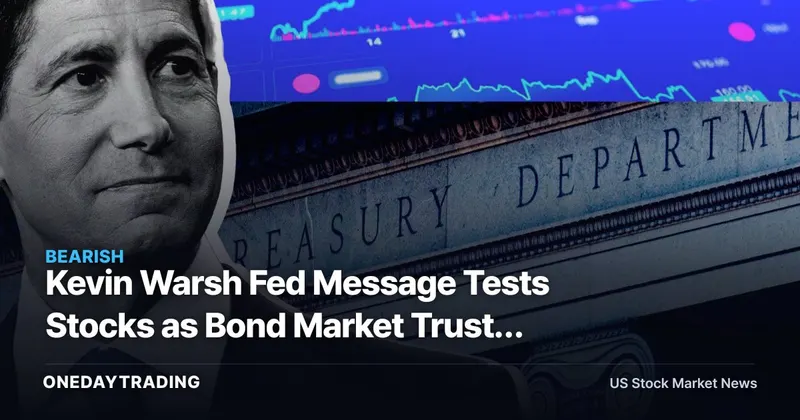
Kevin Warsh Fed chair risk now centers on whether bond-market trust in his inflation warning keeps equity multiples disciplined after MarketWatch reported Friday that the new Federal Reserve chairman said the central bank still has work to do on inflation and the bond market accepted that signal.
The read-through for investors is not a dramatic policy surprise; the read-through is credibility. When Treasury traders believe a Fed chair's anti-inflation language, rate-sensitive equities lose the easy argument that policy restraint is only verbal.
What Happened
MarketWatch reported Friday that Kevin Warsh passed another major test as new Federal Reserve chairman because Kevin Warsh said the Federal Reserve still has work to do on inflation and the bond market took Kevin Warsh at his word.
Fed credibility means investors believe central-bank guidance will translate into policy behavior, so bond yields, discount rates and stock valuations adjust before a formal rate decision. In equity terms, the mechanism runs from inflation language to rates, from rates to multiples, and from multiples to sector leadership.
The source did not provide a Treasury yield level, an equity-index move or an inflation reading. That absence matters: the story is about the market's reaction function, not a single basis-point move.
Background & Context
A Federal Reserve chair wants the bond market to price policy intent without forcing the central bank to over-tighten through surprise. Kevin Warsh receiving that response on Friday gives the Fed a cleaner transmission channel: inflation warnings can tighten financial conditions through expectations.
The equity problem is that the same credibility that stabilizes bonds can pressure long-duration stocks. If investors believe inflation work remains unfinished, future cash flows get discounted at a less generous rate, especially in high-multiple growth and rate-sensitive consumer categories.
Market & Stock Impact
- Growth technology: Software, internet and AI-linked equities are vulnerable when Fed inflation language keeps discount rates elevated, because more of their valuation depends on cash flows expected further in the future.
- Banks and brokers: Financials can benefit from firmer rate expectations if net interest income improves, but the benefit weakens if tighter conditions slow loan demand or lift credit stress.
- Homebuilders and real estate: Rate-sensitive housing shares face the clearest transmission channel because mortgage affordability reacts quickly when bond markets trust a hawkish Fed signal.
- Consumer discretionary: Retail, travel and autos face a two-sided setup: inflation control protects purchasing power, but restrictive policy can pressure financing costs and household demand.
Investor Checkpoints
- Watch the next inflation release after Friday's MarketWatch report, because a hotter print would validate Kevin Warsh's warning that the Fed still has work to do.
- Track the 10-year Treasury yield after Kevin Warsh's Friday remarks, because equity multiples usually react faster to the rate level than to the speech itself.
- Compare Nasdaq leadership with banks, real estate and consumer discretionary shares, because sector rotation will show whether the tape is pricing credibility as stability or restraint.
- Read the next Federal Reserve communication for whether Kevin Warsh repeats the inflation-work message or softens the policy emphasis.
Outlook
The constructive case is that Kevin Warsh's credibility reduces policy uncertainty and lets markets price inflation risk without disorder. The risk case is that trusted hawkishness becomes a valuation headwind if bond yields rise and investors stop paying peak multiples for long-duration earnings.
The next move belongs to the data. If the next inflation print supports Kevin Warsh's Friday message, the bond market's trust becomes a constraint on equities; if inflation cools, the same credibility gives the Fed room to sound tough while markets price less restraint.
FAQ
Why did the bond market trust Kevin Warsh on inflation?
MarketWatch reported Friday that Kevin Warsh said the Federal Reserve still has work to do on inflation and the bond market took Kevin Warsh at his word. The market response signals credibility because bond traders treated the inflation warning as policy-relevant rather than symbolic.
What does Kevin Warsh's Fed message mean for stocks?
Kevin Warsh's Friday inflation message matters for stocks because trusted Fed restraint can keep discount rates higher and pressure equity multiples. Growth technology, real estate and consumer discretionary shares have the clearest sensitivity to that rates channel.
Which market indicator should investors watch after Kevin Warsh's remarks?
Investors should watch the 10-year Treasury yield after Kevin Warsh's Friday remarks because the yield is the fastest public gauge of whether bond traders keep trusting the Fed's inflation stance. A higher yield would tighten the valuation math for equities even before the next Fed decision.
📊 Analysis
Signal Bearish
Why A credible Fed warning that inflation work remains unfinished is a valuation headwind for rate-sensitive equities, even if it supports policy stability.
This article was independently written by OneDayTrading from public reporting. Read the original (MarketWatch)