Summary
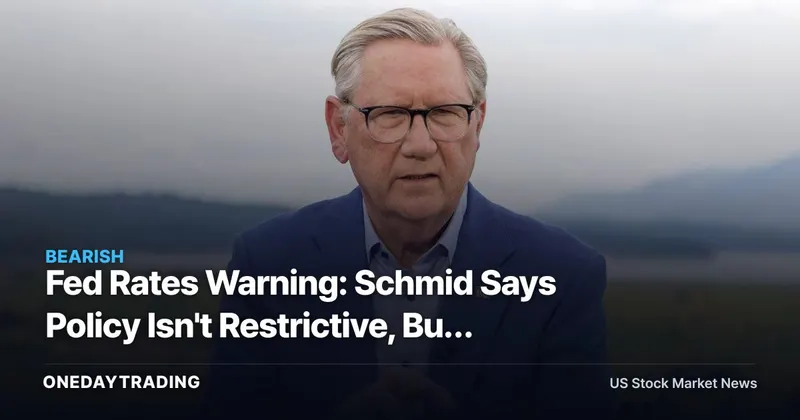
Fed rates are back at the center of the equity debate because Kansas City Fed's Schmid said inflation is stubborn and sticky and said the policy rate is not restrictive, per CNBC's reporting. For investors, the message pressures long-duration growth stocks, supports the higher-for-longer rates narrative, and leaves a hike risk on the table without turning it into an explicit call.
The tape can absorb hawkish language when investors believe the Federal Reserve is finished; Kansas City Fed's Schmid challenged that comfort by questioning whether current policy is tight enough. The point is not that a rate hike was demanded, but that the burden of proof shifts back to inflation data.
The Full Story
Kansas City Fed's Schmid stopped just short of calling for an interest-rate hike, according to CNBC, and that restraint matters. A direct hike call would be a policy shock; saying inflation is sticky and policy is not restrictive is a warning that the Fed's reaction function has not become one-way easing.
Restrictive monetary policy means interest rates are high enough to slow borrowing, demand and pricing power; Kansas City Fed's Schmid argued current policy does not meet that test. That framing matters for U.S. equities because valuation multiples rely on the discount rate investors use to price future earnings.
If markets already price a comfortable path toward lower rates, Schmid's comments lean against that assumption. If upcoming inflation readings cool convincingly, the comments fade into the broader Fed debate; if inflation stays firm, rate-sensitive sectors lose the cushion that supported the soft-landing trade.
Structural Background
Inflation persistence hurts equities through two channels: higher Treasury yields reduce the present value of future cash flows, and tighter financial conditions pressure demand in credit-sensitive industries. That is why the same Fed sentence can weigh more on software, housing, utilities and small caps than on cash-rich defensive franchises.
Kansas City Fed commentary also matters because markets distinguish between what officials say and what they are willing to vote for. Schmid did not cross into an outright hike demand, so the signal is hawkish but not maximal.
Stock & Sector Ripple
- Large-cap technology and AI infrastructure: Higher discount rates challenge premium multiples where investors pay for earnings far into the future, even when revenue momentum remains intact.
- Software and Internet platforms: Long-duration cash-flow models become less forgiving when the policy rate is described as not restrictive.
- Banks and financials: Higher-for-longer rates can support asset yields, but sticky inflation can also raise credit risk and funding pressure.
- Utilities and REITs: Income-oriented sectors compete directly with Treasury yields, so hawkish Fed language can pressure relative valuation.
- Consumer discretionary: If policy tightens further, borrowing costs hit big-ticket demand before they hit everyday spending.
Bull vs Bear Scenarios
The bullish equity case is that Kansas City Fed's Schmid did not call for a hike, leaving room for markets to treat the comment as verbal tightening rather than a policy path change. That outcome works if inflation data soften enough to keep rate-cut expectations alive.
The bearish case is that sticky inflation plus a policy rate described as not restrictive forces investors to reprice the Fed's ceiling, not just the timing of cuts. In that scenario, multiples compress first and earnings revisions follow later in credit-sensitive sectors.
Investor Action Points
- Track the next U.S. inflation release because Schmid's argument depends on whether price pressure stays sticky.
- Watch Treasury yields after Fed speeches because the rates market will show whether investors treat the comment as policy noise or a real repricing risk.
- Compare growth-stock multiples with earnings guidance because higher rates punish valuation before fundamentals break.
- Review bank credit commentary and consumer-loan trends because tighter policy transmits through borrowers before it reaches reported earnings.
FAQ
Why did Fed rate comments matter for stocks today?
Kansas City Fed's Schmid said inflation is stubborn and sticky and said the policy rate is not restrictive, per CNBC's reporting. U.S. stocks care because less-restrictive policy language can push investors to price higher rates for longer.
Did Kansas City Fed's Schmid call for an interest-rate hike?
Kansas City Fed's Schmid stopped just short of calling for an interest-rate hike, according to CNBC. The distinction matters because a warning about restrictiveness is hawkish, while an explicit hike call would be a stronger policy signal.
What sectors are most exposed to sticky inflation and Fed rates?
Sticky inflation and higher Fed rates most directly pressure long-duration technology, software, utilities, REITs and consumer discretionary shares. Banks can benefit from higher asset yields, but credit costs and funding pressure become the offsetting risk.
📊 Analysis
Signal Bearish
Why Schmid's view that inflation is sticky and policy is not restrictive raises higher-for-longer rate risk for equity valuations without providing a clear offsetting growth catalyst.
This article was independently written by OneDayTrading from public reporting. Read the original (CNBC)