What Changes
The first-order read-through is not a Canada story alone. Canada tariffs on U.S. goods turn a failed negotiation into a cost shock for cross-border trade, and the investor question moves from diplomacy to earnings sensitivity.
For U.S. equities, the mechanism is straightforward. A tariff either raises the landed price in Canada, reduces exporter margin, or shifts demand toward non-U.S. suppliers. The market will not need a full spreadsheet to mark down the most exposed businesses, but it will need the tariff list before assigning damage with precision.
Daniel Park's desk would treat this as a policy premium, not a growth shock yet. The S&P 500 can absorb a narrow tariff fight; the multiple has less room if retaliation broadens into a recurring input-cost and export-demand problem.
By the Numbers
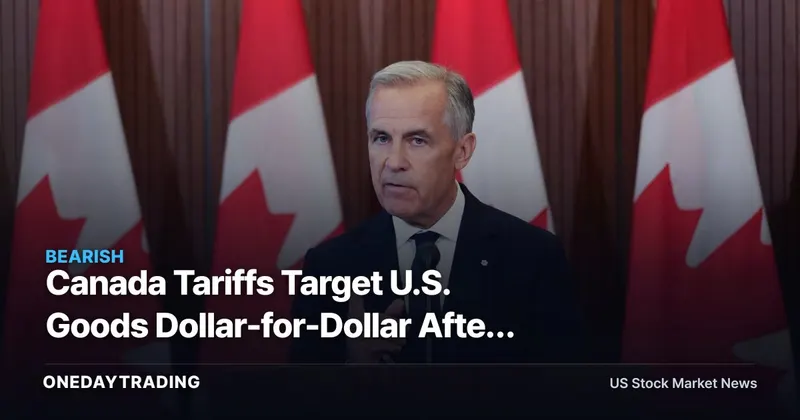
Prime Minister Mark Carney announced on Saturday, Aug. 22, 2026, that Canada would impose dollar-for-dollar tariffs on U.S. goods after trade talks between Canada and the United States broke down, per the source's reporting.
The source did not provide a tariff rate, product list, dollar amount, implementation date, or company-by-company exposure. That absence matters because a dollar-for-dollar framework defines the retaliation principle, while the sector impact depends on the goods covered and the timing of enforcement.
Winners & Losers
- U.S. exporters: U.S. companies selling goods into Canada face the cleanest downside channel because dollar-for-dollar tariffs can reduce Canadian demand or compress exporter margins.
- Canadian importers and consumers: Canadian buyers of U.S. goods face higher effective costs if tariff costs are passed through into prices after the Aug. 22 announcement.
- Domestic Canadian substitutes: Canadian producers competing against tariffed U.S. goods gain a relative price umbrella if buyers switch suppliers.
- Broad U.S. indices: The S&P 500 impact stays limited if the measure remains targeted, but the index risk rises if investors start applying a wider trade-conflict discount.
Risk Check
- The source does not identify the U.S. goods subject to Canadian tariffs, so company-level exposure cannot be ranked responsibly.
- The source does not state the tariff rate or effective date, so earnings models should not treat the cost hit as quantified.
- If U.S.-Canada talks restart quickly, the market can treat the Aug. 22 announcement as bargaining pressure rather than a durable earnings drag.
- If retaliation expands beyond the initial goods list, investors should expect pressure on exporters, logistics flows, and consumer-facing price points.
Bottom Line
Canada's dollar-for-dollar tariff announcement is bearish for trade-exposed U.S. goods sellers because the policy converts failed talks into a direct price and margin problem, but the investable damage stays unquantified until Canada publishes the affected goods, tariff rates, and enforcement date.
FAQ
Why did Canada announce tariffs on U.S. goods?
Canada announced tariffs on U.S. goods on Saturday, Aug. 22, 2026, because trade talks between Canada and the United States broke down, per the source's reporting. Prime Minister Mark Carney described the Canadian response as dollar-for-dollar retaliation.
What does dollar-for-dollar tariffs mean for investors?
Dollar-for-dollar tariffs mean Canada is matching the U.S. tariff burden with retaliatory duties on U.S. goods. For investors, the key issue is whether U.S. exporters lose volume, sacrifice margin, or raise prices for Canadian customers.
Which stocks are affected by Canada tariffs on U.S. goods?
The source does not name specific U.S.-listed companies affected by Canada tariffs on U.S. goods. Investors should wait for Canada's product list and timing before assigning exposure to individual exporters, retailers, transport companies, or industrial suppliers.
📊 Analysis
Signal Bearish
Why Dollar-for-dollar Canadian retaliation creates a negative policy channel for trade-exposed U.S. goods exporters, even though the exact company impact is not yet quantifiable from the source.
This article was independently written by OneDayTrading from public reporting. Read the original (MarketWatch)