At a Glance
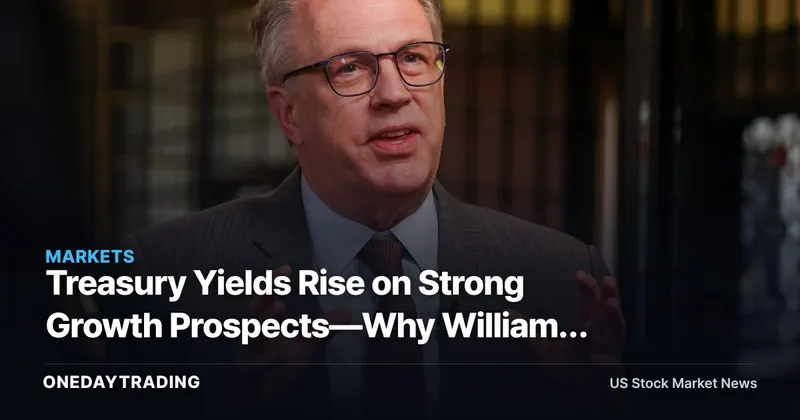
New York Fed President John Williams said the recent rise in Treasury yields reflects stronger economic prospects, not a firm signal that the Federal Reserve has decided to raise rates. For investors, that distinction matters: growth can support earnings and risk assets, while a renewed hiking cycle would pressure equity multiples and rate-sensitive sectors.
Williams made the comments in a CNBC interview, but did not commit to whether an interest-rate increase is necessary. The market therefore has evidence of resilient growth, not a definitive policy path.
Why It Matters Now
Treasury yields are the benchmark discount rate for stocks, corporate borrowing and mortgage pricing. When yields rise because investors expect stronger economic activity, cyclical earnings estimates can improve; when yields rise because inflation or policy tightening is expected, the same move can compress valuation multiples. Williams tied the surge to the first channel while leaving the second unresolved.
That creates a two-sided read-through for U.S. equities. Banks such as JPMorgan Chase and Bank of America can benefit from higher reinvestment yields, but an eventual rate hike would raise funding costs and increase pressure on borrowers. Growth stocks face the opposite trade-off: better economic demand can lift revenue, yet higher discount rates reduce the present value of long-duration cash flows.
The tape has priced a stronger economy through higher yields. It has not received a clear Williams endorsement for another hike. That gap keeps the next policy signal more important than the yield move alone.
Key Debates
- Growth or inflation? Williams attributed the yield increase to economic prospects, but the interview did not establish whether price pressures are also driving rates.
- Is a hike required? Williams declined to say whether the Federal Reserve needs to raise interest rates, preserving uncertainty around the policy reaction function.
- What is already priced? Markets appear to recognize stronger activity; a confirmed tightening signal would represent a separate valuation shock.
- Who absorbs the cost? Financial companies may capture wider asset yields, while highly leveraged households and businesses face more expensive credit.
Related Stocks & Sectors
- JPMorgan Chase (JPM): Higher market yields can improve returns on cash and securities, although credit demand and funding costs become the counterweights if policy tightens.
- Bank of America (BAC): The earnings impact depends on deposit pricing and loan repricing, making the yield curve more important than a single headline rate.
- Technology and long-duration growth: Stronger demand supports revenue, but higher Treasury discount rates can restrain valuation expansion.
- Real estate and utilities: These rate-sensitive groups face a tougher relative backdrop when government-bond yields rise, because financing costs compete with income-oriented valuations.
What to Watch
- Subsequent Federal Reserve remarks that clarify whether Williams views stronger growth as sufficient reason to keep rates unchanged.
- Movements in Treasury yields: a further rise paired with hawkish guidance would carry a different equity signal than a rise driven only by growth expectations.
- Bank disclosures on deposit costs, loan growth and credit quality at the next earnings cycle.
- Economic data that tests the strong-prospects narrative before the next major policy decision.
Overall Outlook
The constructive case is straightforward: stronger economic prospects can support corporate revenue, bank asset yields and cyclical leadership without requiring another hike. The risk is that resilient activity keeps rates elevated long enough to compress equity multiples, or eventually prompts the Federal Reserve to tighten policy. Williams supplied no probability, so investors must separate the growth signal already reflected in yields from the unresolved question of policy.
FAQ
Why did Treasury yields surge?
New York Fed President John Williams said Treasury yields rose because investors see stronger economic prospects. Williams did not say that the Federal Reserve has decided to raise interest rates.
Does John Williams support another rate hike?
John Williams did not commit in the CNBC interview to whether an interest-rate increase is necessary. His comments therefore indicate policy uncertainty rather than a confirmed hiking signal.
What does higher Treasury yields mean for stocks?
Higher yields can help banks earn more on cash and securities when growth is firm, but they also raise the discount rate applied to future corporate profits. Technology, real estate and utilities are especially sensitive to that valuation and financing channel.
📊 Analysis
Signal Neutral
Why Williams linked higher yields to stronger growth but withheld a view on another hike, leaving the equity impact balanced between earnings support and valuation pressure.
This article was independently written by OneDayTrading from public reporting. Read the original (CNBC)