What Changes
For investors, the relevant question is not whether this was a one-off scheme. It is how much social engineering has already slipped past the controls that listed financial firms use to protect customers, limit losses, and keep trust intact.
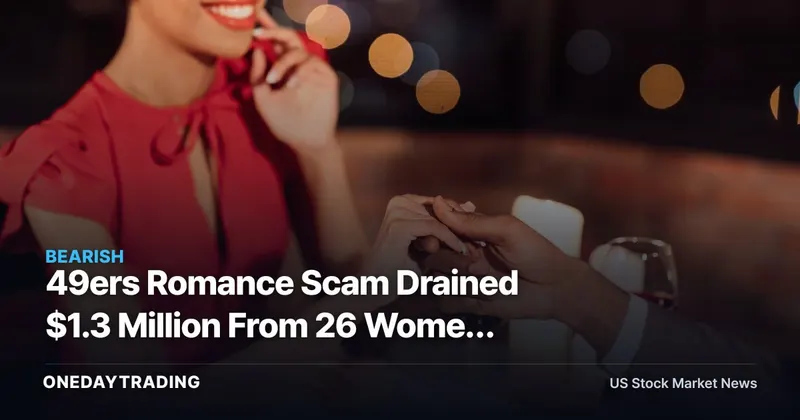
Romance scam is the right definition here: a fraud built on trust, where the victim believes the story before the transfer happens. In this case, the source says the man posed as a 49ers player and collected $1.3 million from 26 women, which makes the scheme a lesson in how identity can be monetized faster than systems can verify it.
The practical market implication is that authorized-payment fraud keeps shifting the burden from card authentication to customer education, case review, and recovery work. That raises operating friction for banks and payments names even when the transaction itself never looks like a classic break-in.
How did a 49ers romance scam take $1.3 million?
The 49ers romance scam worked because the fake identity came with instant credibility. A trusted public persona can lower skepticism, shorten the victim's decision time, and make repeated requests feel normal rather than suspicious.
The other important feature is the payment path. If the victim approves the transfer, fraud models often see consent on the surface even when consent was manipulated underneath. That is why these cases can be expensive without looking noisy inside standard authorization systems.
By the Numbers
The Yahoo Finance report cites 26 women and $1.3 million in losses. If that total were split evenly, the average exposure would be $50,000 per victim, which shows how quickly trust-based fraud can scale from personal contact into material dollar damage.
That math matters for financials because the unit of pain is not the headline amount alone. It is the combination of repeat contact, repeated transfers, and the cost of handling disputes, complaints, and reputational spillover after the money is gone.
Winners & Losers
- Banks and credit unions: higher pressure on fraud teams, customer support, and recovery workflows when the transfer is authorized on paper but manipulated in practice.
- Payment platforms: more scrutiny on onboarding, monitoring, and scam intervention tools because the weak point is the social layer, not just the card rail.
- Consumer-finance brands: trust erosion can hit retention if customers think the system failed to stop an obvious con before money moved.
- Fraud-prevention vendors: demand tends to rise when institutions need better detection of relationship-based fraud and behavioral anomalies.
Risk Check
- The source gives the total loss amount, not the recovery rate, so the final economic damage could differ from the headline figure.
- Not every loss path hits the same part of the financial stack; some transfers are easier to reverse than others.
- One case can overstate the market impact if it does not show up in broader loss trends or reserve builds.
- The key variable is whether this stays a criminal anecdote or starts appearing in quarterly fraud commentary from consumer lenders and payments firms.
Bottom Line
The stock read is bearish for financials in the broad sense because the story spotlights a fraud class that attacks behavior before it attacks systems. The $1.3 million and 26-victim scale show how costly that gap can be, and the real watchpoint is whether banks and payment platforms begin to show higher fraud losses, more complaints, or bigger compliance spend in the next earnings cycle.
FAQ
What is a romance scam?
A romance scam is a fraud in which trust is built first and money is requested later. In the Yahoo Finance case, the suspect allegedly posed as a 49ers player, which gave the scheme a believable identity and a path to $1.3 million in victim transfers.
Why do banks miss romance scams?
Many romance scams move through transfers that the customer appears to approve. That makes them harder to catch than stolen-card fraud because the payment can look legitimate even when the relationship behind it is fake.
What should investors watch next?
Investors should watch fraud losses, customer complaints, and reserve commentary at banks, credit unions, and payment platforms. The next signal is whether this stays a headline crime story or starts showing up in earnings as a real operating cost.
📊 Analysis
Signal Bearish
Why The scheme highlights authorized-payment fraud and trust-based losses, which raises risk for banks, payment platforms, and consumer-finance operations.
This article was independently written by OneDayTrading from public reporting. Read the original (Yahoo Finance)