At a Glance
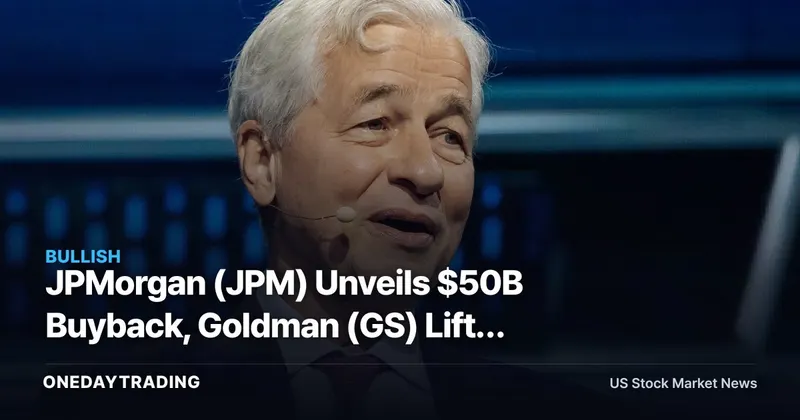
The Federal Reserve's annual stress test confirmed that all 32 large U.S. banks could survive a hypothetical recession, and the sector wasted no time converting that regulatory green light into capital. JPMorgan Chase authorized a fresh $50 billion share buyback, while Goldman Sachs raised its dividend. The read-through is straightforward: excess capital is being handed back to shareholders rather than held in reserve.
Why It Matters Now
The stress test is the gate that determines how much capital banks must hold versus how much they can return. A clean pass across all 32 firms lowers the implied Stress Capital Buffer pressure and frees balance-sheet capacity. For JPMorgan, a $50 billion repurchase authorization mechanically shrinks the share count, supporting earnings per share and signaling that management views the stock as a worthwhile use of capital rather than deploying it into lending or acquisitions.
Goldman's choice to lift the dividend rather than lean solely on buybacks reflects a different mix — a recurring cash commitment that appeals to income investors and implies confidence in durable earnings. The divergence in payout style matters: buybacks are flexible and can be paused, while dividend increases are sticky and harder to reverse without spooking the market.
The broader signal is that the Fed sees the banking system as well-capitalized heading into an uncertain rate and credit environment. That reduces the tail risk that weighed on bank multiples after the 2023 regional-bank stress, and it sets a template the rest of the group typically follows within days of test results.
FAQ
- What is the Fed stress test? An annual exam modeling how large banks perform under a severe hypothetical recession; passing determines permitted capital returns.
- Why does a buyback help the stock? Repurchasing shares reduces the count outstanding, lifting earnings per share and return on equity if profits hold.
- Why did Goldman raise its dividend instead? A dividend hike is a recurring, confidence-signaling payout favored by income-oriented holders.
- Do all banks benefit equally? No — capital return capacity varies by each firm's buffer and business mix; trading-heavy and consumer-heavy banks differ.
Related Stocks & Sectors
- JPMorgan (JPM) — the $50 billion authorization directly shrinks float and underpins EPS; the largest U.S. bank sets the tone for peers.
- Goldman Sachs (GS) — dividend increase signals earnings durability in trading and advisory; appeals to income investors.
- Bank of America (BAC), Wells Fargo (WFC), Morgan Stanley (MS) — likely to announce their own capital plans after passing, with payout size tied to individual capital buffers.
- Big-bank ETFs (KBE, KRE exposure) — broad sector sentiment benefits from a clean systemwide pass.
What to Watch
- Capital-return announcements from BAC, WFC, MS and Citigroup in the days following the test.
- Each bank's updated Stress Capital Buffer, which dictates the true scale of allowable returns.
- Next quarterly earnings for net interest income trends and credit-loss provisions that fund these payouts.
- The pace of actual buyback execution versus the authorized amount — authorizations are ceilings, not commitments.
Overall Outlook
The bull case is clean: a fully passing sector, large authorized returns, and a Fed implicitly endorsing balance-sheet strength support bank valuations and shareholder yield. The counterweight is that capital returns do not change the demand side — loan growth, deposit costs, and credit quality still drive earnings. A buyback authorization is not the same as buyback execution, and a sharp deterioration in credit or a rate-path surprise could see banks slow repurchases to preserve capital. The capital-return story is real, but it rewards earnings consistency rather than guaranteeing it.
Market data check: JPM
JPM last traded near $335.21 (+0.32%). Our composite signal — blending price momentum and news flow — reads 🟡 neutral. Price momentum scores 53/100.
Data as of publication. Price via market feeds; for reference only, not investment advice.
📊 Analysis
Signal Bullish
Why A clean stress-test pass plus a $50B JPMorgan buyback and Goldman dividend hike are direct positive catalysts for bank capital returns and sentiment.
Tickers$JPM$GS$BAC$WFC$MS
This article was independently written by OneDayTrading from public reporting. Read the original (CNBC)