Summary
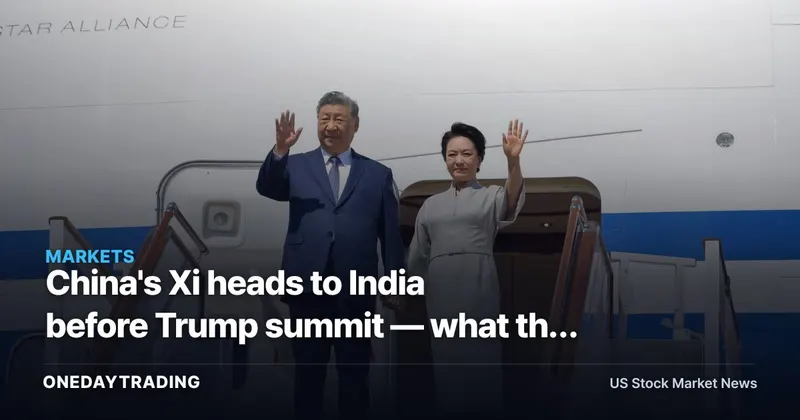
China's Xi Jinping is expected to make his first visit to India before traveling to the U.S. for a meeting with Donald Trump, and that sequence matters because markets tend to trade the odds of de-escalation before they trade the outcome. For investors, the read-through is less about ceremony than about leverage: China is broadening its diplomatic runway ahead of a Trump summit.
State visits are formal diplomatic trips used to signal priority, manage tensions, and set bargaining positions. China, the U.S., India, and trade-sensitive multinationals all sit inside that frame because any shift in bilateral tone can move tariffs, supply-chain assumptions, and risk appetite.
The Full Story
China's Xi Jinping is preparing a diplomatic sequence that starts with India and ends in the U.S. The immediate market question is not whether the trip is symbolic; it is whether the symbolism reduces the chance of a sharper trade confrontation or simply gives both sides more room to posture.
Investors should treat this as a headline risk event for China exposure, not as a confirmed policy pivot. A visit to India before a Trump meeting suggests Beijing wants more than one channel open at once, which can help in negotiations but does not by itself change tariffs, technology controls, or cross-border demand.
The key distinction is between optics and substance. Optics can compress geopolitical risk premiums for a day or two; substance changes revenue assumptions, sourcing plans, and discount rates. The source gives the first, not the second.
Structural Background
For U.S. markets, China diplomacy matters most where trade friction hits actual earnings lines: input costs, shipment timing, China sales, and supply-chain continuity. That is why the same headline can matter to semiconductors, industrials, and global consumer brands at the same time.
India raises the strategic stakes because it is both a major economy and a counterweight in the region. If Xi Jinping uses the India stop to signal flexibility before the Trump meeting, the market may read that as a small improvement in negotiation odds rather than a durable thaw.
Stock & Sector Ripple
- AAPL: Apple is exposed to China demand and China manufacturing, so any shift in bilateral tension can affect both revenue visibility and supply-chain assumptions.
- NVDA: Nvidia is tied to China export rules and AI demand, so diplomatic tone matters if it changes the odds of tighter or looser technology restrictions.
- CAT: Caterpillar is leveraged to global industrial activity, and China policy can move order confidence even when no direct tariff change is announced.
- XLI: The industrials ETF reflects export-sensitive capital spending and trade sentiment, so it can react to headline de-escalation before fundamentals change.
- FXI: The China ETF is a direct read on whether investors think diplomatic sequencing lowers policy risk or just delays it.
Bull vs Bear Scenarios
The bullish case is straightforward: if Xi Jinping's outreach to India and then the U.S. lowers the odds of a new escalation, China-exposed stocks can rerate on lower policy risk even without a formal deal. That matters most for names where China demand or China supply chains already sit inside the margin math.
The bear case is more practical than dramatic. The same diplomatic choreography can also mean both sides are preparing harder bargaining positions, which leaves tariffs, export limits, and strategic competition intact. In that case, the market would have traded the headline and missed the substance.
Investor Action Points
- Track the final confirmation of Xi Jinping's India stop and the public framing around it.
- Watch the agenda and readout from the Trump meeting for any change in trade, tech, or tariff language.
- Monitor Apple, Nvidia, and Caterpillar guidance for any shift in China assumptions.
- Use China-exposed ETFs like FXI as a quick gauge of whether the market is pricing détente or just diplomacy.
FAQ
Why does Xi Jinping's India visit matter before the Trump summit?
Xi Jinping's India visit matters because it suggests China is sequencing diplomacy before negotiating with the U.S. That can improve Beijing's leverage, but it does not guarantee softer policy. For investors, the question is whether the visit changes the odds of de-escalation or only the tone of the talks.
Which U.S. stocks are most sensitive to China diplomacy?
Apple, Nvidia, and Caterpillar are among the most sensitive because they link directly to China demand, China supply chains, or trade policy. China-focused ETFs can also move quickly when headline risk changes. The market usually reacts first to sentiment, then to earnings revisions.
Is this bullish for markets?
It is only modestly bullish unless the diplomacy produces a concrete policy signal. Markets can lift on lower geopolitical tension, but they will not fully reprice until they see changes in tariffs, export controls, or cross-border demand. The next catalyst is the Trump meeting and the language that follows it.
📊 Analysis
Signal Neutral
Why The diplomatic sequence may ease headline risk for China-exposed equities, but the source contains no concrete policy shift or agreement yet.
Tickers$AAPL$NVDA$CAT$XLI$FXI
This article was independently written by OneDayTrading from public reporting. Read the original (CNBC)