At a Glance
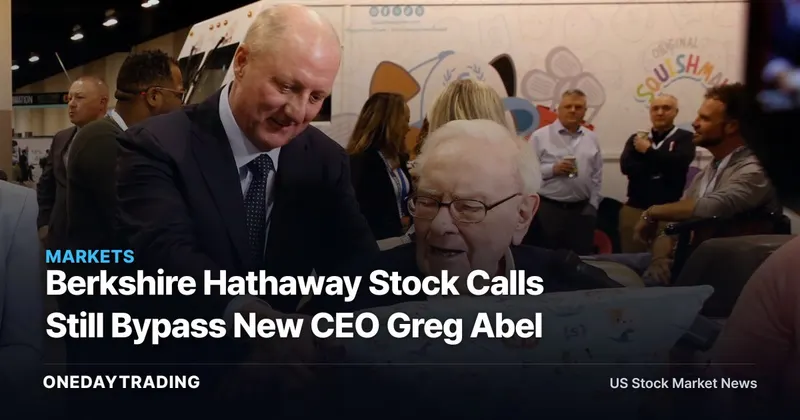
Berkshire Hathaway BRK-B stock investors should read CNBC's report as a governance signal, not a trading signal: new CEO Greg Abel appears to be leaving equity decisions to Warren Buffett and portfolio manager Ted Weschler, keeping Berkshire Hathaway's listed-stock engine tied to its old capital-allocation center.
Berkshire Hathaway BRK-B is a financial and insurance-led conglomerate whose public-equity portfolio can influence reported value, investor confidence and the succession discount embedded in the shares.
Why It Matters Now
CNBC's reporting on Berkshire Hathaway BRK-B says Greg Abel appears not to be directing the company's stock portfolio, while Warren Buffett and Ted Weschler appear to be making the equity calls. For shareholders, the mechanism matters: Berkshire Hathaway BRK-B is not only an operating company, but also a capital allocator whose reputation rests on who decides when cash becomes common stock.
The positive read is continuity. Berkshire Hathaway BRK-B investors who own the stock for Buffett-style discipline can argue that the equity process has not been disrupted by the CEO transition described by CNBC. That reduces the risk of a sudden style change in public markets, where a new leader might chase scale, momentum or optics.
The risk is also continuity. Berkshire Hathaway BRK-B has to prove that Greg Abel can eventually command both the operating businesses and the capital-allocation narrative. If CNBC's description persists through future filings and public comments, investors may separate confidence in Berkshire Hathaway's businesses from confidence in Berkshire Hathaway's post-Buffett investment identity.
Key Debates
- Succession control: Berkshire Hathaway BRK-B benefits if Warren Buffett and Ted Weschler preserve investment discipline, but Greg Abel's limited apparent role in stocks leaves unanswered how equity authority transfers over time.
- Multiple support: Berkshire Hathaway BRK-B can trade with less succession anxiety when investors believe the portfolio process is stable, but the stock can lose premium support if the market concludes the CEO role excludes a core value lever.
- Disclosure limits: CNBC's report identifies apparent decision-makers, but CNBC's report does not provide portfolio weights, trade sizes or performance figures, so investors should not infer a specific near-term earnings effect.
- Financial-sector read-through: Berkshire Hathaway BRK-B remains a reference point for insurance float, balance-sheet conservatism and public-equity allocation across financials, but the report changes governance perception more than sector fundamentals.
Related Stocks & Sectors
- BRK-B: Berkshire Hathaway BRK-B is the direct subject because CNBC says Warren Buffett and Ted Weschler appear to be steering equities while Greg Abel runs as new CEO.
- BRK-A: Berkshire Hathaway BRK-A carries the same economic story through the higher-priced share class, making succession confidence the same core variable.
- Financials: The financials sector reads Berkshire Hathaway BRK-B as a capital-allocation benchmark, especially where insurance float and investment income shape valuation.
- Insurance: Berkshire Hathaway BRK-B links operating insurance economics to portfolio decisions, so authority over equities affects how investors judge float deployment.
What to Watch
- Berkshire Hathaway BRK-B investors should watch the next portfolio disclosure for whether CNBC's apparent Buffett-Weschler control is reflected in continued stock-market activity.
- Berkshire Hathaway BRK-B investors should watch Greg Abel's next public remarks for any explicit division between operating leadership and equity-investment authority.
- Berkshire Hathaway BRK-B investors should watch future shareholder communications for whether Warren Buffett, Ted Weschler or Greg Abel is framed as the accountable voice on stocks.
- Berkshire Hathaway BRK-B investors should watch valuation behavior around succession news because the market can price continuity and governance ambiguity at the same time.
Overall Outlook
Berkshire Hathaway BRK-B earns a neutral read from CNBC's report because the news supports investment-process continuity without proving a new growth or earnings catalyst. The bull case is that Warren Buffett and Ted Weschler keep Berkshire Hathaway's equity discipline intact during Greg Abel's leadership transition. The bear case is that Berkshire Hathaway BRK-B eventually faces a clearer succession discount if investors decide the company's most famous capital-allocation muscle has not truly moved to the new CEO.
FAQ
Who is making Berkshire Hathaway stock decisions now?
CNBC reports that Warren Buffett and portfolio manager Ted Weschler appear to be making Berkshire Hathaway BRK-B equity decisions. CNBC's report says new CEO Greg Abel appears to be letting them handle the company's stock portfolio.
Why does Greg Abel's role matter for Berkshire Hathaway stock?
Greg Abel's role matters for Berkshire Hathaway BRK-B because CEO succession and capital allocation are linked in the stock's valuation. If Greg Abel controls operations while Warren Buffett and Ted Weschler control equities, investors must judge two leadership systems inside one company.
Is Berkshire Hathaway BRK-B more bullish or bearish after the CNBC report?
Berkshire Hathaway BRK-B is best read as neutral after the CNBC report because the report signals continuity rather than a new financial catalyst. If future disclosures show a smooth investment handoff, Berkshire Hathaway BRK-B can reduce succession concern; if authority stays unclear, Berkshire Hathaway BRK-B can carry a governance discount.
Market data check: BRK-B
BRK-B last traded near $495.82 (-0.21%). Our composite signal — blending price momentum and news flow — reads 🟡 neutral. Price momentum scores 48/100.
Data as of publication. Price via market feeds; for reference only, not investment advice.
📊 Analysis
Signal Neutral
Why CNBC's report preserves confidence in Berkshire Hathaway's equity discipline but raises an unresolved succession question around Greg Abel's capital-allocation authority.
This article was independently written by OneDayTrading from public reporting. Read the original (CNBC)