At a Glance
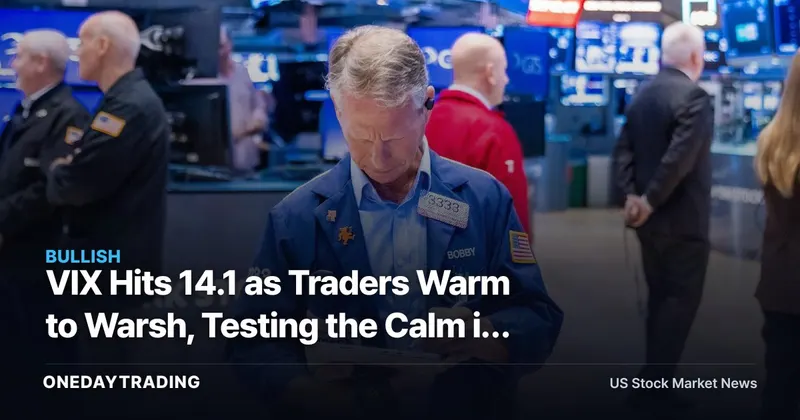
VIX and S&P 500 volatility are sending investors a clear message: CNBC reported that the Cboe Volatility Index fell as low as 14.1, a year-to-date low, as stock traders warmed up to Warsh, making equity protection cheaper and risk appetite more visible.
The Cboe Volatility Index, or VIX, measures the price of 30-day options tied to the S&P 500 Index, so a drop to 14.1 means investors are paying less for near-term downside insurance, per CNBC.
Why It Matters Now
The S&P 500 did not need a new earnings number in CNBC's report to get a macro signal; the signal came from the options market. When the VIX trades at 14.1, the tape is saying investors see less need to hedge the next month of index risk.
That matters because volatility feeds directly into multiples. A lower VIX reduces the visible cost of uncertainty, which can support longer-duration equities, broad index exposure and cyclical risk, provided the policy backdrop does not reopen the case for stress.
The Warsh angle is the live variable. CNBC reported that stock traders warmed up to Warsh, and that matters because markets often price policy personalities through rates expectations before the earnings effect shows up in sector leadership.
Key Debates
- What the market already prices: CNBC's 14.1 VIX reading shows traders have already marked down near-term S&P 500 volatility.
- What the market does not price: CNBC's report does not establish whether the Warsh reaction reflects durable policy confidence or a short-lived positioning shift.
- Multiple risk: A year-to-date low in the VIX can support equity valuations, but low hedging costs leave less cushion if macro expectations reverse.
- Sector rotation: Lower index volatility usually helps risk assets broadly, but leadership depends on whether rates, earnings and policy expectations move in the same direction.
Related Stocks & Sectors
- S&P 500 index exposure: The VIX measures 30-day options on the S&P 500 Index, so broad U.S. equity ETFs and index-sensitive portfolios are the cleanest read-through.
- Growth equities: Lower volatility can ease pressure on higher-multiple stocks because investors demand less compensation for near-term uncertainty.
- Financials: Banks and brokers can benefit from calmer equity markets if risk appetite improves, but lower volatility can also reduce some trading opportunities.
- Defensive sectors: Utilities, staples and low-beta shares can lag if investors rotate toward risk assets after a VIX decline.
What to Watch
- VIX level: If the Cboe Volatility Index holds near CNBC's 14.1 low, the market is confirming cheaper 30-day S&P 500 protection.
- S&P 500 breadth: A healthy low-volatility rally should broaden beyond the largest index weights.
- Rates reaction: The Warsh trade matters most if Treasury yields and equity multiples move consistently.
- Next macro trigger: Inflation data, labor data and Fed communication will test whether the VIX low reflects confidence or complacency.
Overall Outlook
The setup is modestly bullish for U.S. equities because CNBC's VIX reading of 14.1 shows traders are paying less for near-term S&P 500 protection while warming to Warsh. The risk is that low volatility is not the same as low risk; if the next macro catalyst pushes rates higher or policy expectations shift, the calm priced into options can unwind quickly.
FAQ
Why did the VIX fall to 14.1?
CNBC reported that the Cboe Volatility Index fell as low as 14.1 as stock traders warmed up to Warsh. The VIX decline means the price of 30-day options protection on the S&P 500 Index moved lower.
What does a low VIX mean for S&P 500 investors?
A low VIX means investors are paying less for one-month S&P 500 downside insurance. CNBC's 14.1 VIX reading suggests the market is pricing calmer near-term equity conditions, not guaranteed upside.
How does Warsh affect the stock market?
CNBC reported that traders warmed up to Warsh as the VIX touched a year-to-date low. The market channel is policy expectations: if investors see Warsh as supportive of a calmer rates backdrop, equity multiples can get support until new data challenge that view.
📊 Analysis
Signal Bullish
Why A year-to-date low VIX at 14.1 signals cheaper near-term S&P 500 protection and improved risk appetite, though the setup depends on the next macro catalyst.
This article was independently written by OneDayTrading from public reporting. Read the original (CNBC)