At a Glance: Meta, Stargate and the Construction Constraint
Meta, OpenAI, Oracle and SoftBank are tied to a U.S. AI infrastructure buildout that was straining the skilled-construction workforce when CNBC published its report on 2026-11-28. For investors, the central issue is physical execution: data center plans require electricians, plumbers and other skilled workers, while local employers are already losing labor to higher-paying projects.
Associated Builders and Contractors (ABC) estimates that the construction industry must attract 349,000 net new workers in 2026 to keep pace with demand, according to CNBC. That figure covers the broader construction industry, so it does not quantify the labor needed by AI data centers alone. It does show that these projects are competing inside an already constrained national labor market.
Why Abilene Exposes the AI Infrastructure Bottleneck
AI data center construction is the process of building the facilities used to train and run foundation models. The bottleneck is not limited to computing equipment: campuses must also secure the skilled trades required to turn a project into an operating facility.
Thousands of workers have traveled to the Abilene region for data center construction. RV parks and temporary housing have expanded to accommodate them, making the labor migration visible beyond the project sites. Skilled workers have been flocking to Texas since 2025, including for the $500 billion Stargate Project described as a project for OpenAI, Oracle and SoftBank.
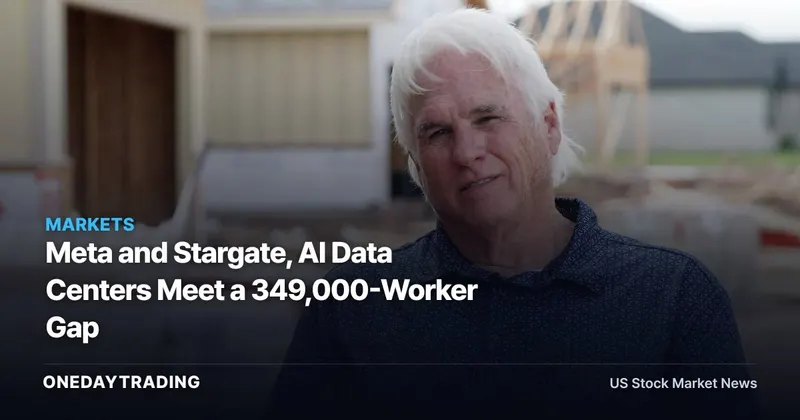
Gene Lantrip called the boom “a two-edged sword.” He said data centers are bringing business and residents to Abilene, while workers have become harder and more expensive to find. His housing activity is busier as new residents arrive, though a smaller labor pool is increasing the cost and time needed to build homes.
This is the investor tension. Construction spending can lift activity around a project, while competition for the same trades can also make execution more difficult for data center developers and unrelated local employers. The fact sheet does not provide project completion dates or company-level construction costs, so the effect cannot be translated into earnings estimates.
Wages Are Pulling Electricians Toward AI Data Centers
Scotty Wristen said some of his electricians left for AI data center work because it offered better pay. He knew of one company that lost 42 guys in one day, a sharp illustration of how quickly a large project can drain an established local workforce.
Wristen said AI data center jobs pay at least triple what he can pay. That comparison explains the recruitment mechanism more clearly than a general labor-shortage label: local contractors must compete against compensation they may be unable to match, and workers have a strong reason to move toward the projects.
The pressure can feed back into construction schedules. A developer that recruits aggressively may staff its own site while weakening the surrounding contractor base; employers that retain workers may face higher labor expense or longer build times. Those are conditional mechanisms, not disclosed financial outcomes, because the precise number of skilled workers missing nationwide is unknown.
Meta, Google and Amazon Are Building a Labor Pipeline
Meta, Google and Amazon are spending millions of dollars on construction-training programs that provide aspiring builders with paid, hands-on experience at data center sites. The programs address the supply side of the constraint by bringing new workers into skilled trades rather than relying only on recruitment from existing employers.
Associated Builders and Contractors (ABC) is partnering with Meta on the $115 million American Workforce Academy. Joel Thames said the program has attracted thousands of people interested in learning a trade and eventually working in data centers.
Training is strategically relevant because higher pay can redistribute workers without increasing the total labor pool. A program that develops additional tradespeople could support more construction capacity, although the fact sheet provides no graduation totals, placement rate or timing for when trainees become fully productive. Investors therefore have evidence of spending and interest, not proof that the labor gap has closed.
The Core Debate: Capacity, Cost and Policy
- Construction capacity: The AI buildout is attracting thousands of workers to Abilene, while the broader industry still needs 349,000 net new workers in 2026 under the Associated Builders and Contractors estimate.
- Local economic trade-off: Gene Lantrip said “the economy of Abilene is great because of the data center,” even as labor becomes more expensive and difficult for local construction employers to secure.
- Workforce development: The Meta partnership creates a route into skilled trades, though the supplied evidence does not establish whether training can expand quickly enough to match project demand.
- Policy uncertainty: Gina Hinojosa has called for a statewide data center moratorium until additional rules are established. The specific restrictions that could apply to future Texas projects are not known.
Company and Sector Read-Through
- Meta: Its planned Hyperion data center in Richland Parish, Louisiana, represents over $50 billion, and its American Workforce Academy targets the construction-labor constraint directly. The evidence supports a large physical buildout and a workforce response, not a conclusion about returns or completion timing.
- OpenAI, Oracle and SoftBank: The $500 billion Stargate Project links these companies to the same competition for skilled construction labor. No allocation of spending, timetable or individual company exposure is supplied.
- Google and Amazon: Both are spending millions of dollars on construction training programs. The fact sheet does not specify program size for either company or connect the spending to a disclosed financial outcome.
- Local construction employers: The Abilene evidence points to worker departures, higher hiring difficulty and longer or more expensive homebuilding. These businesses may gain activity from population inflows while facing a tighter labor pool.
Texas Policy Could Redirect the Workforce
Anita Verma-Lallian, CEO of Arizona Land Consulting, has projects in Texas and Arizona. She expects “going to be some uncertainty” around potential Texas projects because the restrictions remain unknown, and she believes constrained supply could increase urgency around existing developments.
Katie Hobbs was described by Verma-Lallian as fairly moderate on data centers. If Texas construction eventually slows, Verma-Lallian said the labor diaspora “will go to other states or other projects.” That is a possible path rather than a confirmed outcome; the evidence does not establish whether or when construction will slow.
Donald Trump has discussed a “tremendous tax” on American companies building data centers outside the U.S., but neither the amount nor the structure is known. Without those terms, investors cannot assess whether the proposal would alter project location, spending or labor demand.
What Investors Should Monitor Next
- Hiring progress: Compare future construction-worker recruitment with the Associated Builders and Contractors requirement for 349,000 net new workers in 2026.
- Training conversion: Look for enrollment, completion and job-placement evidence from Meta’s American Workforce Academy and the programs supported by Google and Amazon.
- Project execution: Watch for disclosed completion schedules and evidence that labor availability is changing construction time or cost at Stargate and Hyperion.
- Texas rules: Track the terms of any additional restrictions and whether they apply to existing projects, future projects or both.
Outlook: Strong Activity, Unpriced Execution Risk
The constructive case rests on tangible activity: thousands of workers have reached Abilene, temporary housing has expanded, local business has increased, and technology companies are funding training. Those facts show that AI infrastructure investment is reaching the physical economy rather than remaining only a corporate plan.
The risk sits between announced scale and completed capacity. Wage competition is already pulling electricians from local employers, training outcomes are not yet quantified, future Texas rules are unresolved, and the cited projects have no supplied completion dates. The next meaningful signal is whether workforce expansion begins to ease the labor constraint before policy uncertainty or construction delays redirect projects and workers.
📊 Analysis
Signal Neutral
Why AI infrastructure demand supports construction activity, but labor scarcity, higher local costs and unresolved Texas policy rules leave the company-level financial impact uncertain.
This article was independently written by OneDayTrading from public reporting. Read the original (CNBC)