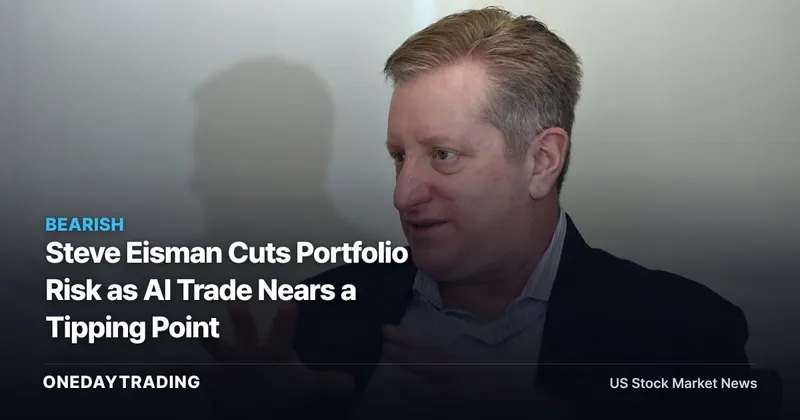
Steve Eisman Reduces Risk Without Shorting the AI Trade
Steve Eisman made his portfolio more conservative as the artificial intelligence trade approached what he called a “tipping point,” CNBC reported on 2026-10-29. He reduced risk without becoming net short, a distinction that matters for investors exposed to Alphabet and the broader AI sector: the signal is caution about the quality and visibility of the underlying economics, not a definitive forecast of a crash.
The sharpest evidence comes from two different parts of the AI business model. Anthropic’s disclosed capital-efficiency measure weakened between quarters, while Google acknowledged that growth in AI mode queries affected the business because those queries carried lower monetization. Together, those facts frame the central investor question: can AI usage translate into revenue efficiently enough to support the resources committed to it?
Anthropic’s Ratio Puts Capital Efficiency Under Scrutiny
CNBC reported that Anthropic’s revenue-to-equipment-expense ratio was 2.08 in the second quarter. The same CNBC account placed Anthropic’s revenue-to-equipment-expense ratio at 1.7 in the third quarter. A revenue-to-equipment-expense ratio compares revenue with equipment expense; in this context, it offers a limited view of how much revenue accompanies the reported equipment cost.
The direction is more informative than an unsupported conclusion. A move from 2.08 to 1.7 means the ratio weakened across the stated periods. If that direction persists, the economic burden attached to equipment could become harder to justify through revenue generation. The ratio alone does not establish profitability, cash generation, demand, or the eventual return on investment, so it should be treated as a warning signal rather than a complete financial diagnosis.
Disclosure quality compounds the concern. Anthropic left its latest revenue figures blank in its initial IPO filing, and metrics for its upcoming quarter were not provided in the available facts. Investors therefore have a capital-efficiency indicator moving in an unfavorable direction without the latest revenue figures needed to test whether that movement reflects a durable deterioration or a temporary mismatch.
Google’s AI Mode Creates a Monetization Test for Alphabet
Alphabet’s stock fell after it reported earnings on Wednesday. Google executives said the same day that they were conducting experiments, while chief business officer Philipp Schindler said growth in AI mode queries had an impact because AI mode produced lower monetization. His statement identifies the business-model tension directly: query growth does not automatically carry the same revenue value when the newer format monetizes less effectively.
For Alphabet investors, usage and monetization must be evaluated separately. Higher engagement with AI mode could expand the role of the product, but lower monetization can weaken the revenue contribution attached to that engagement. The commercial outcome depends on whether Google’s experiments improve monetization without undermining the growth that made the issue financially relevant.
Schindler said, “Our ad experiments have shown promising results.” That is constructive evidence at the experiment stage, not confirmation that the monetization gap has closed. The next meaningful disclosure is whether Google reports that its experiments changed the economics of AI mode, rather than merely demonstrating technical or early commercial promise.
Why Eisman’s Positioning Is Cautious, Not Capitulation
Eisman told CNBC, “I’ve gotten much more conservative in my own portfolio.” He also said he was not net short. Those positions can coexist: reducing exposure or offsetting risk expresses lower confidence in the reward available for taking risk, while avoiding a net-short position acknowledges that the timing and direction of the AI trade remain uncertain.
This distinction prevents an overly simple reading. Eisman did not establish that the AI trade will crash, and the future effect on the broader market and economy is unknown. His phrase “I think we’re getting closer” describes his assessment of proximity to a tipping point, not a measurable threshold or a scheduled event.
The portfolio message is therefore about asymmetry. The known evidence includes weaker reported capital efficiency at Anthropic, incomplete revenue disclosure, lower monetization in Google’s AI mode, and a decline in Alphabet’s stock after earnings. The missing evidence includes Anthropic’s latest revenue figures, its upcoming-quarter metrics, proof that Google’s experiments will improve monetization, and any confirmed outcome for the AI trade.
Alphabet and AI-Sector Read-Through
- Alphabet: The direct issue is the conversion of AI mode query growth into monetization. Lower monetization can dilute the financial value of query growth unless Google’s experiments improve the revenue attached to that activity.
- Anthropic: The reported change from a 2.08 revenue-to-equipment-expense ratio in the second quarter to 1.7 in the third quarter raises a capital-efficiency question. Its blank latest revenue figures prevent a fuller assessment.
- AI sector: The evidence supports scrutiny of revenue conversion and equipment economics rather than a blanket conclusion about the sector. Eisman’s refusal to become net short reinforces that uncertainty.
Bull and Bear Conditions Around the Tipping-Point Thesis
Bull condition: Google’s advertising experiments could improve AI mode monetization, consistent with Schindler’s description of promising results. Clearer revenue disclosure from Anthropic could also show that the weaker ratio does not capture the full trajectory of the business. Either development would challenge the view that today’s warning signs necessarily lead to a broader break in the AI trade.
Bear condition: Continued lower monetization in AI mode would make query growth less valuable to Alphabet’s business. A further weakening in Anthropic’s revenue-to-equipment-expense relationship, paired with incomplete revenue visibility, would deepen concern that equipment expense is not being matched by sufficient revenue.
The evidence does not determine which condition will prevail. It does show why the next phase of AI analysis must be KPI-forensic: usage growth matters only alongside monetization, and revenue growth matters only alongside the equipment expense required to generate it.
Investor Checkpoints After Eisman’s Warning
- Test Google’s experiments against monetization: At the next company disclosure, look for evidence that AI mode’s lower monetization has changed, not simply another statement that experiments are underway.
- Demand complete Anthropic revenue data: Its latest revenue figures are necessary to interpret the reported movement in the revenue-to-equipment-expense ratio.
- Recalculate the same efficiency measure: When upcoming-quarter metrics become available, compare Anthropic’s revenue with equipment expense on the same basis used for the second-quarter 2.08 and third-quarter 1.7 readings.
- Separate risk reduction from a crash call: Eisman’s more conservative portfolio and lack of a net-short position indicate caution under uncertainty, not a confirmed bearish outcome for the market or economy.
Market data check: Alphabet Inc.
Alphabet Inc. last traded near $283.06 (-12.88%). Our composite signal — blending price momentum and news flow — reads 🟡 neutral. Price momentum scores 5/100 (soft).
Data as of publication. Price via market feeds; for reference only, not investment advice.
📊 Analysis
Signal Bearish
Why Lower AI-mode monetization at Google and weakening Anthropic capital efficiency support caution, although Eisman is not net short.
This article was independently written by OneDayTrading from public reporting. Read the original (CNBC)