At a Glance
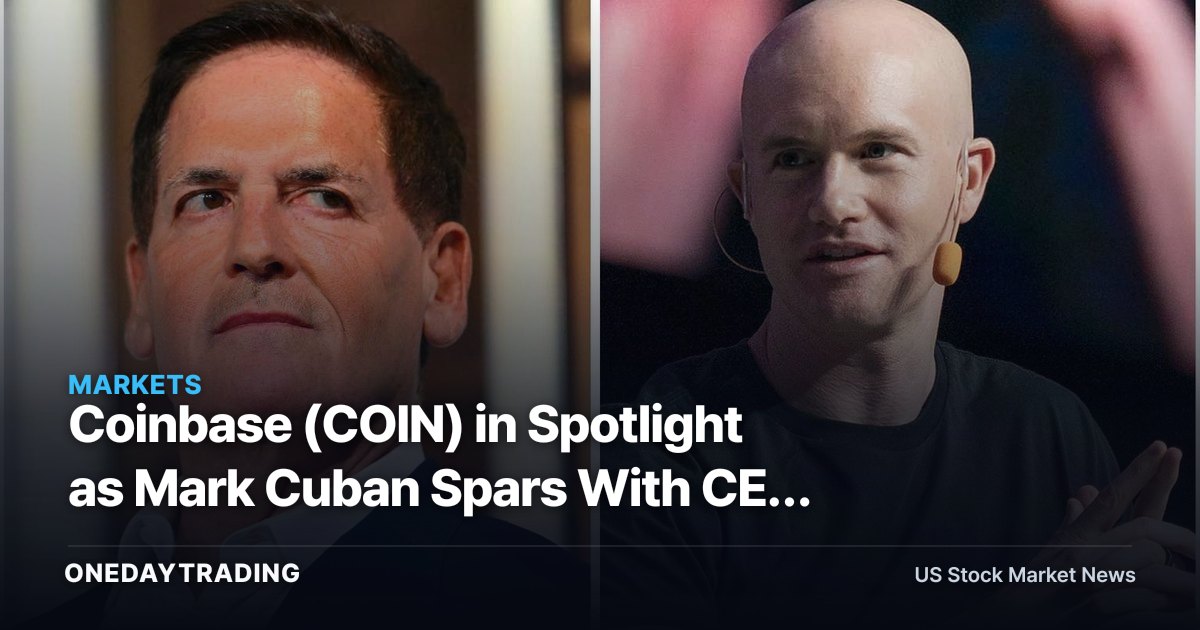
A public exchange of words between investor Mark Cuban and Coinbase chief executive Brian Armstrong has pushed the largest U.S. crypto exchange operator back into the conversation. For investors, the real signal is not the personalities but the strategic debate over how Coinbase should grow, regulate itself, and defend its dominant role in digital-asset trading.
Why It Matters Now
Coinbase remains the most direct way for U.S. equity investors to take a position on crypto market activity without holding tokens directly. Its revenue is heavily tied to transaction volumes, which rise and fall with token prices and trading enthusiasm. When a high-profile figure like Cuban publicly challenges the company's leadership or approach, it reopens scrutiny of fee structure, competitive pressure, and how reliant the business still is on volatile retail trading rather than steadier subscription and custody income.
The exchange has spent recent years trying to diversify into custody, staking, stablecoin-linked revenue, and institutional services to reduce dependence on boom-and-bust trading fees. A war of words does not change fundamentals, but it spotlights the strategic questions that actually drive the stock: can Coinbase keep market share as rivals and lower-cost platforms compete on price, and can it convert crypto enthusiasm into recurring revenue.
FAQ
- Does this directly affect Coinbase earnings? No. A public disagreement is not a financial event; the durable drivers are trading volume, fee rates, and recurring revenue lines.
- Why does Coinbase stock swing so much? Its results track crypto trading activity, so quiet markets compress transaction revenue while rallies amplify it.
- What is Coinbase trying to change? It is pushing into custody, staking, and stablecoin-related income to lean less on cyclical trading fees.
- Who competes with it? Other exchanges and brokerages offering crypto access, several of them on thinner fees.
Related Stocks & Sectors
- Coinbase (COIN) — the subject; most exposed to sentiment around its strategy, fee model, and crypto trading cycles.
- Robinhood (HOOD) — competes for retail crypto flow and benefits when trading activity broadens.
- MicroStrategy (MSTR) — a leveraged proxy for crypto sentiment that often moves with exchange-sector mood.
- Crypto miners (MARA, RIOT) — tied to the same underlying token prices that drive exchange volumes.
What to Watch
- Coinbase's next quarterly results, especially transaction revenue versus subscription and services revenue mix.
- Trading-volume trends and any fee-rate compression from competition.
- Crypto price direction, the strongest swing factor for the whole exchange complex.
- Regulatory and policy headlines affecting U.S. crypto trading rules.
Overall Outlook
The bull case rests on Coinbase converting crypto interest into more durable, recurring revenue while holding its dominant share. The risk case is just as concrete: results remain hostage to volatile trading volumes, fee competition is intensifying, and regulatory uncertainty can reprice the stock quickly. The Cuban-Armstrong exchange is noise; the strategy questions it raises are the substance investors should track.
Market data check: COIN
COIN last traded near $164.92 (-2.57%). Our composite signal — blending price momentum and news flow — reads 🟡 neutral. Price momentum scores 29/100 (soft).
Data as of publication. Price via market feeds; for reference only, not investment advice.
📊 Analysis
Signal Neutral
Why A public disagreement between Cuban and the Coinbase CEO is reputational noise with no described financial impact, so it carries no clear directional catalyst for the stock.
Tickers$COIN$HOOD$MSTR$MARA$RIOT
This article was independently written by OneDayTrading from public reporting. Read the original (Yahoo Finance)