Summary
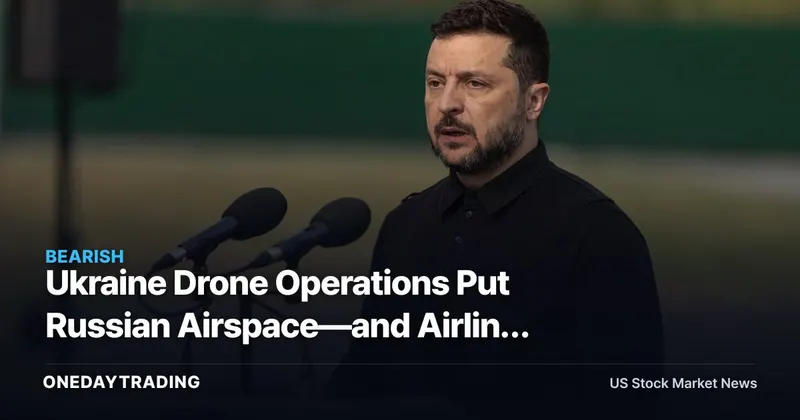
Ukrainian President Volodymyr Zelenskyy urged airlines to avoid Russian airspace after warning that expanding Ukrainian drone operations are making the region’s skies increasingly unsafe. For airline investors, the immediate issue is not a quantified earnings shock but a higher operational-risk premium: carriers may need to alter routes, accept longer flight paths or reassess exposure to corridors that depend on Russian overflight.
The market read-through is therefore concentrated in network planning, fuel consumption and schedule reliability. Without company-specific disclosures, the direction for individual stocks is conditional rather than uniform.
The Full Story
Zelenskyy’s warning changes the framing of Russian airspace from a geopolitical backdrop into an airline operating variable. Drone activity introduces uncertainty over where civil aircraft can safely fly, how quickly advisories change and whether carriers can preserve existing schedules. The commercial consequence is a potential mismatch between a published timetable and the route actually available on departure day.
Airlines that reroute around Russian territory would face longer sectors and potentially higher fuel burn, while aircraft and crew rotations could require additional planning. A carrier with limited network flexibility would have fewer ways to absorb disruption than an operator able to substitute aircraft, alter hubs or redesign connecting itineraries. Those mechanisms matter more than the headline warning itself because they determine whether risk appears as a one-off inconvenience or recurring cost pressure.
Structural Background
Russian airspace is a geographic constraint in international route design, not a product sold by airlines. When a large airspace area becomes harder to use, carriers must balance safety guidance against elapsed flying time, fuel requirements, crew-duty limits and passenger connection windows. That trade-off can compress aircraft utilization even when demand is unchanged.
The source provides no closure date, incident count or financial estimate. Investors should separate the confirmed policy signal—Zelenskyy’s call to avoid Russian airspace—from assumptions about how many routes, carriers or flight hours will ultimately be affected.
Stock & Sector Ripple
- United Airlines (UAL): A broad international network makes route flexibility and connection timing central variables if transcontinental itineraries require detours.
- Delta Air Lines (DAL): Longer routings would place the emphasis on fuel cost per available seat and the ability to protect schedule reliability across connecting flights.
- American Airlines (AAL): Any disruption that forces aircraft or crew reallocation could raise execution risk where daily rotations leave little slack.
- U.S. airline sector: The first read-through is operational rather than demand-led; costs rise only if rerouting becomes persistent or materially lengthens flights.
Bull vs Bear Scenarios
The bullish case for airline shares is that the warning remains precautionary, carriers avoid affected corridors without broad cancellations and incremental costs stay manageable. Clearer aviation guidance would reduce planning uncertainty and allow networks to normalize around safer routes.
The bearish case is a widening drone operating area, repeated airspace closures or rapidly changing restrictions. Longer flights would increase fuel exposure and reduce aircraft productivity, while missed connections and schedule changes could raise compensation and rebooking costs. Valuations would be vulnerable if investors began pricing a prolonged capacity drag rather than a temporary reroute.
Investor Action Points
- Track airline filings and earnings calls for route suspensions, detour mileage, fuel-burn commentary and changes to international capacity.
- Watch official aviation notices for the geographic scope and duration of restrictions, rather than extrapolating from the presidential warning alone.
- Compare schedule reliability and aircraft utilization in the next reported quarter; those metrics will show whether the issue is operationally contained.
- Monitor whether carriers disclose incremental fuel, crew or rebooking costs before treating the event as an earnings thesis.
FAQ
Why did Zelenskyy tell airlines to avoid Russian airspace?
Ukrainian President Volodymyr Zelenskyy said expanding Ukrainian drone operations are making Russian skies increasingly unsafe. His warning is a safety and route-planning signal, not a disclosed estimate of airline losses.
What does avoiding Russian airspace mean for airline costs?
Airlines that detour around Russia could fly longer routes, which raises fuel consumption and can complicate crew, aircraft and passenger connections. The source does not quantify the impact, so the cost depends on each carrier’s affected routes and ability to redesign schedules.
Which airline stocks are most exposed to this airspace risk?
United Airlines (UAL), Delta Air Lines (DAL) and American Airlines (AAL) are relevant U.S.-listed names because international network operations would bear any rerouting burden. Actual exposure requires company disclosures identifying affected corridors and incremental operating costs.
Market data check: UAL
UAL last traded near $104.86 (+0.22%). Our composite signal — blending price momentum and news flow — reads 🟡 neutral. Price momentum scores 52/100.
Data as of publication. Price via market feeds; for reference only, not investment advice.
📊 Analysis
Signal Bearish
Why The warning introduces potential route, fuel and schedule costs for airlines, although the financial impact is not yet quantified.
This article was independently written by OneDayTrading from public reporting. Read the original (CNBC)