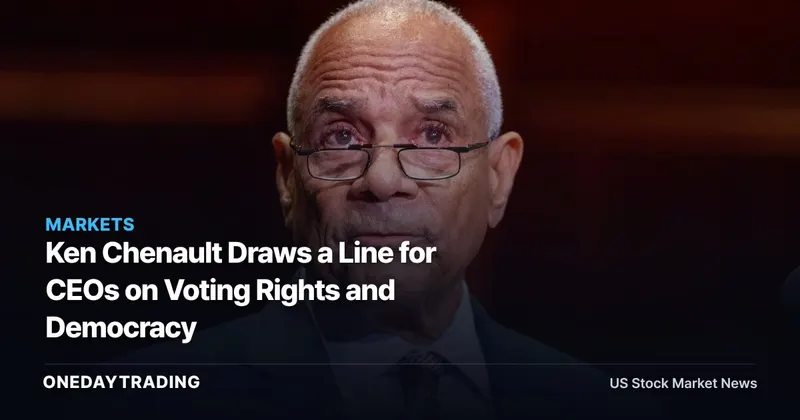
What Ken Chenault’s Argument Changes
Ken Chenault’s intervention puts voting rights inside the long-term governance conversation for American business. CNBC published the account on 2026-11-03, reporting that the former American Express chief views threats to democratic processes as issues on which business leaders may need to speak publicly.
Corporate political speech, in this context, means a chief executive publicly addressing a civic or political issue that may not have an obvious or immediate effect on the company. Chenault did not endorse routine CEO commentary on every controversy. He drew a boundary around fundamental matters, identifying voting rights and the integrity of democratic processes as concerns that can extend beyond a single industry.
The investable read-through is therefore conditional. A public position can become relevant to investors when it changes how customers, employees or other stakeholders view a company, although the fact sheet supplies no evidence that such a change occurred here. Silence can also carry stakeholder implications when a company’s leadership believes a basic institutional issue is at stake. Neither pathway is quantified in the available reporting.
Chenault summarized his long-horizon test by telling CNBC, “If you want to build an enduring company, you should care about what happens in our society.” That statement is an argument about leadership judgment, not a forecast for revenue, costs, capital returns or valuation.
Chenault’s American Express Record Frames the Message
Ken Chenault left American Express in 2018 after 37 years at the company, including nearly 17 years as chief executive, according to CNBC. His tenure gives the comments the perspective of a former financial-services operator, while his current role as chairman and managing director of General Catalyst places him outside American Express management.
American Express appointed Ken Chenault CEO in 2001, making him one of the first few Black chief executives of a Fortune 500 company. That history is directly relevant to his focus on voting access: his position connects corporate leadership with what he described as the particular history of denying Black Americans the right to vote.
His record also shows that the threshold was not limited to issues without an immediate business connection. Following the 2008 financial crisis, Chenault publicly acknowledged that the financial industry needed to adapt to additional regulatory oversight. That episode involved a direct industry concern; his present argument extends the leadership test to certain foundational civic issues.
Voting Rights Are the Specific Test Case
In March 2021, Ken Chenault and former Merck CEO Ken Frazier urged corporate leaders to oppose political efforts restricting voting access. Chenault’s March 31, 2021 statement to CNBC was categorical: “Corporations have to stand up. There is no middle ground.”
The current remarks apply that principle to acceptance of election results. CNBC cited an Oct. 27 report from The Washington Post stating that Donald Trump declined to promise unconditional acceptance and instead said he would accept the results “if they’re honest elections.” The year attached to that Oct. 27 report is not specified in the fact sheet, so it should not be inferred.
Chenault said he would not remain quiet if an upcoming election were threatened or its verdict rejected. He described preservation of democracy and the fundamental right to vote as the underlying standard. The remarks address the conduct expected of corporate leaders; they do not establish that American Express or General Catalyst has adopted a new policy.
The Evidence Shows a Real Leadership Trade-Off
A 2025 study by Ivy League researchers found that the average person generally prefers CEOs to remain silent on divisive political issues, CNBC reported. The researchers’ names and the study title are not provided, limiting how far its finding can be evaluated from the available material.
That preference creates the central tension. Speaking can associate a company with a disputed political position, while staying silent can conflict with a leader’s stated view that voting rights are fundamental. Chenault’s answer is selectivity: reserve the corporate voice for issues that meet a high institutional threshold instead of treating every political matter as a business mandate.
Layna Mosley of Princeton University supplied a related business framework in a July 2023 report published through The Brookings Institution and States United Democracy Center. The report concerned democratic erosion and business, providing context for why executives may treat institutional stability as relevant even when the near-term company effect is not measurable.
The investor discipline is to separate that framework from company-specific evidence. The reporting contains no quantified effect on American Express, Merck, General Catalyst or Patagonia, and it supplies no basis for estimating sales, expenses, capital deployment or share-price direction.
Evidence-Supported Company Read-Throughs
- American Express: Chenault’s 37-year history and nearly 17-year chief-executive tenure make the company central to his leadership credentials. He stepped down in 2018, and the evidence does not attribute his current remarks to American Express or identify a present corporate action.
- General Catalyst: Chenault now serves as chairman and managing director. The fact sheet establishes that role, not a financial or operational consequence for the firm.
- Merck: Former CEO Ken Frazier joined Chenault’s March 2021 appeal concerning voting access. No current Merck policy, performance effect or market outcome is stated.
- Patagonia: The company appears as an example in the broader discussion of businesses and politics. No quantified result or direct connection to Chenault’s remarks is supplied.
Risk Check for Investors and Boards
- Mandate risk: Chenault’s view is personal leadership guidance, not evidence of a decision by American Express, General Catalyst, Merck or Patagonia.
- Stakeholder risk: The 2025 study indicates a general preference for CEO silence on divisive issues, creating a counterweight to public advocacy.
- Measurement risk: No revenue effect, cost impact, valuation response, market price or future business outcome is quantified.
- Attribution risk: The exact date of Chenault’s Monday interview is absent from the article body, and the year of The Washington Post’s Oct. 27 report is unspecified.
The Next Checkpoint After Chenault’s Remarks
The practical checkpoint is the next observable corporate response to a voting-rights or democratic-process dispute. Investors can then examine whether a serving chief executive speaks, whether the company itself adopts a position, and whether any subsequent filing or company disclosure identifies a financial consequence.
Until such evidence appears, the balanced conclusion is narrow. Chenault has articulated a selective standard for CEO involvement in politics, backed by his experience leading American Express and his earlier work with Ken Frazier. The potential upside is clearer leadership on an issue he considers fundamental; the risk is stakeholder division in an environment where the cited 2025 research found a general preference for silence. For American Express investors, this remains governance context rather than a directional stock catalyst.
Market data check: American Express Company
American Express Company last traded near $326.09 (-0.58%). Our composite signal — blending price momentum and news flow — reads 🟡 neutral. Price momentum scores 45/100.
Data as of publication. Price via market feeds; for reference only, not investment advice.
📊 Analysis
Signal Neutral
Why Chenault’s remarks frame a governance issue for corporate leaders, but no financial impact, market pricing effect or future business outcome is quantified.
This article was independently written by OneDayTrading from public reporting. Read the original (CNBC)