Summary
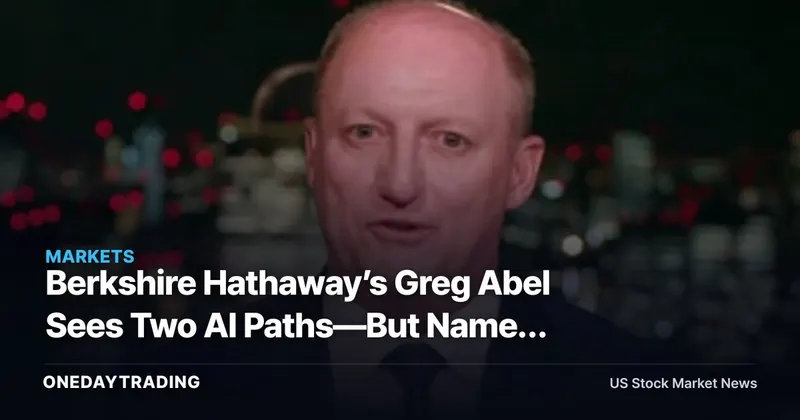
Berkshire Hathaway CEO Greg Abel told CNBC that the company is pursuing artificial-intelligence opportunities along two paths, making AI a stated strategic theme for the conglomerate. The report does not identify either path, the targeted businesses, the investment size or a timetable, so the immediate signal is strategic intent rather than a measurable earnings catalyst.
For Berkshire Hathaway shareholders, the key question is whether AI becomes an incremental source of operating income or simply another area for capital allocation. Until Abel provides specifics, the stock’s read-through is more about governance and discipline than near-term revenue.
The Full Story
What does Greg Abel’s AI comment mean for Berkshire Hathaway investors? It means Berkshire Hathaway is examining artificial intelligence through two separate avenues, but the available report supplies no operating metrics with which to value them. That gap matters because Berkshire combines insurance, industrial, consumer and investment businesses whose exposure to AI would carry very different economics.
Abel, Berkshire Hathaway’s chief executive, disclosed the two-track approach in comments to CNBC. The statement establishes that AI has entered the company’s opportunity set; it does not establish a transaction, partnership, product launch, forecast change or commitment of shareholder capital.
Investors should therefore separate what the market can price today from what remains unquantified. The confirmed fact is strategic attention. Unconfirmed variables include whether Berkshire will buy an AI company, deploy AI inside existing operations, finance infrastructure, or pursue another route; none of those details appeared in the source.
Structural Background
Berkshire Hathaway’s structure makes AI analysis unusually dependent on business mix. An internal software deployment could affect productivity and claims processing without creating a new reportable revenue stream, while an acquisition would introduce purchase-price, integration and valuation risk. A minority investment would create a different exposure again, with returns tied to the investee rather than Berkshire’s operating margins.
That distinction is especially important for a conglomerate whose balance sheet and capital-allocation record often matter more than a single technology narrative. Without figures for spending, savings, revenue or returns, investors cannot yet translate the announcement into a revised intrinsic-value estimate.
Stock & Sector Ripple
- Berkshire Hathaway (BRK-B): The direct impact is a modest strategic-positive signal, but no earnings estimate changes without a defined project, dollar commitment or guidance.
- AI infrastructure suppliers: A future Berkshire project could create demand, yet the report names no vendor, facility or hardware order, so supplier read-through is presently speculative.
- Insurance and industrial operations: Internal AI adoption could lower administrative or underwriting costs, but Berkshire has disclosed no use case or quantified efficiency target.
- Financials: The announcement reinforces the importance of capital allocation and governance for diversified financial companies, rather than changing sector fundamentals.
Bull vs Bear Scenarios
The bull case is disciplined deployment: Berkshire uses its scale, data and cash-generation capacity to improve existing businesses or secure attractive AI-linked returns without overpaying. In that scenario, AI becomes an operating or investment advantage that compounds across the portfolio.
The bear case is narrative outrunning economics. AI assets may command high valuations, internal projects may take time to monetize, and an unspecified two-path strategy gives investors no basis for judging return on capital. The absence of a disclosed amount or timetable keeps execution risk high.
Investor Action Points
- Track Berkshire’s next shareholder communication for the identity of the two AI paths.
- Look for disclosed capital commitments, acquisition terms or operating-cost targets before revising valuation assumptions.
- Compare any AI initiative with Berkshire’s established hurdle for disciplined capital allocation.
- Watch whether future guidance links AI to revenue, margins, productivity or investment returns.
FAQ
Why is Berkshire Hathaway pursuing AI?
Greg Abel said Berkshire Hathaway is pursuing AI opportunities on two paths, according to CNBC. The report did not explain whether the paths involve internal deployment, investments, acquisitions or another structure.
What are Berkshire Hathaway’s two AI paths?
The source confirms that two paths exist but does not name or describe them. Investors need a subsequent company disclosure before assigning different revenue, cost or valuation assumptions to each path.
Will Berkshire Hathaway stock rise because of the AI strategy?
The announcement alone does not provide a quantified earnings catalyst for BRK-B. A durable stock impact would require evidence such as committed capital, measurable savings, AI-related revenue or returns above Berkshire’s investment hurdle.
Market data check: BRK-B
BRK-B last traded near $506.03 (-0.41%). Our composite signal — blending price momentum and news flow — reads 🟡 neutral. Price momentum scores 47/100.
Data as of publication. Price via market feeds; for reference only, not investment advice.
📊 Analysis
Signal Neutral
Why Greg Abel’s two-path AI strategy is strategically positive but lacks the disclosed projects, capital figures or financial metrics needed to establish a directional earnings impact.
This article was independently written by OneDayTrading from public reporting. Read the original (CNBC)