What Changes
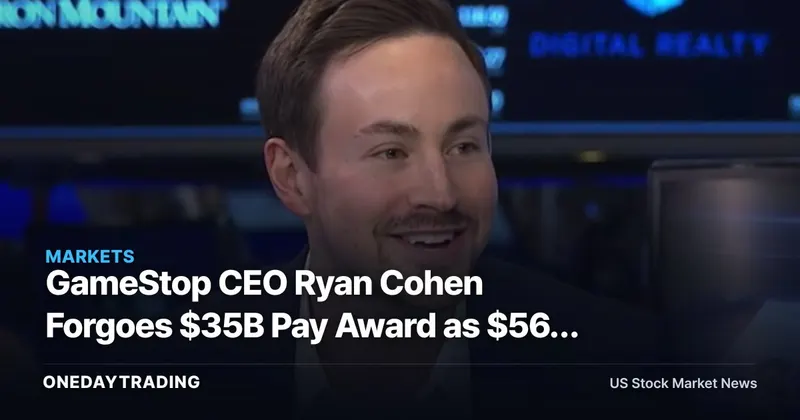
The headline figure investors should anchor on is dilution. A $35 billion equity-linked award is enormous relative to GameStop's market value, and granting it would have meaningfully expanded the share count over time. By walking away from it, Cohen reduces a structural risk that long-term GME holders have flagged: that founder-aligned compensation could erode per-share value even if the underlying business stabilizes.
The decision also reframes the eBay storyline. Cohen has positioned himself as a capital allocator first and a retailer second, using GameStop's balance sheet and convertible raises to build a cash war chest. An ambition the size of a $56 billion bid for eBay only makes sense through that lens — GameStop's legacy mall-based game retail does not generate the cash flow to fund such a deal organically, so any move would lean on equity, debt, or the existing cash position.
For eBay, the dynamic is different. eBay is a profitable marketplace with recurring take-rate revenue from gross merchandise volume, advertising, and managed payments. A rejected approach can put a stock in play, inviting speculation about whether a higher bid, an activist push, or a strategic review follows.
By the Numbers
Three figures define the situation: the roughly $35 billion pay package Cohen gave up, the $56 billion price tag attached to his eBay proposal, and the May rejection date that started the clock. The gap between GameStop's retail fundamentals and a $56 billion ambition underscores that this is a balance-sheet and deal-making story, not an operating-results story.
Winners & Losers
- GME — Mixed-to-positive: forgoing the $35 billion award removes a dilution overhang, but the lack of clarity on the eBay path keeps event risk elevated.
- EBAY — Potentially positive: a public takeover interest, even if rejected, can support a valuation floor and draw deal speculation around its marketplace cash flows.
- Marketplace and payments peers — Indirect read-through: any premium framing for eBay's GMV-based model can shift how investors value comparable transaction platforms.
Risk Check
- No confirmed financing structure for a $56 billion deal; funding via equity or debt could pressure GME.
- eBay has already said no — there is no certainty a transaction ever happens.
- GameStop's core retail revenue continues to face secular decline in physical game sales.
- Headline-driven moves in GME can decouple from fundamentals, raising volatility for both longs and shorts.
Bottom Line
Cohen surrendering a $35 billion package strengthens the alignment argument and trims dilution risk, which is a genuine positive for patient GME holders, but it does nothing to clarify whether a $56 billion eBay deal is financeable or even likely after May's rejection — making this a capital-allocation signal to track, not a thesis to underwrite.
Market data check: GME
GME last traded near $21.03 (-1.91%). Our composite signal — blending price momentum and news flow — reads 🟡 neutral. Price momentum scores 35/100 (soft).
Data as of publication. Price via market feeds; for reference only, not investment advice.
📊 Analysis
Signal Neutral
Why Removing the $35B dilution overhang is positive for GME, but the rejected $56B eBay bid remains unfunded and unresolved, leaving no clear directional catalyst.
This article was independently written by OneDayTrading from public reporting. Read the original (CNBC)