At a Glance
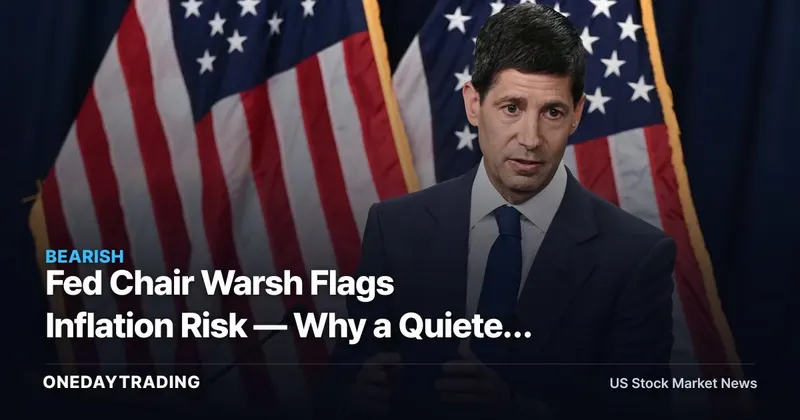
Fed Chair Warsh and U.S. equity markets face a communication test: per CNBC Markets, Warsh expressed concern about inflation, outlined a preference for a quieter central bank, and avoided giving investors a fresh rate signal during the speech.
The investor read-through is not a new policy promise; the read-through is a Fed chair trying to reduce market dependence on every phrase while keeping inflation risk in the foreground.
Why It Matters Now
A quieter Fed means fewer verbal guardrails for stocks, bonds and the dollar. If Warsh speaks less often or less explicitly about policy direction, U.S. Treasury yields will lean harder on incoming inflation data, labor reports and actual Federal Reserve decisions.
Inflation concern matters because equity multiples are rate-sensitive. Growth stocks and long-duration technology shares benefit when investors expect easier money, while banks, insurers and value sectors often hold up better when higher nominal rates support interest income or discount-rate assumptions.
Federal Reserve communication is the channel through which policymakers shape expectations before formal votes; a quieter central bank reduces that guidance channel and forces markets to price probability from economic data rather than speeches.
Key Debates
- Inflation risk versus rate clarity: Warsh raised inflation concern but avoided a direct policy signal, so the market receives a risk warning without a trading map.
- Communication premium: A quieter Fed can lower noise, but less guidance can raise volatility around CPI, payrolls and Federal Reserve meeting dates.
- Multiple pressure: If inflation stays sticky, higher expected rates compress the present value of future earnings, especially for growth-heavy sectors.
- Credibility trade-off: Restraint can strengthen institutional discipline, but investors may punish ambiguity when data move against consensus.
Related Stocks & Sectors
- Large-cap technology: Microsoft, Nvidia, Apple and other duration-sensitive leaders face valuation pressure when inflation concern lifts expected discount rates.
- Banks: JPMorgan Chase and Bank of America can benefit from higher-rate expectations through net interest income, though credit costs can offset that advantage if policy stays tight.
- Real estate and REITs: Rate-sensitive property stocks usually suffer when inflation concern pushes financing costs higher.
- Consumer discretionary: Retail and travel shares depend on household spending, which weakens if inflation and borrowing costs pressure consumers.
What to Watch
- Next CPI release: Inflation data will carry more weight if Warsh’s Federal Reserve gives fewer policy hints between meetings.
- FOMC statement language: Investors should compare formal Federal Reserve text with Warsh’s quieter-communication philosophy.
- Treasury yield reaction: The 10-year yield is the cleanest market test of whether inflation concern is being priced into equities.
- Sector leadership: A rotation from growth toward banks, energy or defensive value would show investors are pricing a higher-rate path.
Overall Outlook
The market impact is mildly bearish for rate-sensitive equities because Warsh’s inflation concern keeps the burden of proof on disinflation. The countercase is that a quieter Fed reduces headline-driven overreaction and lets stocks rally if incoming data confirm inflation is cooling.
The next real catalyst is not another adjective from the Fed chair. The next catalyst is whether inflation data validate Warsh’s concern or give investors enough evidence to price easier policy despite quieter guidance.
FAQ
Why does Fed Chair Warsh’s inflation concern matter for stocks?
Fed Chair Warsh’s inflation concern matters for stocks because inflation shapes expected interest rates, and expected interest rates shape equity valuation multiples. Growth stocks are most exposed when investors raise discount rates.
What does a quieter Federal Reserve mean for investors?
A quieter Federal Reserve means investors receive fewer informal signals before official policy decisions. Markets then react more sharply to inflation reports, employment data and FOMC statements.
Which sectors are most exposed to a higher-rate Fed stance?
Technology, real estate and consumer discretionary stocks are most exposed when higher-rate expectations pressure valuations and borrowing costs. Banks can benefit from higher rates, but credit risk becomes the offset if tighter policy slows the economy.
📊 Analysis
Signal Bearish
Why Warsh’s inflation concern keeps higher-rate risk alive for equity multiples even though the speech avoided a direct policy signal.
Tickers$MSFT$NVDA$AAPL$JPM$BAC
This article was independently written by OneDayTrading from public reporting. Read the original (CNBC Markets)