Key Takeaways
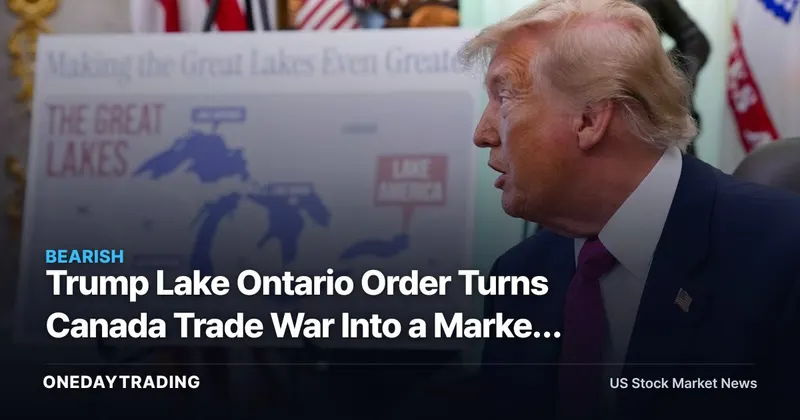
Trump Lake Ontario Lake America order matters for investors because President Donald Trump used an executive order, per CNBC, to add a sovereignty symbol to the Canada trade war rather than a tariff number. The tape can ignore a name change; the tape cannot ignore a higher probability of policy escalation between the U.S. and Canada.
The market read-through is bearish for Canada-exposed trade, industrial supply chains and cross-border consumer demand if the executive order hardens negotiating positions. The counter-case is simple: if the order stays symbolic and no new duties, quotas or retaliation follow, equity impact stays limited.
What Happened
President Donald Trump signed an executive order that he said would immediately change the name of Lake Ontario to Lake America, according to CNBC reporting on the Canada trade war. Lake Ontario is the named asset in the order, and Canada is the named counterparty in the trade conflict described by CNBC.
A trade war is a policy fight in which governments use tariffs, restrictions or retaliation to pressure another country, and the market channel runs through import costs, export demand and corporate margin risk. In this case, CNBC reported a political action inside an active U.S.-Canada trade dispute, not a new tariff rate or company earnings event.
Background & Context
The important market distinction is between symbolism and enforceable economics. A renamed lake does not change cash flow by itself, but an executive order tied to a trade war can change investor assumptions about how willing the White House is to keep pressure on Canada.
Markets usually price the measurable first: tariff rates, retaliation lists, customs delays and earnings guidance. The unpriced risk is second-order: Canadian officials respond politically, negotiations slow, and companies with cross-border revenue or inputs face a longer policy overhang.
Market & Stock Impact
- U.S.-Canada industrial trade: Industrial companies suffer if a symbolic order raises the odds of harder trade barriers, because factory supply chains rely on predictable cross-border movement and stable input costs.
- Autos and parts: Auto manufacturers and suppliers are exposed when U.S.-Canada trade tensions threaten parts flow, because vehicle production depends on repeated border crossings before final assembly.
- Materials and commodities: Materials producers face headline risk if the Canada trade war expands into resource-linked policy, because metals, lumber and energy-linked inputs are sensitive to border rules.
- Consumer goods: Retailers and food companies face margin pressure if tariffs or retaliation follow the order, because import costs either hit gross margin or pass through to shoppers.
- Macro-sensitive equities: Broad equity multiples absorb less policy risk when trade uncertainty rises, because investors demand a higher discount for earnings exposed to Washington and Ottawa decisions.
Investor Checkpoints
- Track whether the executive order produces only naming changes or is followed by tariff, customs or sanctions action in the U.S.-Canada trade war.
- Watch Canadian government responses after the CNBC-reported order, because retaliation risk is the mechanism that turns symbolism into earnings risk.
- Check the next earnings calls from U.S. companies with Canada revenue, suppliers or plants for mentions of border friction, input costs and guidance buffers.
- Monitor rates and the dollar if trade rhetoric escalates, because policy uncertainty can tighten financial conditions even before tariffs hit invoices.
Outlook
The bearish case is not that Lake Ontario becomes Lake America on a map; the bearish case is that the order signals a negotiating style that keeps the Canada trade war alive long enough to enter corporate guidance. If no enforceable trade action follows CNBC’s reported executive order, investors should fade the symbolism and focus back on tariff schedules, retaliation dates and earnings revisions.
FAQ
Why did Trump rename Lake Ontario Lake America?
President Donald Trump signed an executive order to immediately change the name of Lake Ontario to Lake America, according to CNBC. CNBC framed the order as occurring amid the Canada trade war, which makes the investor issue policy escalation rather than geography.
What does the Lake America order mean for stocks?
The Lake America order has no direct earnings math in CNBC’s reported facts because no tariff rate, company charge or revenue figure was reported. The stock-market risk comes if the order raises the probability of U.S.-Canada retaliation that affects industrials, autos, materials or consumer goods.
Which sectors are exposed to the Canada trade war?
U.S.-Canada trade-war exposure is highest in sectors that depend on cross-border supply chains, including industrials, autos, materials and consumer goods. Investors should separate symbolic actions from enforceable policy before assigning a multiple or margin impact.
📊 Analysis
Signal Bearish
Why The order is not an earnings event by itself, but it raises policy-escalation risk in the Canada trade war without adding a measurable offsetting benefit for exposed sectors.
This article was independently written by OneDayTrading from public reporting. Read the original (CNBC)