Key Takeaways
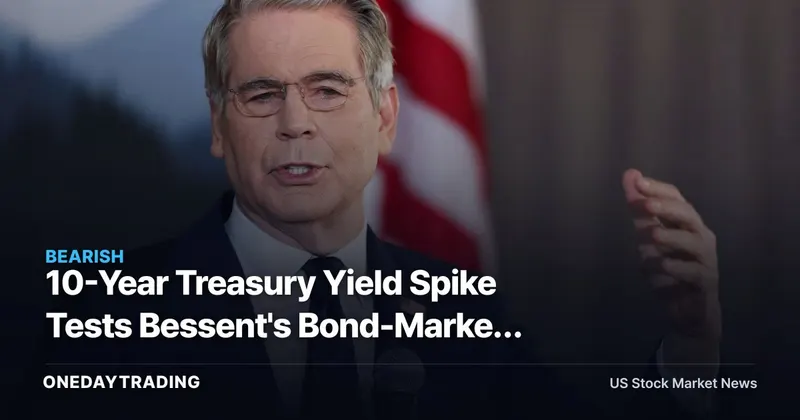
10-year Treasury yield spike is the real signal for investors: Treasury Secretary Scott Bessent used the bond-market move to defend confidence in the U.S. market, but higher long-end yields still pressure equity multiples, housing demand and long-duration growth stocks.
The source's CNBC report says Scott Bessent downplayed short-term bond moves and argued that what happens over a month does not matter, which frames the tension between policy messaging and market pricing.
What Happened
CNBC reported that Treasury Secretary Scott Bessent touted the U.S. bond market even as the 10-year Treasury yield spiked. The 10-year Treasury yield is the benchmark borrowing rate investors use to discount future cash flows, price mortgages and compare equities with risk-free income.
Bessent's point was not that yields are irrelevant. Bessent's point, per the source's reporting, was that a one-month bond move should not define confidence in the U.S. market.
The tape hears that differently. A higher 10-year yield mechanically lifts the discount rate applied to future earnings, so the first pressure usually lands on expensive growth equities, homebuilders and other rate-sensitive assets before it shows up in reported earnings.
Background & Context
The bond market matters because the 10-year Treasury yield sits between Federal Reserve expectations and private-sector financing costs. When the 10-year Treasury yield rises, the market is either demanding more compensation for inflation, fiscal supply, growth uncertainty or some combination of those risks.
Bessent's message tries to separate market depth from market discomfort. The U.S. Treasury market can remain the world's core liquidity venue while still forcing investors to mark down equity valuations when yields rise quickly.
Market & Stock Impact
- Banks: Higher long-term yields can help net interest income when deposit costs lag, but the benefit fades if the same yield move tightens credit conditions or weakens loan demand.
- Homebuilders: A 10-year Treasury yield spike feeds mortgage-rate expectations, which can pressure affordability and slow order momentum even before builders report cancellations.
- Software and internet growth: Long-duration earnings streams lose valuation support when the risk-free rate rises, so high-multiple names are more exposed than cash-generating platforms.
- Dividend and utility stocks: Higher Treasury income raises the hurdle rate for bond-proxy equities, making payout durability and balance-sheet leverage more important.
- Energy and industrials: Cyclical stocks can hold up if yields rise on stronger growth, but they weaken if the move reflects financing stress rather than demand.
Investor Checkpoints
- Track whether the 10-year Treasury yield spike extends beyond the one-month window Bessent dismissed in the CNBC report.
- Watch equity leadership: banks outperforming growth would imply a rate-led rotation, while broad weakness would point to multiple compression.
- Check mortgage-sensitive data and builder commentary at the next earnings updates for evidence that higher yields are hitting demand.
- Use the next Federal Reserve communication and inflation data as the test of whether bond volatility is policy noise or a new discount-rate regime.
Outlook
The bullish case is that Bessent is right on market structure: a short burst in the 10-year Treasury yield does not undermine the U.S. bond market's role, and equities can absorb higher yields if earnings growth broadens. The bearish case is narrower and more immediate: if the 10-year Treasury yield spike persists, multiples reprice before fundamentals have time to prove resilient.
FAQ
Why did the 10-year Treasury yield spike matter for stocks?
The 10-year Treasury yield spike matters for stocks because the 10-year rate anchors the discount rate investors apply to corporate earnings. Higher 10-year Treasury yields usually pressure high-multiple equities first because more of their value depends on future cash flows.
What did Scott Bessent say about the bond market?
Scott Bessent downplayed short-term bond moves in CNBC's report and said a one-month move does not matter. Scott Bessent also touted the U.S. market, which signals confidence in market depth rather than a guarantee that equity valuations will ignore higher rates.
Which sectors are most exposed to a 10-year Treasury yield spike?
Rate-sensitive sectors such as banks, homebuilders, utilities and long-duration growth stocks are most exposed to a 10-year Treasury yield spike. The direction depends on the channel: stronger growth can support cyclicals, while tighter financial conditions can compress valuations across sectors.
📊 Analysis
Signal Bearish
Why A 10-year Treasury yield spike raises discount rates and pressures rate-sensitive equity valuations, even if Bessent argues the short-term move does not define the bond market.
This article was independently written by OneDayTrading from public reporting. Read the original (CNBC)