At a Glance
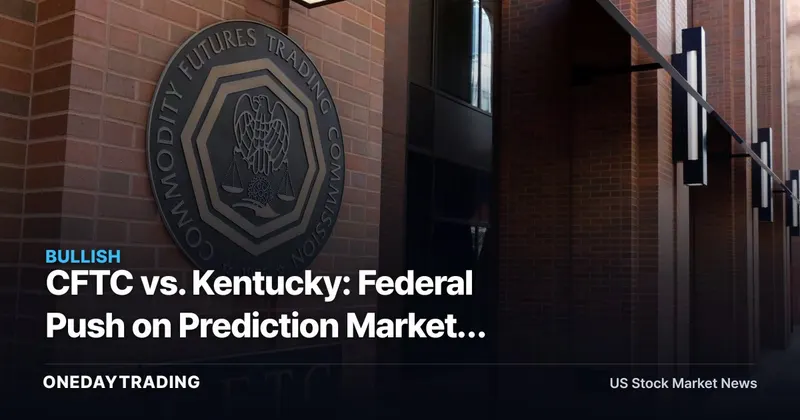
The Commodity Futures Trading Commission has sued Kentucky, marking the ninth state it has taken to court and the first Republican-led state in its campaign to assert exclusive federal authority over event contracts. The legal thrust matters because it pushes prediction markets toward a single national regulatory lane rather than 50 state regimes — a structural advantage for federally registered platforms and a threat to state-licensed sports betting.
Why It Matters Now
The core dispute is jurisdictional: the CFTC argues that event contracts, including sports-outcome and political-outcome wagers offered through registered exchanges, fall under the Commodity Exchange Act and therefore preempt state gaming law. If federal preemption holds across all nine cases, platforms that distribute these contracts can operate nationwide under one rulebook, sidestepping the patchwork of state licenses, taxes and exclusivity deals that govern legal sportsbooks.
That asymmetry is the investment story. Brokerages and trading apps that have added event contracts gain access to states where traditional sports betting is illegal or heavily taxed, expanding their addressable market at near-zero incremental regulatory cost. Conversely, incumbent operators that paid for state licenses and built businesses around state-by-state rollouts face a rival channel that may reach customers they cannot, while bypassing the tax rates they shoulder.
The expansion to a red state is the signal worth noting. Earlier challenges clustered in Democratic-led states; extending enforcement to Kentucky suggests the agency intends to standardize its stance regardless of state politics, raising the odds of a consistent — and ultimately court-tested — national framework.
FAQ
- What is the CFTC actually claiming? That it holds exclusive authority to regulate event contracts under federal commodities law, overriding state attempts to block or restrict prediction markets.
- How many states are involved? Nine in total, with Kentucky the first Republican-led state named.
- Why do brokerages care? Federal preemption would let registered platforms offer event contracts across state lines without separate state gaming licenses.
- What is the risk to sports betting firms? Prediction markets can offer economically similar products nationally while avoiding state taxes and exclusivity costs.
Related Stocks & Sectors
- Robinhood (HOOD) — has rolled out event-contract trading; a federal-preemption outcome widens its national reach and adds a new transaction-fee revenue stream.
- DraftKings (DKNG) — state-licensed sportsbook model is directly exposed to competition from lower-cost, federally framed prediction markets.
- Flutter Entertainment (FLUT) — owner of FanDuel faces the same competitive and tax-asymmetry pressure as DraftKings.
- Interactive Brokers (IBKR) — has distributed event contracts and benefits from regulatory clarity favoring registered exchanges.
- Online gaming and brokerage sectors — the ruling reshapes where wagering-style products can legally flow.
What to Watch
- Court rulings or injunctions in the nine state cases — early decisions will set the preemption precedent.
- Whether more states, red or blue, are added to the docket.
- Event-contract volume and revenue disclosures in upcoming HOOD and IBKR earnings.
- Any commentary from DKNG and FLUT management on prediction-market competition and tax exposure.
Overall Outlook
The bull case for trading platforms rests on a clean federal-preemption win that unlocks a national market without state gaming friction. The risk is that this is litigation, not law: courts could side with states, Congress could intervene, or a split across jurisdictions could prolong uncertainty for years. Sports betting incumbents are not without defense — brand, liquidity and live-odds infrastructure remain hard to replicate — but the regulatory boundary between a wager and a contract is now squarely in front of the courts, and the answer will redraw the competitive map for both camps.
Market data check: HOOD
HOOD last traded near $103.1 (-2.47%). Our composite signal — blending price momentum and news flow — reads 🟡 neutral. Price momentum scores 30/100 (soft).
Data as of publication. Price via market feeds; for reference only, not investment advice.
📊 Analysis
Signal Bullish
Why Federal preemption of event-contract regulation favors registered prediction-market platforms like Robinhood, expanding their addressable market.
Tickers$HOOD$DKNG$FLUT$IBKR
This article was independently written by OneDayTrading from public reporting. Read the original (CNBC)