Summary
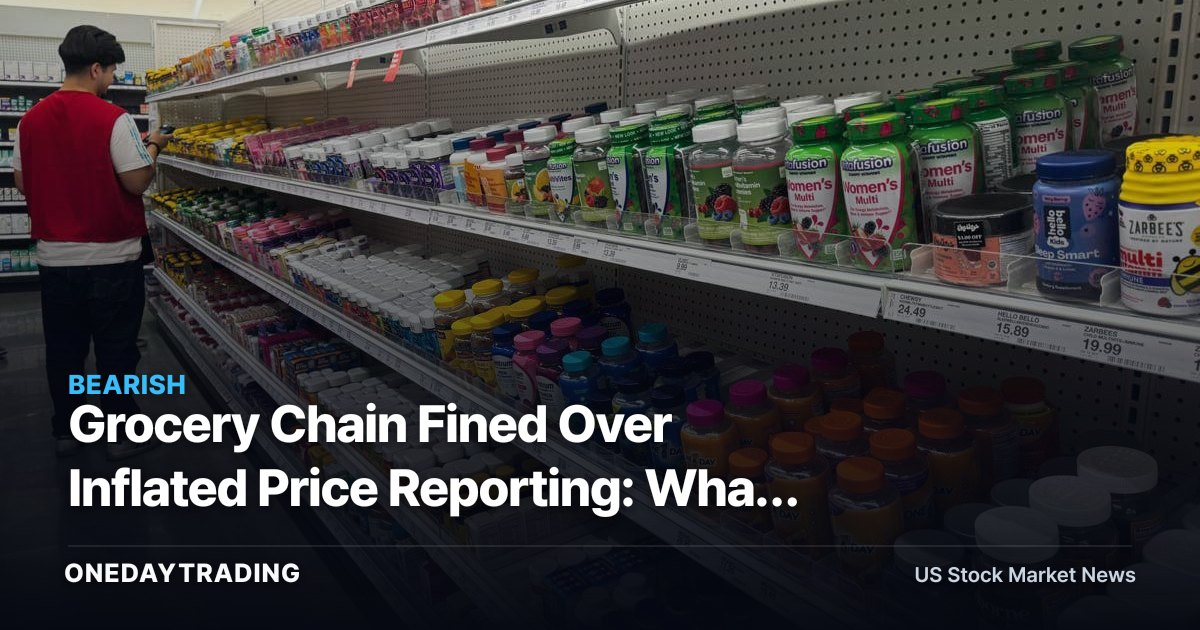
A grocery chain has paid a substantial fine after being accused of inflated price reporting, a development that lands squarely on the most politically exposed corner of consumer retail. The headline matters less for its dollar amount than for the signal it sends: pricing practices at food retailers are now a live regulatory and reputational variable, not background noise.
The Full Story
The core issue is price reporting integrity. When a grocer is accused of inflating the prices it reports, the dispute touches the trust layer that the entire food-retail model depends on, since shoppers and regulators both assume shelf and reported prices reflect real cost pass-through rather than opportunistic markups.
For investors, the read-through is that grocery margins are being treated as a public-policy question. Food inflation has been one of the most visible household pressures of recent years, and any case alleging manipulated or inflated pricing gives regulators and politicians a concrete example to point to when arguing for tighter oversight of the sector.
Structural Background
Grocery is a thin-margin, high-volume business where operating margins typically sit in the low single digits. That structure means the industry leans on scale, private-label mix, and disciplined pricing to defend profitability. It also means the sector is unusually sensitive to anything that compresses pricing freedom or adds compliance cost, because there is little margin cushion to absorb it.
Stock and Sector Ripple
- Kroger (KR) as the largest US pure-play grocer, it is the bellwether most exposed to any broad shift in pricing scrutiny and the optics of food-cost politics.
- Albertsons (ACI) a similarly concentrated grocery operator where regulatory and pricing headlines weigh on sentiment and on its strategic flexibility.
- Walmart (WMT) the dominant US grocery seller by volume, though its everyday-low-price positioning and diversified mix make it a relative defensive within the theme.
- Costco (COST) insulated by a membership model where low markups are the brand promise, making it a contrast case to margin-driven scrutiny.
- Target (TGT) exposed through its grocery aisle but cushioned by general-merchandise revenue.
Bull vs Bear Scenarios
The bear case is that one fine becomes a template: more enforcement, more disclosure demands, and political pressure that caps pricing power across the group at the exact moment cost inflation is sticky. The bull case is that fines of this kind are usually immaterial to large-cap earnings, that the strongest operators benefit when scrutiny falls hardest on weaker pricing practices, and that scale players with genuine low-price credibility can take share. The key variable is whether this stays an isolated enforcement action or hardens into a broader regulatory framework.
Investor Action Points
- Watch the next KR and ACI earnings calls for management language on pricing, gross margin, and any change in compliance or legal reserves.
- Track gross-margin trends versus food-CPI prints to see whether grocers are still passing through cost or absorbing it.
- Monitor whether regulators or lawmakers cite this case to propose sector-wide pricing rules, which would be the real escalation.
- Compare margin-led grocers against membership and everyday-low-price models, where the regulatory beta is structurally lower.
Market data check: KR
KR last traded near $56.61 (-8.43%). Our composite signal — blending price momentum and news flow — reads 🟡 neutral. Price momentum scores 5/100 (soft).
Data as of publication. Price via market feeds; for reference only, not investment advice.
📊 Analysis
Signal Bearish
Why An enforcement fine over inflated price reporting raises regulatory and reputational risk across thin-margin grocery retailers, a sentiment headwind even if the dollar amount is immaterial.
Tickers$KR$ACI$WMT$COST$TGT
This article was independently written by OneDayTrading from public reporting. Read the original (Yahoo Finance)