What Changes
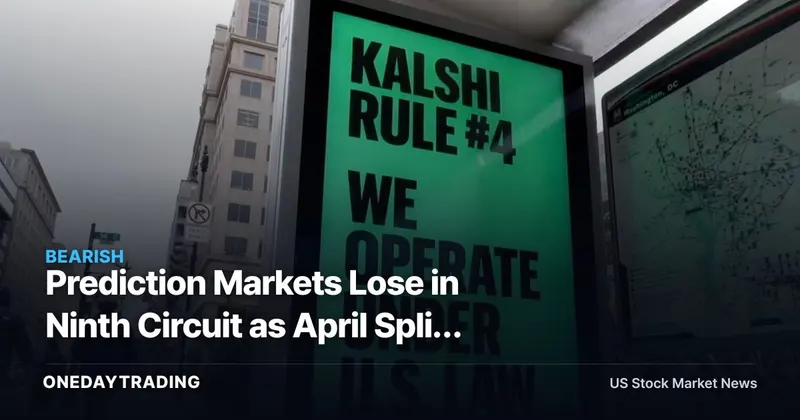
Prediction markets now carry a sharper legal discount because the Ninth Circuit and Third Circuit have split over whether sports-related event contracts qualify as swaps, per CNBC's reporting. For investors, that split matters because inconsistent appellate rulings raise the probability of a Supreme Court fight and extend uncertainty around product design, compliance cost and market access.
A prediction market lets users trade event contracts whose payoff depends on a specified outcome; in this case, CNBC reported that the disputed contracts were sports-related event contracts. If a contract is treated as a swap, the legal pathway, venue economics and compliance burden can look different than if a court rejects that classification.
The balance-sheet channel is straightforward. Prediction-market operators need tradable events to generate activity, activity to create fees, and legal clarity to keep users and market makers engaged. A ruling that narrows the legal theory for sports contracts pressures that chain even before any final Supreme Court decision arrives.
By the Numbers
The central number is two: CNBC reported that the Ninth Circuit's ruling conflicts with an April Third Circuit ruling. Two federal appellate courts pointing in different directions is the mechanism that turns a niche market-structure dispute into a national legal overhang.
The source did not report trading volume, revenue exposure, legal expenses or market share, so investors should avoid treating the ruling as a quantified earnings shock. The cleaner takeaway is directional: legal optionality fell in the Ninth Circuit, while Supreme Court optionality rose because the April Third Circuit result now stands against it.
Winners & Losers
- Prediction-market platforms: The Ninth Circuit ruling is negative for sports-event expansion because fewer defensible contract categories can mean fewer listings, lower user activity and weaker fee leverage.
- Traditional sportsbooks: Sportsbooks benefit if prediction-market rivals face slower legal clearance, because regulatory friction protects existing sports-betting channels.
- Market makers: Liquidity providers lose visibility when the same sports contract can face different treatment by circuit, because capital commitment depends on enforceable listing rules.
- Retail traders: Users gain no immediate clarity from the split; access depends on where courts ultimately draw the line between event contracts and swaps.
Risk Check
- The source does not identify a public company, so ticker-level conclusions would overstate the record.
- A Supreme Court review could resolve the split in either direction, which means the Ninth Circuit loss is not necessarily the final rule.
- If platforms can pivot to non-sports events, the revenue damage from the sports-contract ruling narrows.
- If legal uncertainty persists, compliance spending and product delays become the practical margin risk.
Bottom Line
The Ninth Circuit ruling makes prediction markets a less clean growth story because the legal classification of sports-related event contracts now depends on a court split rather than a settled rule. Upside returns if the Supreme Court or later litigation validates the April Third Circuit path; risk compounds if the Ninth Circuit view becomes the national standard.
FAQ
Why did the Ninth Circuit ruling matter for prediction markets?
The Ninth Circuit ruling mattered because CNBC reported that the court said sports-related event contracts are not swaps. That finding conflicts with an April Third Circuit ruling and creates legal uncertainty for prediction-market products tied to sports outcomes.
What are sports-related event contracts in prediction markets?
Sports-related event contracts are tradable prediction-market instruments whose payoff depends on a sports outcome, per the CNBC-described dispute. The legal fight is whether those contracts fit the swap category, which affects how platforms can list and defend them.
Will the Supreme Court decide the prediction markets case?
CNBC reported that the Ninth Circuit ruling sets up a likely fight at the Supreme Court because the Ninth Circuit contradicted the Third Circuit's April ruling. If the Supreme Court takes the issue, the key investor checkpoint is whether sports-related event contracts receive a uniform national classification.
📊 Analysis
Signal Bearish
Why The Ninth Circuit ruling adds legal uncertainty to sports-related prediction-market contracts and raises compliance and product-expansion risk for the sector.
This article was independently written by OneDayTrading from public reporting. Read the original (CNBC)