Key Takeaways
Fox's agreement to acquire Roku for roughly $22 billion in enterprise value is less about hardware and more about owning the home screen where connected-TV advertising is decided. For investors, the deal converts Roku from a standalone platform bet into a strategic asset inside a traditional media owner of news and sports networks, and it puts every connected-TV (CTV) ad player on notice.
What Happened
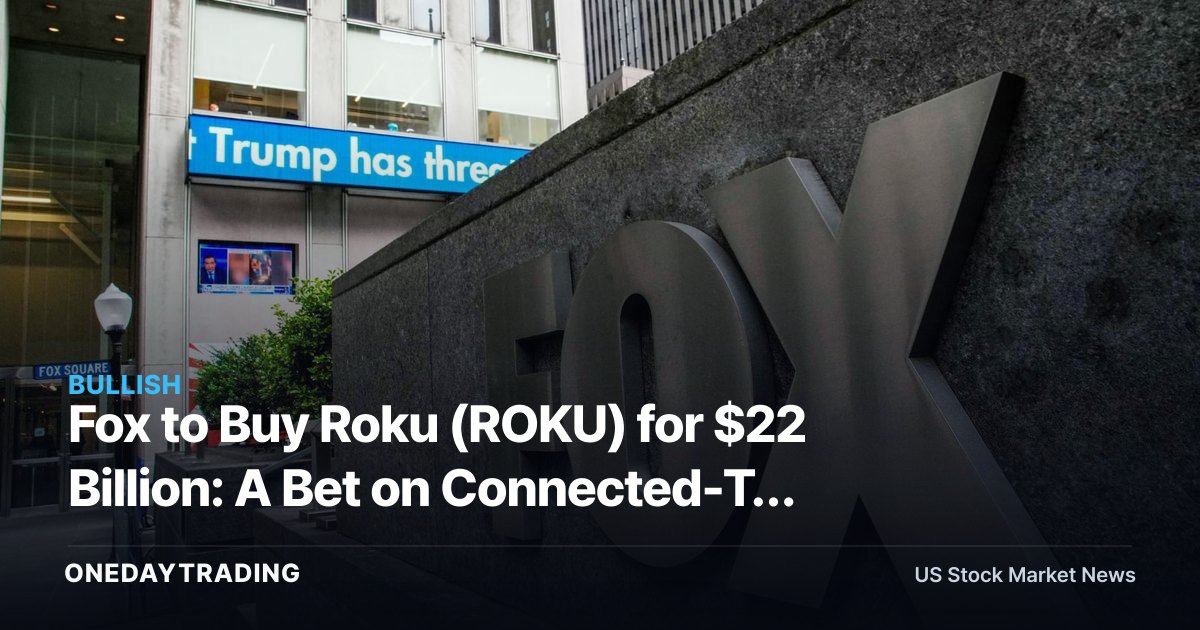
Fox said it reached a deal to buy Roku, the streaming-device maker, for about $22 billion in enterprise value. Fox is best known as the parent of widely watched news and sports networks, businesses whose economics are increasingly migrating from cable carriage fees toward streaming distribution and digital advertising.
Roku matters here because it is not primarily a gadget company. Its real value sits in the Roku operating system, the home-screen interface, and the advertising and account relationships that come with a large installed base of streaming households. By folding that platform into Fox, the combined entity would control both premium news and sports content and a direct pipe to viewers' living-room screens.
The price tag signals that Fox is paying for distribution and ad inventory control rather than device margins, which in streaming hardware are notoriously thin.
Background and Context
Linear TV ad budgets have been shifting to CTV for years, and the home-screen layer — the menu users see when a TV turns on — has become prime advertising real estate. Owning that layer lets a media company guarantee placement for its own apps, sell ad space against rivals, and capture viewing data that sharpens targeting.
For a content owner like Fox, controlling a distribution platform is a hedge against losing leverage to third-party aggregators and a way to keep more of the advertising value chain in house rather than sharing it with an independent platform.
Market and Stock Impact
- Roku (ROKU): The direct beneficiary as the target; an acquisition at $22 billion enterprise value crystallizes a valuation for a platform that the market had long debated, shifting the stock from a fundamentals story to a deal-completion story.
- Fox (FOXA, FOX): Gains a streaming distribution arm and CTV ad inventory, but takes on integration risk and the cost of absorbing a lower-margin platform; investors will scrutinize how the purchase is financed and whether it dilutes returns.
- The Trade Desk (TTD): CTV-focused ad demand platforms face a more vertically integrated competitor controlling first-party home-screen inventory and data.
- Amazon (AMZN) and Alphabet (GOOGL): Owners of rival TV operating systems and ad ecosystems now contend with a content-plus-platform combination targeting the same living-room ad dollars.
Investor Checkpoints
- Deal terms and financing: cash versus stock, leverage taken on, and any breakup or regulatory conditions.
- Regulatory review timeline — a media owner acquiring a major distribution platform may draw antitrust scrutiny.
- Roku platform metrics in upcoming disclosures: active accounts, streaming hours, and platform ad revenue trends.
- Fox's next earnings commentary on how Roku fits its advertising and direct-to-consumer strategy.
Outlook
The bull case is straightforward: Fox locks in distribution, guarantees shelf space for its news and sports apps, and monetizes a large CTV audience it previously had to reach through intermediaries. The risks are equally concrete. A $22 billion outlay must clear regulators, integrate a hardware-and-platform business with different margins and culture, and justify the premium against a CTV ad market where Amazon, Alphabet, and independent demand platforms all compete aggressively. Whether this is value creation or an expensive defensive move hinges on execution and the price ultimately paid.
Market data check: ROKU
ROKU last traded near $142.5 (-0.81%). Our composite signal — blending price momentum and news flow — reads 🟡 neutral. Price momentum scores 44/100.
Data as of publication. Price via market feeds; for reference only, not investment advice.
📊 Analysis
Signal Bullish
Why A $22 billion acquisition at enterprise value crystallizes a concrete, premium valuation for Roku shareholders, a clear positive catalyst for the target.
Tickers$ROKU$FOXA$FOX$TTD$AMZN$GOOGL
This article was independently written by OneDayTrading from public reporting. Read the original (CNBC)