What Changes
U.S.-Canada tariffs are import taxes charged on selected Canadian goods entering the United States, and a 50% tariff means the levy equals half of the declared import value before distribution, retail markup or industrial use.
The tape already prices some trade friction because tariff headlines have been a recurring Trump administration policy channel. The tape does not fully price the second-order effect: a failed Friday deal turns an avoidable negotiation headline into a live cost item for buyers of the affected Canadian exports.
For investors, the mechanism matters more than the politics. A tariff raises input cost first, then forces management teams to choose between price increases, margin compression or supplier substitution; each path hits revenue quality differently.
By the Numbers
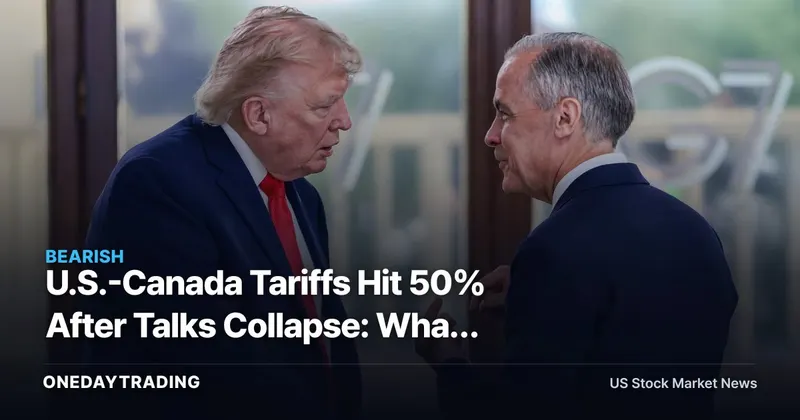
CNBC reported that the new Trump administration tariffs are 50% on some Canadian exports after the United States and Canada failed to reach a deal on Friday. CNBC did not specify in the provided source which Canadian export categories were covered.
The 50% figure is large enough to matter because companies rarely hold that much unused gross-margin cushion on tariffed inputs. If covered goods are production inputs, the effect flows into cost of goods sold; if covered goods are consumer products, the effect tests pricing power and demand elasticity.
Winners & Losers
- U.S. importers using covered Canadian exports: A 50% levy raises landed cost immediately, so earnings risk concentrates where contracts prevent fast price pass-through.
- Domestic substitutes: U.S. producers competing with tariffed Canadian exports gain a price umbrella if customers cannot source around the levy quickly.
- Retail and consumer distributors: Companies selling tariffed goods face the weakest trade-off because higher shelf prices can protect margin but reduce unit demand.
- Industrials and materials supply chains: Manufacturers face planning risk because the source report confirms tariffs on some Canadian exports but does not identify the covered categories.
- Broad U.S. equities: The S&P 500 risk is not the tariff alone; the risk is whether trade friction lifts inflation expectations and pressures valuation multiples.
Risk Check
- Coverage risk: CNBC reported tariffs on some Canadian exports, so sector impact cannot be ranked without the covered product list.
- Duration risk: A short tariff episode is a working-capital problem; a durable tariff regime is an earnings and sourcing problem.
- Retaliation risk: A Canadian response would widen the shock from import costs to export demand.
- Inflation risk: If tariff costs reach consumer prices, rate-cut expectations become less dependable for equity multiples.
Bottom Line
The U.S.-Canada trade collapse is bearish for tariff-exposed equities because a 50% duty converts political risk into measurable cost pressure, but the investable signal stays incomplete until investors see the covered export categories, company-level guidance and any Canadian countermeasure.
FAQ
Why did U.S.-Canada trade talks collapse affect stocks?
U.S.-Canada trade talks affected stocks because CNBC reported that the failed Friday deal triggered new 50% Trump administration tariffs on some Canadian exports. A tariff that large can reduce margins for importers or raise prices for customers.
What Canadian exports face the new 50% tariff?
CNBC reported that some Canadian exports face new 50% Trump administration tariffs after Friday talks failed. The provided source did not identify the covered Canadian export categories, so investors should not assume a specific company or commodity is included.
What should investors watch after the new Trump tariffs?
Investors should watch the official covered-goods list, company guidance and any Canadian retaliation after CNBC reported new 50% tariffs on some Canadian exports. The next market signal is whether management teams quantify tariff exposure in margin guidance or pricing plans.
📊 Analysis
Signal Bearish
Why A 50% tariff on some Canadian exports creates direct cost, margin and inflation risk for tariff-exposed equities after talks failed.
This article was independently written by OneDayTrading from public reporting. Read the original (CNBC)