Federal Reserve Pause Masks the Next Rate Risk
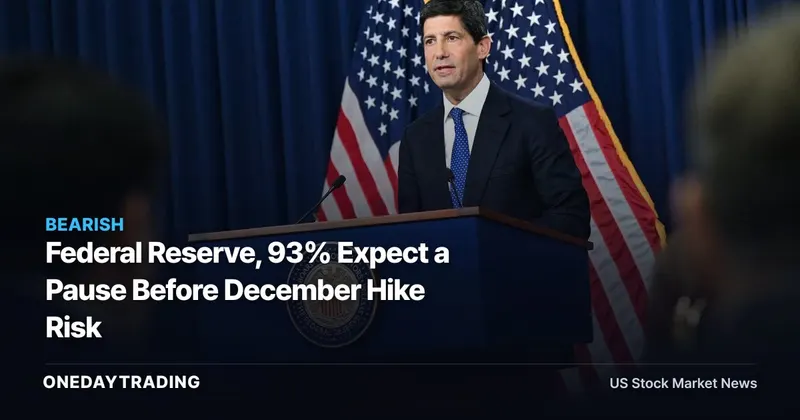
The Federal Reserve may pause this week, but investors cannot read that decision as the end of tightening. CNBC Markets reported that 93% of the latest CNBC Fed Survey’s 30 fund managers, strategists and economists expected no increase at the meeting taking place this week, while 76% anticipated a rate hike at the next meeting in December.
The sharp gap between those two results is the market signal: the survey separates the immediate decision from the broader policy path. A pause would leave the December decision live, and more than half of respondents expected an average of about two Federal Reserve rate hikes next year.
The CNBC Fed Survey is a poll conducted before every Federal Reserve meeting to measure the policy, economic and market expectations of fund managers, strategists and economists. Its findings describe respondents’ expectations rather than a Federal Reserve commitment.
Why the CNBC Survey Challenges the Equity Outlook
The equity tension appears in the survey’s own S&P 500 forecasts. Respondents kept their outlook for this year at around 7,600 index points, compared with the S&P 500 Monday close of 7,676, while cutting the next-year forecast to 8,033 index points from 8,274 in the prior survey.
Those levels do not establish a certain market outcome. They show that respondents combined expectations for further rate increases with a next-year index forecast below their prior estimate. For investors, that pairing matters more than the pause viewed in isolation: the near-term policy decision and the longer-term equity outlook point in different directions.
The rate forecast reinforces that caution. Respondents on average expected the 10-year yield to remain above 5% this year and ease only to 4.8% in 2027. Subodh Kumar, president of Subodh Kumar & Associates, described Treasury yields above 5% as a new band rather than an anomaly.
The Inflation Debate Inside the Federal Reserve Outlook
The survey reveals disagreement over how much restraint the economy requires. CNBC reported that 40% said the Federal Reserve must slow growth below potential to address inflation, while 27% said growth need not slow and 23% said only some slowing was necessary.
Richard Bernstein, global head of macro investing at Janus Henderson Investors, called the reluctance to raise rates “unfathomable,” citing nominal GDP running at 6-8%. John Ryding, chief economic advisor for Brean Capital, LLC, pointed to aggregate demand data north of 7% and argued that the inflation and demand readings supported a rate increase.
A competing view stresses the risk of tightening amid economic strain. Mark Zandi, chief economist at Moody's Analytics, said, “This isn't the time for more Fed rate hikes,” while identifying the Iran war, falling real wages, rising interest rates and an unstable AI-fueled stock market as concerns.
- Act now or wait: Although 93% expected a pause this week, 30% said the Federal Reserve should raise rates at the current meeting.
- How broad is inflation: CNBC found that 70% viewed inflation as broader than the increase in energy prices.
- How much slowing is required: The largest group favored below-potential growth, though the remaining views split between no slowdown and only some slowing.
- How durable is the pause: The 76% expectation for a December increase makes the next meeting the central policy checkpoint.
Growth, Inflation and Recession Send Different Signals
The macro forecasts do not describe a simple downturn. GDP growth was projected at 2.4% this year and 2.2% in 2027, compared with 2.05% in 2025. Respondents collectively placed the probability of a U.S. recession in the next year at 26%, down from 29% in the last survey.
Labor and inflation expectations add another layer. Unemployment was forecast at 4.2% for the remainder of the year and 4.4% in 2027. The Consumer Price Index was expected to decline to 3.6% from 3.7% in September and reach 2.6% next year.
That combination leaves room for opposing interpretations without resolving them. Inflation was expected to ease, recession risk declined, and growth remained above potential, while the survey still showed broad expectations for additional Federal Reserve tightening. The December decision will test which part of that outlook carries the most weight.
S&P 500, Oil and AI Exposure
- S&P 500: The index closed Monday at 7,676, above the survey’s around-7,600 forecast for this year. The next-year estimate fell to 8,033 from 8,274 in the prior survey, placing the emphasis on whether the reduced outlook can hold alongside expected rate increases.
- U.S. crude oil benchmark: Respondents forecast $88 per barrel six months from now, up from $82 per barrel in the September survey and below the current level of $101 per barrel. The survey also identified continuation of the Iran war as one of the biggest risks.
- Artificial-intelligence exposure: The bursting of the artificial-intelligence bubble was listed among the biggest risks. On debt supply, 13% identified borrowing to fund the AI buildout as the larger source of pressure, while a third said government debt and AI-related debt contributed equally.
- Government debt: Half of respondents identified government debt as the larger supply issue behind high yields. The survey also found that 41% expected higher deficits following the congressional election, without linking that expectation to a particular party outcome.
Debt Supply and Election Uncertainty
Respondents divided the explanation for high bond yields among inflation, growth, debt issuance and expectations for a higher Federal Reserve policy rate. When asked specifically about supply, 50% selected government debt, compared with 13% choosing debt used to finance the AI buildout.
The congressional election creates a separate source of uncertainty. CNBC reported that 63% saw some market risk from legal challenges that could prolong uncertainty over control of Congress. John Donaldson, director of fixed income at Haverford Trust Co., called prolonged election uncertainty one of the largest near-term market risks.
More than half expected Democratic control of both houses in next week’s congressional election, up from 29% in the last survey. Another 40% expected Democratic control of the House but not the Senate. Respondents anticipated little change to individual or corporate taxes, while 41% expected higher deficits.
What Investors Should Check Next
- This week’s Federal Reserve meeting: Compare the decision with the 93% pause expectation and check whether at least two Federal Reserve voters dissent, as respondents anticipated.
- The December meeting: Test the 76% rate-hike expectation against the actual decision. The survey did not state the expected size of any increase.
- Consumer Price Index: Track whether inflation moves from 3.7% in September toward the survey’s 3.6% forecast and then toward 2.6% next year.
- Market levels: Follow the 10-year yield against the above-5% forecast for this year and the S&P 500 against around 7,600 index points this year and 8,033 next year.
The Conditional Outlook After the Pause
The constructive case rests on GDP growth of 2.4% this year, a lower 26% next-year recession probability and Consumer Price Index inflation reaching 2.6% next year. The adverse case combines expected Federal Reserve rate increases, a 10-year yield above 5% this year, high oil prices and a reduced next-year S&P 500 forecast.
The survey cannot settle that balance. It provides neither its sampling methodology nor margin of error, exact fieldwork dates, the names of all 30 respondents, the anticipated size of a December increase, or the identities of the Federal Reserve voters expected to dissent.
The next signal is therefore not the widely expected pause alone. It is whether the Federal Reserve’s decision, any dissents and the subsequent December outcome confirm a policy path that 76% of respondents already anticipate while the S&P 500 outlook has moved lower.
📊 Analysis
Signal Bearish
Why Expected Federal Reserve tightening, an above-5% 10-year yield outlook and a reduced S&P 500 forecast create a challenging backdrop for equities.
This article was independently written by OneDayTrading from public reporting. Read the original (CNBC Markets)