At a Glance
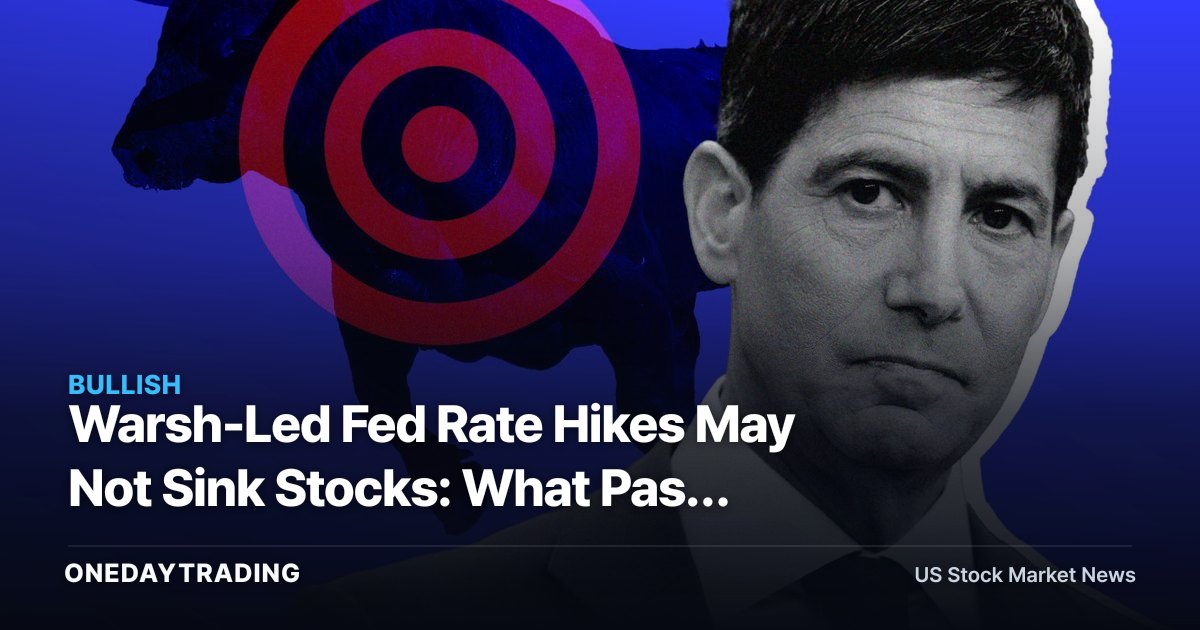
The argument that a Kevin Warsh-led Federal Reserve and renewed rate-hike threats would automatically kill the bull market does not hold up against the historical record. In several past tightening cycles, equities advanced rather than collapsed, because hikes typically arrive alongside a strengthening economy and rising corporate earnings. For investors, the bigger variable is not the direction of the policy rate but the pace, the messaging, and whether growth holds up.
Why It Matters Now
Markets have been conditioned to treat any hint of tighter policy as a threat, but the transmission from rate hikes to stock prices is not one-directional. A central bank raises rates when it judges the economy strong enough to handle higher borrowing costs. That backdrop — firm demand, expanding profits, contained recession risk — is historically supportive for equity multiples even as discount rates rise. Warsh, seen as a hawkish-leaning figure, may prefer that the credible threat of hikes does the work of cooling inflation expectations without forcing him to deliver many of them.
The nuance for U.S. investors is in the composition of the rally. If the policy channel keeps short rates higher, banks and insurers can benefit from wider net interest margins, while richly valued long-duration growth names face more scrutiny because their cash flows are discounted more heavily. The market can rise overall while leadership rotates underneath the surface. That rotation, rather than the index level, is where positioning decisions are actually made.
There is also a confidence channel: a Fed perceived as serious about inflation can anchor long-term yields and lower the risk premium investors demand. Paradoxically, demonstrated hawkishness can be friendlier to stocks than a Fed seen as falling behind on prices.
FAQ
- Do rate hikes always hurt stocks? No. In multiple historical hiking cycles, equities rose because hikes coincided with economic strength and earnings growth, which can offset the drag from higher discount rates.
- Why would Warsh matter specifically? He is viewed as hawkish, and the article's premise is that he may rely on the threat of hikes to manage inflation expectations rather than aggressive actual tightening.
- What stops the bull market then? A recession, an earnings downturn, or a policy mistake that tightens far faster than growth can absorb — not the mere existence of hikes.
- Should investors de-risk preemptively? The historical pattern argues against reflexive selling on hike headlines; the more useful focus is growth and earnings durability.
Related Stocks & Sectors
- Banks (JPM, BAC): Higher-for-longer short rates can widen net interest margins, a direct earnings tailwind if loan demand and credit quality hold.
- Broad index ETFs (SPY, QQQ): Capture the overall bull-market thesis; QQQ carries more duration risk given its concentration in high-multiple tech.
- Long-duration growth/tech (NVDA): Most sensitive to discount-rate moves; valuation compression is the channel of risk if yields climb.
- Insurers and financials broadly: Benefit from reinvesting reserves at higher yields.
What to Watch
- Fed communication and any formal signal on Warsh's role, plus the tone on inflation expectations.
- The 10-year Treasury yield as a real-time gauge of how the market prices the tightening threat.
- Forward earnings revisions — the durability of the bull case rests here, not on the rate path alone.
- Sector leadership: financials outperforming growth would confirm the rotation thesis.
Overall Outlook
The bull case rests on a simple historical truth: rate hikes and rising stocks have coexisted when the economy is expanding. The counter-scenario is equally concrete — if hikes are delivered into slowing growth, or if long yields spike, high-valuation segments are vulnerable and the index-level optimism can unwind quickly. The constructive read is that policy hawkishness alone is not a sell signal; the deciding factor remains whether earnings and demand keep pace with the cost of money.
📊 Analysis
Signal Bullish
Why The thesis is that rate-hike threats under a Warsh Fed need not end the bull market, with history showing equities can rise through tightening cycles.
Tickers$SPY$QQQ$JPM$BAC$NVDA
This article was independently written by OneDayTrading from public reporting. Read the original (MarketWatch)