Key Takeaways
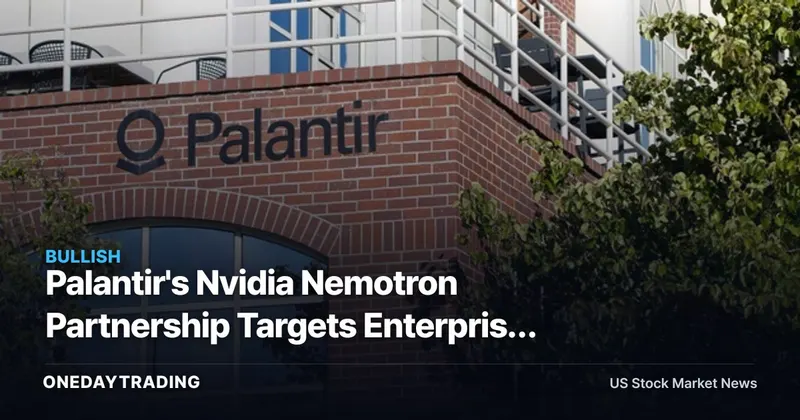
Palantir's partnership with Nvidia on the Nemotron large language model family signals a deliberate push to convert government-forged AI credibility into scalable commercial software revenue. The tie-up hands PLTR a distribution wedge into enterprises already building on Nvidia's GPU stack — but whether that translates into durable ARR growth is a question the stock's lofty multiple has already assumed an optimistic answer to. The metric that actually matters is not the announcement; it is commercial net revenue retention in the next two quarters.
What Happened
Palantir is expanding commercial adoption of its AI software offerings by teaming with Nvidia specifically on Nemotron — Nvidia's open-weight LLM family built for enterprise deployment across its GPU infrastructure. The collaboration positions Palantir's Artificial Intelligence Platform as a high-level software orchestration and governance layer running on top of Nemotron's inference capabilities, targeting enterprises that have committed to Nvidia hardware but need a workflow engine to operationalize AI at scale without bespoke model training.
The strategic logic runs in both directions. For Palantir, Nemotron access accelerates model availability without the capital intensity of training proprietary frontier models. For Nvidia, AIP integration gives Nemotron an enterprise-ready deployment channel — critical as Nvidia pushes further up the software stack beyond hardware margins and seeks recurring revenue stickiness in its enterprise book.
Background & Context
Palantir's commercial business has been the growth narrative the market has priced in aggressively. The company's U.S. commercial segment has posted strong sequential expansion, but its revenue base remains modest relative to the multiples the stock commands. Net retention and new commercial logo cadence are the metrics that actually tell the story of AIP stickiness — a high-profile Nemotron partnership can generate pipeline, but it does not guarantee conversion rates or contract values. Palantir's go-to-market has historically leaned on intensive bootcamps to demonstrate AIP's value to enterprise buyers; that motion is labor-intensive and hard to scale without ecosystem leverage. Nvidia's existing enterprise GPU relationships represent precisely that kind of leverage — co-selling into accounts where the compute decision is already made.
Market & Stock Impact
- PLTR (Palantir Technologies) — Direct beneficiary if Nemotron integration shortens the enterprise sales cycle. The risk is valuation: PLTR trades at a material premium to software peers on both revenue and earnings multiples, pricing in commercial ARR acceleration this partnership aims to deliver but has not yet proven.
- NVDA (Nvidia) — Incrementally positive as AIP-Nemotron integration creates another software layer that drives inference compute demand on Nvidia GPUs. The read-through is modest at Nvidia's scale but reinforces the stack flywheel — more enterprise software built on Nemotron means stickier GPU demand per account.
- MSFT (Microsoft) — Indirect competitive pressure. Microsoft's Azure AI Foundry and Copilot for enterprise compete for the same AI orchestration budget Palantir is targeting. A credible Palantir-Nvidia pairing in this space tightens that competitive dynamic at the account level.
- CRM (Salesforce) / SNOW (Snowflake) — Enterprise AI workflow and data platform adjacencies. If Palantir-Nemotron wins enterprise AI deployment deals, it can crowd out adjacent platform spending in the same account.
Investor Checkpoints
- Next PLTR earnings call: Watch U.S. commercial revenue growth rate, new customer count, and net revenue retention — these confirm whether the Nvidia co-selling motion generates contract conversion, not just pipeline optics.
- Nemotron enterprise adoption disclosures: Nvidia's developer conference and quarterly commentary on Nemotron deployment footprint will signal how large a distribution channel Palantir is actually accessing through this tie-up.
- AIP bootcamp-to-contract conversion: Palantir has historically disclosed bootcamp pipeline metrics. Any update on how the Nvidia co-sell is influencing that funnel is a leading indicator of revenue durability, not a lagging one.
- PLTR multiple compression risk: The stock requires commercial ARR to compound at a rate that justifies its premium multiple. The spread between guidance and reported commercial revenue is the trigger — any miss compresses the multiple sharply given the optimism already embedded in the price.
Outlook
The bull case is structurally sound: Nvidia's hardware dominance in enterprise AI gives Palantir a distribution lever it could not build organically. Enterprises already locked into Nvidia GPU infrastructure have a natural on-ramp to Palantir's AIP when Nemotron is the inference layer — reducing the cold-start friction that has historically slowed commercial expansion. If the co-selling motion works, the commercial ARR inflection PLTR's valuation prices in becomes meaningfully more plausible.
The counter-scenario is equally concrete. Partnership announcements are not contracts. Palantir competes against Microsoft's Azure AI Foundry, Google's Vertex AI, and Salesforce's Einstein — each with deeper enterprise relationships and comparable access to open-weight models that run on Nvidia hardware. Nemotron is one of several model families enterprises can deploy; Palantir's AIP is not the only governance layer competing for that position. At current multiples, the stock offers investors limited cushion if the commercial ramp comes in softer than the price assumes — the next earnings print, not this press release, is where that thesis gets tested.
Market data check: PLTR
PLTR last traded near $117.08 (+3.67%). Our composite signal — blending price momentum and news flow — reads 🟡 neutral. Price momentum scores 79/100 (firm).
Data as of publication. Price via market feeds; for reference only, not investment advice.
📊 Analysis
Signal Bullish
Why A Nvidia distribution channel reduces Palantir's enterprise sales friction and accelerates AIP's commercial pipeline, directly addressing the commercial ARR growth the stock's multiple depends on.
Tickers$PLTR$NVDA$MSFT$CRM$SNOW
This article was independently written by OneDayTrading from public reporting. Read the original (Seeking Alpha)