Summary
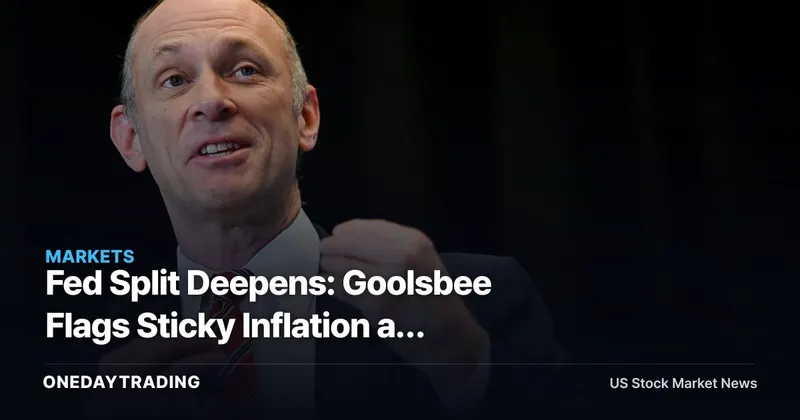
Two Federal Reserve officials offered conflicting reads on the same data: Chicago Fed President Austan Goolsbee said inflation is still too high, while New York Fed President John Williams sees price pressures easing. For investors, the gap matters more than either quote — it signals the rate path is genuinely contested, which keeps Treasury yields, banks and long-duration growth names hostage to each incoming inflation print.
The Full Story
In a live CNBC interview from his home district, Goolsbee declined to speculate on where rates are headed and emphasized that inflation remains above the Fed's comfort zone. Williams, speaking separately, struck a softer tone, framing price pressures as cooling. Neither committed to a timeline, but the divergence is the signal: when a hawkish-leaning regional president and a core leadership voice like Williams disagree on the trajectory, the market cannot lean confidently on a near-term cut.
The practical effect is heightened sensitivity to every CPI, PCE and jobs release. A hot print validates Goolsbee and pushes yields up; a soft print validates Williams and revives cut expectations. That two-way risk is why rate-sensitive sectors trade nervously around Fed-speak even when no policy change is announced.
Structural Background
Williams sits at the center of the policy-setting committee as a permanent voter and tends to telegraph the consensus, which is why his easing comment carries weight beyond a single regional view. Goolsbee's reluctance to forecast reflects a data-dependent Fed that has repeatedly burned investors who priced cuts too early. The disagreement is less personal than informational — the underlying inflation data is mixed enough to support both interpretations.
Stock & Sector Ripple
- Banks (JPM, BAC): Higher-for-longer rates support net interest margins, but a stalled cut cycle pressures loan demand and raises credit-cost risk if the economy slows.
- Megacap growth/tech (NVDA, AAPL): Long-duration cash flows are discounted harder when yields rise on a hot inflation read, making these names the first to wobble on hawkish commentary.
- Homebuilders and REITs: Directly geared to mortgage and financing costs; a delayed easing path caps the rate relief these groups need.
- Broad index (^GSPC): Equity multiples are anchored to the discount rate, so an unresolved Fed path keeps a lid on multiple expansion.
Bull vs Bear Scenarios
Bull case: Williams is right, disinflation continues, and the Fed gains room to cut — easing financial conditions and lifting rate-sensitive and growth equities together. Bear case: Goolsbee is right, inflation proves sticky, and the market is forced to unwind cut bets, lifting yields and compressing valuations on the most rate-exposed names. The key variable is whether the next inflation readings break the tie.
Investor Action Points
- Track the next CPI and PCE releases — a sustained move toward target favors the Williams view; reacceleration favors Goolsbee.
- Watch the 10-year Treasury yield (^TNX) as the real-time scoreboard for which official the market believes.
- Monitor fed funds futures for shifts in the implied timing and number of cuts after each data point and Fed speech.
- Note positioning: if exposed to long-duration growth, size for two-way rate risk rather than assuming a cut.
📊 Analysis
Signal Neutral
Why Two senior Fed officials gave opposing inflation reads with no policy commitment, leaving the rate path genuinely contested rather than clearly directional.
Tickers$JPM$BAC$NVDA$AAPL
This article was independently written by OneDayTrading from public reporting. Read the original (CNBC)