At a Glance
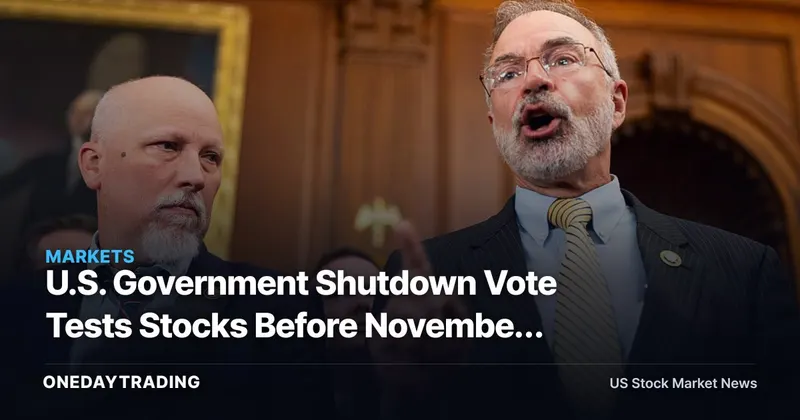
U.S. government shutdown risk is the macro variable investors should price carefully: CNBC reported that the U.S. House is expected on Tuesday, Sept. 1, 2026, to vote on a short-term spending measure that would keep federal funding open until after the November midterm election despite resistance from GOP hardliners.
A continuing resolution is a temporary funding bill that keeps federal agencies operating when Congress has not passed longer-term appropriations; for markets, the mechanism runs through confidence, Treasury volatility, federal-contract timing and the discount rate applied to earnings.
Why It Matters Now
The S&P 500 does not need a shutdown scare to become an earnings story, but a funding lapse can turn a valuation story into a policy-risk story fast. Per CNBC's reporting, the U.S. House vote on Tuesday targets only a short-term bridge, so the tape can remove the immediate shutdown tail risk without resolving the fiscal fight.
The clean read-through is narrower than a broad risk-on signal. If the short-term spending measure passes, investors get continuity through the November midterm election; if GOP hardliner resistance blocks the measure, the market has to reprice operational disruption before the election rather than after it.
Daniel Park's macro lens is simple here: the vote matters less because Washington is noisy and more because the timing pushes a binary fiscal event into an already rate-sensitive market. What equities already price is another temporary patch; what they do not fully price is a failed patch becoming a funding lapse.
Key Debates
- Duration versus certainty: The U.S. House measure reported by CNBC would avoid a shutdown only until after the November midterm election, so the bill reduces near-term risk without creating a full-year funding path.
- Hardliner resistance: GOP hardliner opposition is the live variable because a small procedural break can matter more than the headline expectation of a Tuesday vote.
- Rates channel: Averted shutdown risk supports equity multiples by reducing fiscal uncertainty; a failed vote can push investors toward Treasuries and pressure cyclicals if confidence deteriorates.
- Sector exposure: Federal contractors, defense suppliers, government IT vendors and consumer names tied to federal pay cycles have clearer revenue timing risk than purely private-demand businesses.
Related Stocks & Sectors
- Defense contractors: Lockheed Martin, RTX and Northrop Grumman sit closest to federal budget flow, so a short-term funding bridge protects continuity while leaving appropriation risk after the November midterm election.
- Government services and IT: Federal software, consulting and systems-integration vendors are exposed to agency purchasing delays if the Tuesday vote fails.
- U.S. banks: JPMorgan Chase and Bank of America are more tied to the rates and confidence channel than direct federal spending, so the shutdown risk matters through credit sentiment and Treasury volatility.
- Broad equities: The S&P 500 and Nasdaq respond to whether the House removes a near-term policy shock or forces investors to price one before November.
What to Watch
- The U.S. House vote on Tuesday, Sept. 1, 2026, because passage would push shutdown risk past the November midterm election.
- The scale of GOP hardliner resistance, because the source's reporting identifies that bloc as the obstacle to the short-term spending measure.
- Treasury yields after the vote, because shutdown risk usually transmits first through safety demand and rate volatility.
- Guidance from defense, government-services and federal IT companies in the next earnings cycle, especially any comments on order timing or agency procurement delays.
Overall Outlook
The market-positive case is that the U.S. House passes the short-term spending measure on Tuesday and removes an avoidable shutdown risk from September trading. The risk is that investors treat a temporary bridge as a permanent fiscal fix; CNBC's reporting says the measure only avoids a shutdown until after the November midterm election, which means the policy premium can return quickly.
FAQ
Will the U.S. House vote prevent a government shutdown?
CNBC reported that the U.S. House is expected on Tuesday, Sept. 1, 2026, to vote on a short-term spending measure designed to avoid a government shutdown until after the November midterm election. The outcome depends on whether GOP hardliner resistance is large enough to disrupt passage.
Why does a government shutdown risk matter for the stock market?
A U.S. government shutdown risk matters for the stock market because federal funding uncertainty can affect confidence, Treasury yields, agency spending and the timing of government contracts. The Tuesday House vote matters because a passed measure removes the immediate risk, while a failed measure pulls that risk into pre-election trading.
Which sectors are most exposed to a U.S. shutdown fight?
Defense contractors, government IT vendors, federal services firms and banks have the clearest market exposure to a U.S. shutdown fight. Defense and IT face order-timing risk, while banks and broad equities respond through rates, liquidity preference and investor confidence.
📊 Analysis
Signal Neutral
Why The expected House vote could remove near-term shutdown risk, but CNBC reported GOP hardliner resistance and the measure only extends funding until after the November midterm election.
This article was independently written by OneDayTrading from public reporting. Read the original (CNBC)