At a Glance
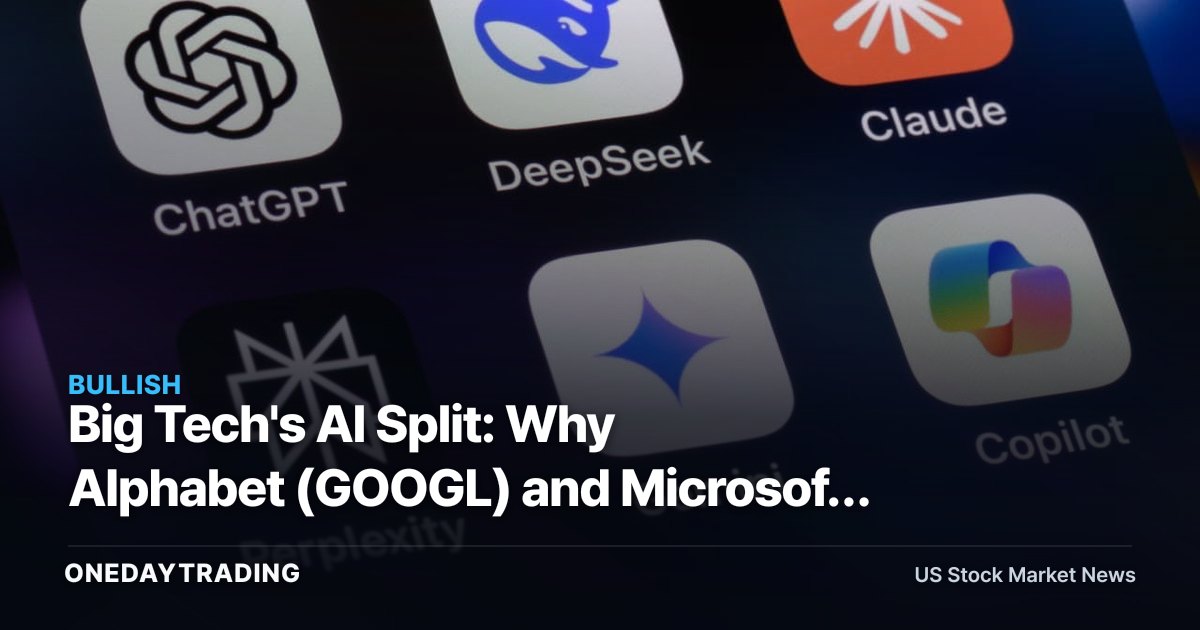
The AI trade is no longer one trade. Big Tech has effectively split into two camps: integrated incumbents that fund AI from existing cash machines, and high-risk pure plays racing to be the next OpenAI. The argument favoring names like Alphabet and Microsoft rests on a simple point about who can absorb the cost of this build-out and still get paid.
Why It Matters Now
The distinction that matters for investors is not who has the flashiest model, but who controls distribution and cash flow. Alphabet monetizes AI through Search, Cloud, and Android — channels with billions of existing users — so model improvements convert into incremental revenue without needing a new business to materialize. Microsoft does the same through Azure, Office, and its enterprise sales motion, embedding AI into software that companies already pay for. That is a fundamentally different risk profile than a standalone lab whose entire valuation depends on staying ahead in a field where the lead changes quarterly.
The capital intensity of AI sharpens the split. Training and serving frontier models requires enormous spending on compute, and a diversified incumbent can fund that from advertising or subscription profits while a pure play burns external capital to do the same. When the cost curve is this steep, the company with a captive cash engine has staying power that a single-product challenger does not. The smart-money framing here is less about upside and more about who survives a longer, more expensive race.
FAQ
- What are the two AI camps? Broadly, integrated giants that bolt AI onto existing platforms versus narrower players whose value depends on winning the frontier-model race outright.
- Why are Alphabet and Microsoft framed as safer? They already own the distribution and the cash flow to monetize AI, so they do not need a brand-new market to appear to justify the spending.
- Is chasing the next OpenAI a bad idea? Not inherently, but the payoff is binary — concentrated upside paired with the risk that a leadership change or funding crunch resets the thesis.
- Does safer mean cheaper? No. Incumbent quality is reflected in valuation, which is itself a key risk if AI revenue scales slower than capital spending.
Related Stocks & Sectors
- Alphabet (GOOGL) — monetizes AI across Search, Cloud, and Android; model gains flow into an existing ad and cloud revenue base.
- Microsoft (MSFT) — embeds AI into Azure and Office, converting enterprise subscriptions into AI revenue with built-in distribution.
- Amazon (AMZN) — another integrated camp member via AWS, with cloud cash flow to fund compute.
- Nvidia (NVDA) — the picks-and-shovels supplier benefiting from both camps spending heavily on training and inference hardware.
- Software and Cloud sector — the channel through which incumbents turn AI capability into recurring revenue.
What to Watch
- Cloud growth and AI revenue disclosure in the next Alphabet and Microsoft earnings — proof that spending is converting to sales.
- Capital-expenditure guidance: rising capex without matching revenue is the warning sign for the incumbent thesis.
- Operating margins, to see whether AI costs are compressing the cash engines that fund the build-out.
- Whether challenger labs secure fresh funding or cede ground, which would validate the safer-incumbent argument.
Overall Outlook
The bull case for the integrated camp is durability: distribution plus cash flow lets these companies outspend and outlast pure plays through a long, expensive cycle. The risk runs the other way — if AI monetization lags the capex, even quality names face multiple compression, and a breakthrough from a focused challenger could still reorder the field. The split is real; which camp rewards investors depends on whether revenue catches up to the spending.
Market data check: GOOGL
GOOGL last traded near $347.35 (-5.62%). Our composite signal — blending price momentum and news flow — reads 🟡 neutral. Price momentum scores 5/100 (soft).
Data as of publication. Price via market feeds; for reference only, not investment advice.
📊 Analysis
Signal Bullish
Why The thesis frames diversified incumbents like Alphabet and Microsoft as structurally advantaged in the AI build-out thanks to existing distribution and cash flow.
Tickers$GOOGL$MSFT$AMZN$NVDA
This article was independently written by OneDayTrading from public reporting. Read the original (MarketWatch)