Summary
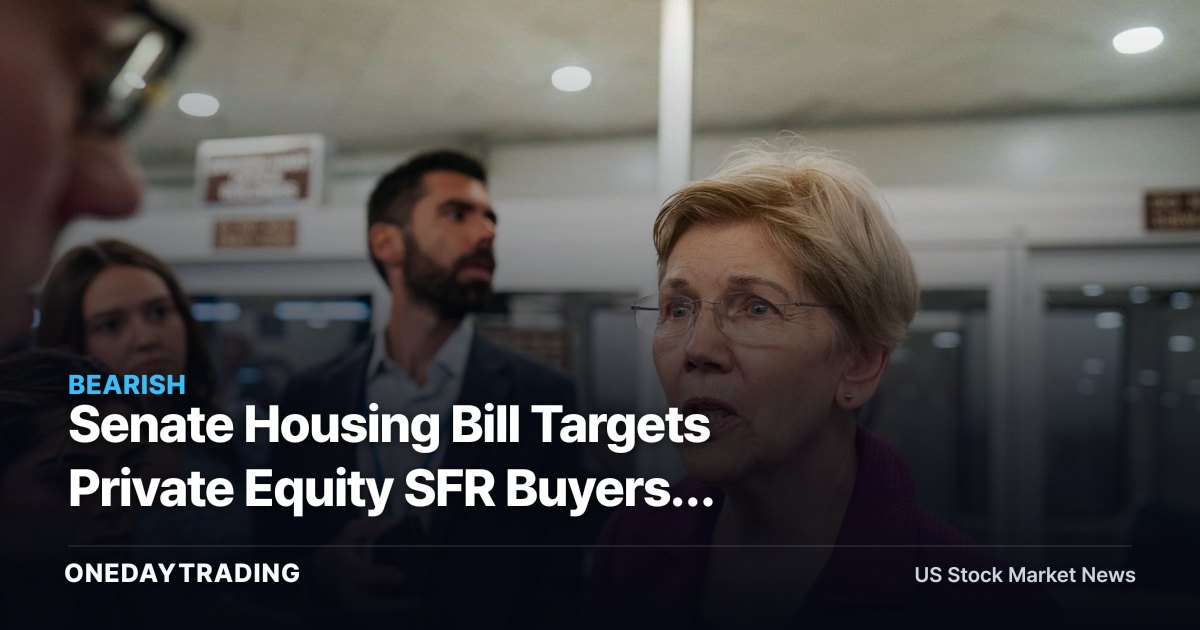
Congress is moving a broad housing package this week designed to expand supply and rein in private equity purchases of single-family homes. The proposal cuts directly into the business model of large institutional single-family rental landlords, while builders and affordability-linked names sit on the other side of the trade. Policy risk, not earnings, is the swing factor here.
The Full Story
Both chambers are expected to advance the legislation, which pairs supply-side incentives with new limits on bulk buyers of detached homes. The core market consequence is regulatory: companies whose growth depends on acquiring and renting out single-family houses at scale would face a narrower acquisition pipeline if curbs become law.
For publicly traded single-family rental operators, the threat is structural rather than cyclical. Their net asset value and rental growth assume continued access to home acquisitions; caps or disincentives on institutional buying would slow portfolio expansion and could pressure the premium investors assign to that growth runway. The same logic reaches the private equity sponsors that pioneered the asset class after the 2008 foreclosure wave.
On the opposite side, measures that add housing supply are a demand signal for the companies that physically build homes. More starts and faster permitting feed order books, even if margins depend on mortgage rates and land costs.
Structural Background
Institutional ownership of single-family homes scaled up over the past decade as low rates and post-crisis distressed inventory let firms assemble large rental portfolios. That concentration has since become a political flashpoint tied to affordability, which is why a bipartisan supply bill is now coupling incentives with restrictions on bulk buyers.
Stock and Sector Ripple
- Invitation Homes (INVH) — the largest listed single-family rental landlord; acquisition limits directly throttle its growth engine and external expansion.
- American Homes 4 Rent (AMH) — similar SFR model, though its build-to-rent development pipeline may partly insulate it versus pure acquirers.
- Blackstone (BX) — the private equity sponsor most associated with institutionalizing single-family rentals; headline and policy overhang risk.
- Homebuilders (DHI, LEN, PHM) — potential beneficiaries if the supply provisions ease permitting and lift new-home demand.
- Mortgage and title names — leverage to any pickup in new-construction transaction volume.
Bull vs Bear Scenarios
Bear case for SFR landlords: a hard cap on institutional purchases compresses growth expectations and forces a multiple de-rating, with BX absorbing reputational and fund-level pressure. Bull case: legislation often softens in committee, and SFR operators already own large stabilized portfolios that generate rent regardless of new buying limits, so cash flows may prove more durable than headlines imply. Builders face their own counter-risk — supply incentives mean little if mortgage rates stay elevated and buyer affordability remains stretched.
Investor Action Points
- Track the final bill text for whether limits are hard caps, taxes, or disclosure rules — the channel determines the earnings impact.
- Watch INVH and AMH next earnings calls for management commentary on acquisition pace and same-home rental growth.
- Monitor homebuilder order trends (DHI, LEN, PHM) alongside the 30-year mortgage rate as the real demand gate.
- Follow the House-Senate reconciliation timeline; passage odds and amendments will reprice the affected names faster than fundamentals.
Market data check: INVH
INVH last traded near $28.45 (+0.12%). Our composite signal — blending price momentum and news flow — reads 🟡 neutral. Price momentum scores 51/100.
Data as of publication. Price via market feeds; for reference only, not investment advice.
📊 Analysis
Signal Bearish
Why Proposed federal limits on private equity single-family home buying threaten the acquisition-driven growth model of listed SFR landlords like INVH and AMH.
Tickers$INVH$AMH$BX$DHI$LEN$PHM
This article was independently written by OneDayTrading from public reporting. Read the original (CNBC)