What Changes
Why did Affirm stock barely move after a blowout quarter?
Affirm Holdings (AFRM) is the U.S. buy now, pay later lender, and the Aug. 28 print says the model is still gaining transaction volume without obvious credit slippage. The market already had the growth story in hand; what it had not fully priced was whether the consumer could keep absorbing inflation in essentials while still expanding usage.
The better read is that Affirm Holdings (AFRM) is broadening usage, not just buying growth. The Affirm Card active user count more than doubled to 5.2 million, transactions per active consumer rose to 7.0, and the company said it has now posted 11 straight quarters of GMV growth above 30%, which points to deeper habit formation.
That is why Levchin's caution matters. If higher gas prices keep squeezing take-home spending, the next question is not whether demand exists, but whether that demand keeps showing up in higher-quality cohorts and stable delinquency. The market is pricing execution; it is not fully pricing consumer strain.
What does $4.09 gas mean for BNPL demand?
Yahoo Finance reported on Aug. 30 that the national average gas price was $4.09 a gallon on Aug. 28, down from above $4.50 in May but still above pre-Iran-war levels. For Affirm Holdings (AFRM), that matters because gas is a direct weekly hit to household cash flow, and BNPL usage often rises when consumers need to smooth that pressure.
The upside is that higher usage can feed transaction count and merchant volume, especially if consumers keep shifting spending into installments. The risk is that a consumer leaning on financing for more categories can also look weaker at the margin if inflation stays sticky.
By the Numbers
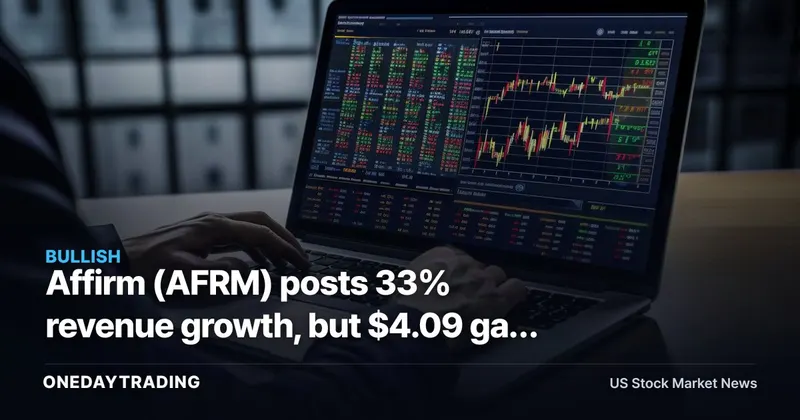
Affirm Holdings (AFRM) said fiscal fourth-quarter revenue reached $1.17 billion, versus $1.11 billion expected, and GMV reached $14.1 billion, versus a $13.39 billion estimate. Adjusted operating income came in at $353 million, and the GAAP operating margin expanded six points to 12.6%.
For the full fiscal year, Affirm Holdings (AFRM) reported GMV of $50.2 billion, up from $36.7 billion, on $4.26 billion in revenue. The company also lifted active consumers 21% to 27.8 million, raised transactions per active consumer 20% to 7.0, and said 30-day delinquency improved to 2.5% from the prior 2.7% to 2.8% band.
Winners & Losers
- Affirm Holdings (AFRM): Higher GMV, better margins, and lower delinquency support the core BNPL thesis.
- Shopify (SHOP): The Australia expansion extends the Shop Pay Installments relationship and can widen volume if merchant adoption scales.
- PayPal (PYPL): Stronger Affirm growth raises the bar for other digital payments and installment products competing for checkout share.
- Block (SQ): A resilient BNPL print makes it harder for peers to argue that consumer installment demand has weakened broadly.
Risk Check
- Gas at $4.09 a gallon on Aug. 28 still leaves households under pressure, and that can hit repayment behavior before it shows up in headline volume.
- Affirm Holdings (AFRM) has now logged 11 straight quarters of GMV growth above 30%, so the market will punish any slowdown from that pace.
- 30-day delinquency at 2.5% is healthy now, but credit trends can turn fast if consumers keep leaning on financing.
- The Shopify Australia rollout adds growth optionality, but international execution is a separate test from U.S. underwriting.
Bottom Line
Affirm Holdings (AFRM) just proved that BNPL can still produce rapid growth, wider margins, and cleaner credit metrics at the same time, which is why the stock deserves a premium to weaker consumer finance names. The live risk is that higher fuel costs and broader inflation keep squeezing the borrower before the next quarter can show whether 2.5% delinquency is a floor or just a good month.
FAQ
Why did Affirm stock not surge more after earnings?
Affirm Holdings (AFRM) posted a clear beat, but investors also heard a cautious message about the consumer from Max Levchin. The market is weighing the 33% revenue gain and 36% GMV growth against the possibility that higher gas prices eventually slow spending or stress repayment.
Is Affirm growing because of better credit quality or more risk taking?
Affirm Holdings (AFRM) said 30-day delinquency improved to 2.5% from the prior 2.7% to 2.8% range, which argues for better credit performance rather than looser underwriting. The company also said active consumers reached 27.8 million and transactions per active consumer rose to 7.0, which suggests growth is coming from deeper engagement.
What should investors watch next?
Investors should watch whether gas prices stay near the $4.09 level cited on Aug. 28 and whether that flows into consumer behavior. They should also track whether Affirm Holdings (AFRM) can keep GMV growth above 30% while holding delinquency near 2.5% and scaling the Shopify-led international rollout.
Market data check: AFRM
AFRM last traded near $77.76 (+0.35%). Our composite signal — blending price momentum and news flow — reads 🟡 neutral. Price momentum scores 53/100.
Data as of publication. Price via market feeds; for reference only, not investment advice.
📊 Analysis
Signal Bullish
Why Affirm beat on revenue, GMV, margin, users, and credit quality, and it raised the quality of the growth story even as consumer cost pressure stays a real risk.
Tickers$AFRM$SHOP$PYPL$SQ
This article was independently written by OneDayTrading from public reporting. Read the original (Yahoo Finance)