Key Takeaways
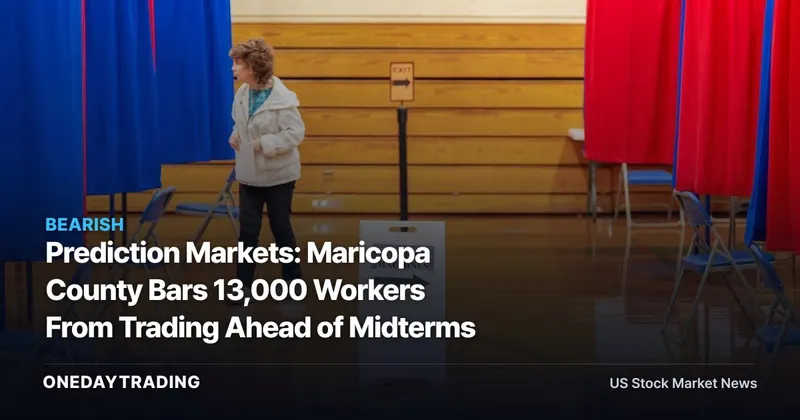
Maricopa County, Arizona adopted a resolution in July 2026 barring roughly 13,000 county employees from trading on non-public information tied to elections, weather events and court hearings, according to CNBC. Delaware County, Pennsylvania separately banned about 2,200 election-office employees from wagering on election-related prediction-market contracts, folding the prohibition into an existing anti-betting oath. Neither Kalshi nor Polymarket is a publicly traded company, so the immediate read for investors is regulatory, not a direct equity move: the episode adds to an unresolved fight between states and the Commodity Futures Trading Commission over who polices this asset class.
What Happened
Thomas Galvin, a Maricopa County supervisor who helps oversee voter tabulation and Election Day voting, told CNBC the county's July resolution bans about 13,000 employees from trading on non-public information, a category that spans weather events, elections and court hearings. The measure followed an executive order from Arizona Governor Katie Hobbs banning state workers from insider trading on prediction markets. Galvin framed the policy as a transparency signal: "When we implement a policy for our employees not to trade or bet on non-public information, that goes a long way towards showing people that not only are we working hard to maintain transparent elections, but also shows that we are being very aware of new technology," he said.
Delaware County, Pennsylvania took a parallel step. James Allen, the county's elections director, said its roughly 2,200 employees already operated under an oath prohibiting bets on elections; the office simply added prediction-market contracts to that oath. "It makes sense to add prediction markets to that [oath], because prediction markets are gambling, despite the dubious claims that they are not," Allen said, adding that the platforms are "the newest and most existential threat to undermining faith in the elections." Maryland's administrator of elections went further, sending a letter to the state prosecutor in July requesting an investigation into whether prediction-market election contracts violate a state law that prohibits wagers on election outcomes.
Background & Context
The concern driving these bans is twofold, per CNBC's reporting: insider-trading risk for employees with ballot access, and public confusion between prediction-market odds and polling. Koleman Strumpf, an economics professor at Wake Forest University, noted that prediction markets update live while polls are static snapshots — "By the time you see the poll, it's ancient history," he said. Thessalia Merivaki, a government professor at Washington State University, added that polls ask a fundamentally different question than a market contract, sampling voter intent rather than pricing an outcome. Galvin said that distinction gets lost among constituents: "I have seen when I travel the district and when I travel the county, that some people confuse the numbers reflected in prediction markets with public opinion polling," he said, adding a 98%-implied-probability market is not the same as a 98-to-2 poll margin.
That confusion carries real-world friction, according to Dean Logan, Los Angeles County's registrar-recorder/county clerk, who spoke at a July webinar hosted by the Partnership for Large Election Jurisdictions. Logan said early returns in a Los Angeles race diverged from prediction-market expectations — markets had anticipated incumbent Mayor Karen Bass would face former reality-TV star Spencer Pratt, but councilmember Nithya Raman instead advanced to the November runoff against Bass. "We definitely had a situation here where early election returns differed from market expectations, and that resulted in suspicion and questioning of normal ballot processing and canvassing procedures in California," Logan said.
Market & Stock Impact
- Kalshi and Polymarket (private): Both are named directly in CNBC's reporting as the platforms drawing scrutiny; neither trades on a public exchange, so there is no listed ticker to reprice, but expanding county-level bans and Maryland's requested investigation add regulatory friction to their core election-contract product ahead of the midterms.
- CFTC oversight fight: CNBC reports states and the Commodity Futures Trading Commission are contesting who regulates event contracts; Maryland's letter to its state prosecutor and Delaware County's oath change are additional fronts in that jurisdictional dispute, with no resolution reported yet.
- CNBC/Kalshi disclosure: CNBC disclosed a commercial relationship with Kalshi that includes customer acquisition and a minority investment — a relevant data point for readers weighing how election-prediction-market coverage is sourced.
Investor Checkpoints
- Watch whether additional counties or states adopt trading bans similar to Maricopa County's and Delaware County's before the midterm elections.
- Track the outcome of Maryland's requested investigation into whether prediction-market election contracts violate the state's anti-wagering law.
- Monitor how the state-versus-CFTC jurisdictional dispute over event contracts develops, since it determines which regulator ultimately sets the rules for this product category.
- Watch whether Kalshi or Polymarket engage directly with election officials on these concerns — CNBC reports neither answered that question directly as of publication.
Outlook
The bull case for prediction markets rests on the feature both platforms emphasize: real-time pricing that a Kalshi spokesperson told CNBC "complements" rather than replaces traditional polling, giving traders and media a faster read on race dynamics. Polymarket's position — that states lack legal jurisdiction to regulate prediction markets — would, if it prevails, limit the reach of state-level bans like Maryland's.
The risk is that county-level bans are early signals of a broader trust problem rather than isolated policy tweaks. Dean Logan's account of Los Angeles County ballot-count suspicion, layered on Delaware County's "existential threat" framing and Maryland's formal investigation request, shows officials in multiple states treating election contracts as a distinct integrity risk. Until the CFTC-versus-state jurisdiction question is resolved, the regulatory perimeter around prediction markets remains unsettled heading into the midterms.
FAQ
What is a prediction-market election contract?
It is a tradable contract on platforms such as Kalshi or Polymarket whose price reflects the market's real-time implied probability of an election outcome. Unlike a poll, which samples voter intent at a point in time, the contract price updates continuously as new information arrives, according to CNBC's reporting.
Why are county employees being banned from trading on election prediction markets?
Officials cited insider-trading risk from employees with access to non-public ballot and tabulation information, plus a desire to demonstrate election-integrity commitments to the public. Maricopa County's Thomas Galvin said the ban shows the county is "working hard to maintain transparent elections" while also addressing new financial technology.
Are Kalshi and Polymarket regulated as gambling?
That question is unresolved: states and the CFTC are contesting regulatory authority over these event contracts, per CNBC. Maryland has asked its state prosecutor to investigate whether the contracts violate an anti-wagering law, while Polymarket maintains states lack jurisdiction to regulate the platforms.
📊 Analysis
Signal Bearish
Why Spreading county-level trading bans, a Maryland legal probe, and an unresolved state-versus-CFTC jurisdiction fight add regulatory overhang to the prediction-market sector ahead of the midterms.
This article was independently written by OneDayTrading from public reporting. Read the original (CNBC)