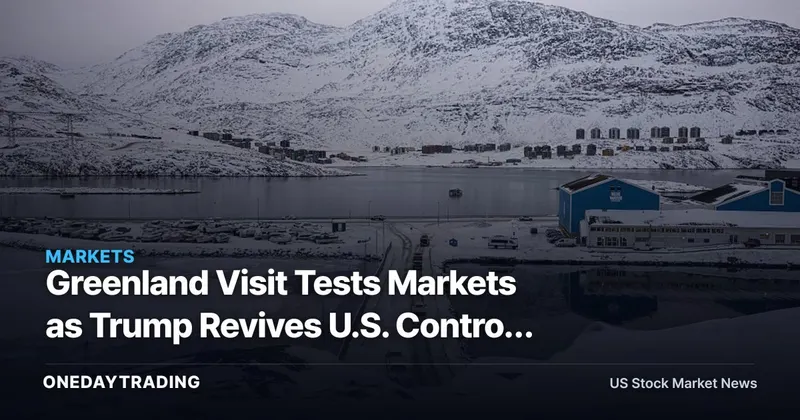
Why is the EU chief going to Greenland?
The EU chief is going to Greenland as President Donald Trump renews his push for greater U.S. control of the territory, according to CNBC's report. Greenland is a self-governing Danish territory, meaning the dispute engages both local governance and Denmark's relationship with the European Union.
The visit raises the political cost of treating Greenland as a bilateral U.S.-Danish question. For markets, that matters because a wider institutional response can lengthen negotiations and increase the number of approvals required before rhetoric becomes executable policy.
By the Numbers
The source supplies no transaction value, ownership proposal, policy date, opinion polling, budget allocation or listed-company exposure. That absence is the central valuation fact: investors cannot yet translate the episode into revenue, cash flow or discount-rate changes.
The current sequence contains two observable events: renewed U.S. pressure for greater control and a visit by the EU chief. Neither event, on the facts reported, changes a corporate order book or commodity supply curve.
Winners & Losers
- Defense contractors: A durable procurement response would support backlog, but a diplomatic visit alone creates no order or funded program.
- Mining companies: Any future change in territorial policy could alter permitting expectations, yet the source identifies no project, mineral, producer or concession.
- Shipping operators: Political control matters only when it changes access, regulation or infrastructure spending; none of those outcomes appears in the reported facts.
- European risk assets: Escalation could add a geopolitical discount, while a contained diplomatic process would leave earnings expectations largely untouched.
Risk Check
- Headline risk can move faster than evidence when takeover language is interpreted as settled policy.
- The EU visit could represent resistance, negotiation or symbolic support; the source does not specify the intended outcome.
- No disclosed timetable means investors cannot assign a clean catalyst window.
- Sector trades risk outrunning fundamentals because no company, contract or spending figure is identified.
Bottom Line
Greenland has entered the geopolitical risk ledger, but not yet the earnings model. The upside scenario for exposed industries requires funded orders, investment commitments or operating-rule changes; the downside scenario is prolonged tension without monetizable activity. The next investable trigger is a formal U.S., EU, Danish or Greenlandic policy action that specifies authority, money and timing.
FAQ
Why is Greenland important to U.S. markets?
Greenland matters to markets in this report because President Donald Trump is seeking greater U.S. control while the EU chief is visiting the self-governing Danish territory. The market impact becomes measurable only if that contest changes spending, regulation, access or corporate contracts.
Which stocks benefit from the Greenland dispute?
The CNBC report identifies no publicly listed beneficiary and provides no contract, project or budget figure. Defense, mining and shipping stocks gain a fundamental tailwind only if later policy creates funded demand or commercially usable rights.
What should investors watch after the EU chief visits Greenland?
Investors should look for a dated policy statement, negotiating framework, spending commitment or change in territorial authority from the United States, European Union, Denmark or Greenland. Without one of those signals, the episode remains political headline risk rather than an earnings catalyst.
📊 Analysis
Signal Neutral
Why The renewed U.S. control push raises geopolitical uncertainty, but the source reports no policy action, financial commitment or company-level earnings impact.
This article was independently written by OneDayTrading from public reporting. Read the original (CNBC)